
Beyond the Wallet: Predicting Spending Behavior through the Lens of Socio-Mobile Interactions
Predicting Spending Behavior Using Socio-mobile Features
This paper introduces a socio-mobile framework to predict human spending behavior using mobile phone data. By analyzing face-to-face proximity (Bluetooth), call logs, and SMS metadata from 52 adults, the authors successfully classify couples' propensity for business exploration, customer loyalty, and overspending using a Naïve Bayes approach.
TL;DR
Researchers from MIT Media Lab have demonstrated that how you use your phone—who you call, how often you text, and who you meet face-to-face—is a better predictor of your spending habits than your personality. By analyzing 10 million data points from young families, they achieved up to 77% accuracy in identifying overspenders and loyal customers, significantly outperforming traditional demographic and psychological models.
Background: The Social DNA of Spending
Why do we spend the way we do? Economics has long debated whether spending is a solitary rational choice or a social construct. This paper argues for the latter, positioning spending as a behavior deeply "embedded" in our social networks. Traditionally, marketers have been blind to the habits of prospects—people who haven't shopped with them yet. This work bridges that gap by using the mobile phone as a "socioscope" to predict financial behavior without needing a single prior receipt.
Methodology: Transforming Logs into Insights
The study focused on 26 couples (52 adults) in a "Living Laboratory" environment. The researchers moved beyond individual metrics to couple-level variables, recognizing that in households, financial decisions are often shared.
1. Data Modalities
- Bluetooth Scans: Capturing face-to-face proximity (Physical Sociality).
- Call Logs: Synchronous distant communication.
- SMS Logs: Asynchronous textual communication.
2. Feature Engineering
For each modality, four core metrics were calculated:
- NumEvents: Interaction volume.
- NumContacts: Social reach.
- InteractionDiversity: The "entropy" of social contacts (do you talk to many people or just a few?).
- EngagementTop3: Loyalty to a tight inner circle.
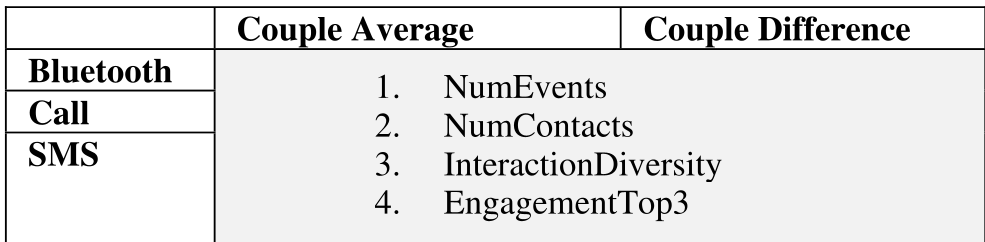 Table: The 24-feature matrix capturing both the average intensity and the internal differences within couples.
The Core Insight: Why Social Data Trumps Personality
One of the most striking findings is the comparison against the "Big Five" personality traits (Openness, Conscientiousness, etc.). While personality has some predictive power (60% accuracy), it is a static snapshot. Socio-mobile data (72% average accuracy) captures the dynamic intent and contextual influence of one's peer group.
- Exploration (Diversity): Linked strongly to SMS and Call diversity. If your social circle is diverse, your shopping habits likely are too.
- Loyalty (Engagement): Predicted by the "Top 3" engagement in communication logs. People who are loyal to a few friends are often loyal to a few vendors.
- Overspending: Interestingly, this was best predicted by Bluetooth events (physical co-location). High physical social activity often correlates with high discretionary spending in "social" venues like restaurants and pubs.
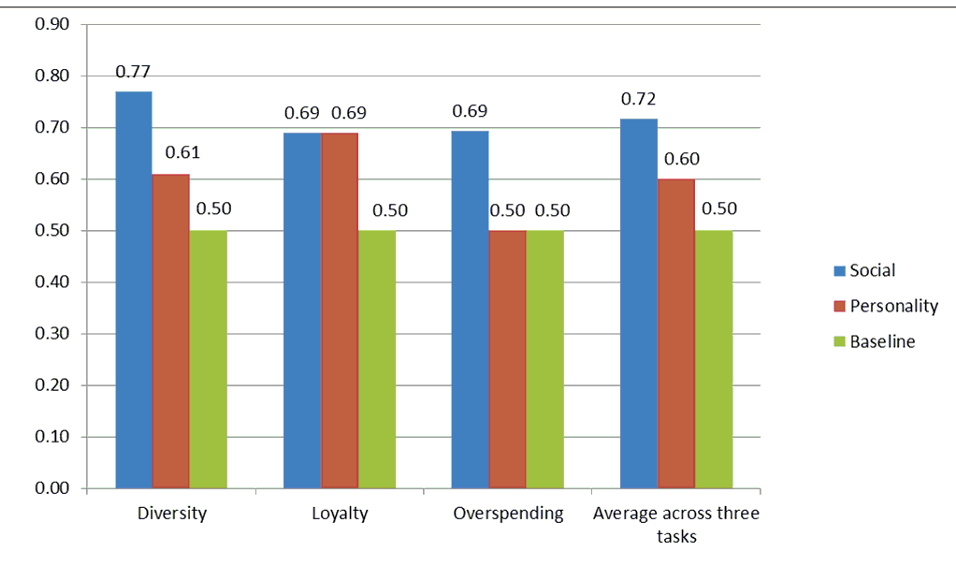 Performance across tasks: Socio-mobile features consistently outperform baseline and personality-based approaches.
Experiments & Real-World Impact
The researchers used a Naïve Bayes classifier with leave-one-out cross-validation. The results were telling:
- Overspending Detection: 77% Accuracy.
- Spending Diversity: 69% Accuracy.
- Customer Loyalty: 69% Accuracy.
These aren't just academic numbers. For the 5 billion mobile users worldwide—many of whom lack a formal banking history—this data represents a "behavioral credit score." It allows micro-finance institutions to estimate creditworthiness based on reliable social patterns rather than non-existent paper trails.
Critical Analysis & Future Outlook
While the study is groundbreaking, it acknowledges its small sample size (26 couples) and homogeneous demographic (university-affiliated families). However, the density of the data (>10 million points) provides a high-fidelity proof of concept.
The Takeaway: As our financial and social lives increasingly merge through platforms like Mint, Twitter-to-Amex, and mobile wallets, "Social Computing" will become the backbone of retail and economic policy. The "Social fMRI" provided by our smartphones is no longer just for tracking health; it's a window into the global economy.
Conclusion
This work grounds the intuition that "we shop like the people we talk to." By leveraging the passive traces of our socio-mobile lives, this research paves the way for a future where financial services are more accessible and marketing is more contextual, moving us from "Fortune Telling" to data-driven "Reality Mining."