
Decoding Wikipedia's Web of Trust: Predicting Votes via Social Network Metrics
Predicting Trust in Wikipedia’s Vote Network Using Social Networks measures
This paper presents a trust prediction framework for Wikipedia’s Vote Network using Social Network Analysis (SNA) metrics. By extracting 20 structural features from positive, negative, and total adjacency matrices, the authors trained multiple classifiers—notably Random Forest—to predict whether a user will support or oppose a candidate for adminship.
TL;DR
Can we predict how one Wikipedia editor will vote on another's promotion? This paper investigates trust prediction by transforming the "Wikipedia Voted Network" into a series of structural features. By leveraging Degree Centrality, Betweenness, and Clustering Coefficients across positive and negative relationship sub-graphs, the authors achieved nearly 90% accuracy in predicting trust using Random Forest classifiers.
Context & Motivation
In the digital world, "Trust" is more than a feeling—it is a measurable link in a Social Network. Wikipedia's "Request for Adminship" (RfA) process is a goldmine for this research. When a user is nominated for admin privileges, other users vote: Support (+1), Neutral (0), or Oppose (-1).
The authors argue that previous models often missed the "structural fingerprint" of the users involved. Their insight was to treat trust not just as a global reputation score, but as a local network property. Why does a specific user trust another? It likely depends on their shared neighbors and their historical voting behaviors within the network structure.
Methodology: The Architecture of Trust
The core of the methodology lies in Feature Engineering. Since the Wikipedia network is "signed" (positive and negative), the authors couldn't use a single adjacency matrix. Instead, they decomposed the network into three perspectives:
- Adj_pos: Only positive (support) links.
- Adj_neg: Only negative (oppose) links.
- Adj_tot: All links treated as neutral connections.
From these, they extracted 20 specific features for every pair (Actor A, Actor B):
- Degree Centrality: Measuring the "flow" of votes in and out of the nodes.
- Betweenness: Identifying if a user acts as a "bridge" between different communities in the network.
- Clustering Coefficient: Measuring the density of a user's local neighborhood (the "ego network").
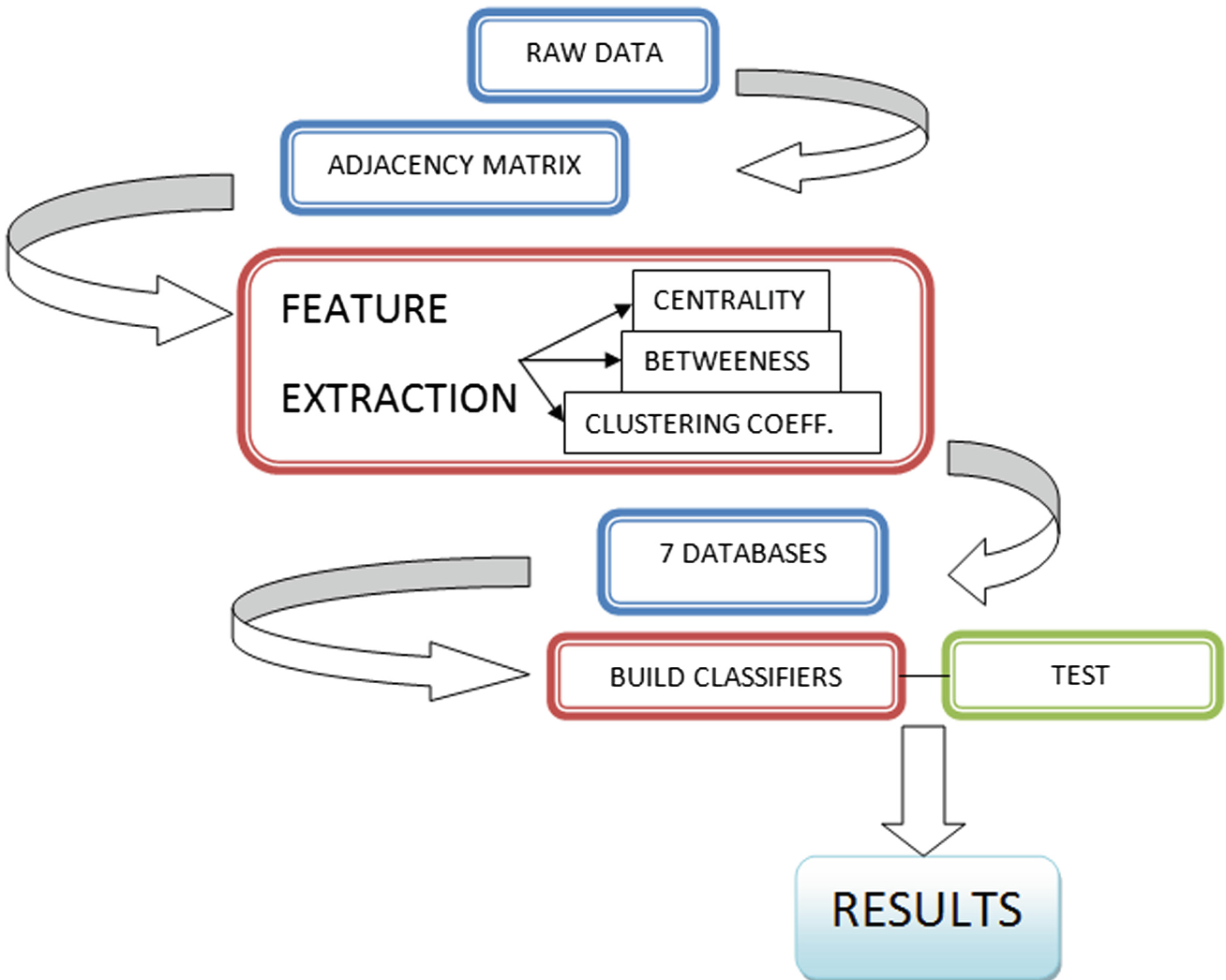 Fig 1: The feature extraction process involves calculating SNA measures across polarized sub-graphs.
Experiments and Performance
The researchers tested seven different combinations of these feature groups (DB1 through DB7) across various machine learning algorithms, including Naive Bayes, Multilayer Perceptrons (MP), and Random Forests (RF).
Key Findings:
- Winning Model: Random Forest (RF) consistently outperformed others, hitting an 89.40% Overall Accuracy (OA).
- Feature Importance: Contrary to intuition, Node Betweenness was a weak predictor. Databases including betweenness (DB2, DB6) performed significantly worse than those focusing on local connectivity (Degree and Clustering).
- Class Imbalance: The dataset was heavily skewed (approx. 80% positive votes). Despite this, the model achieved a Recall of 66.9% for the negative class, which is a vital metric for identifying potential "distrust" or conflict.
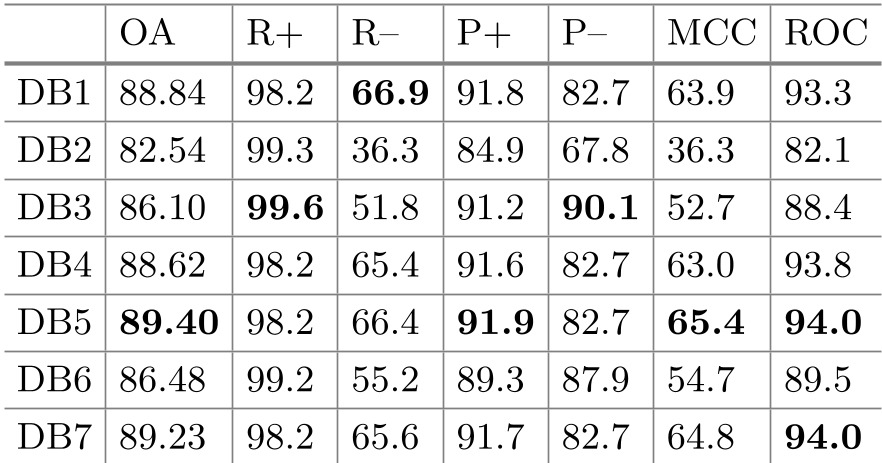 Table 1: Summary of the best results across different feature databases (DB1-DB7).
Critical Analysis & Conclusion
Takeaway
The paper proves that a user's structural position in a trust network—specifically their "local density" and "inbound/outbound flow"—is a highly reliable indicator of their future voting behavior. You don't need complex user profiles; the graph structure speaks for itself.
Limitations & Future Work
- Temporal Dynamics: The study treats the network as static, whereas Wikipedia elections happen over time. A user's reputation evolves.
- Neutrality: The researchers ignored neutral (0) votes to simplify the problem into a binary classification. In a real-world setting, "Neutral" is a significant signal that remains unexplored here.
By focusing on the "dark side" of trust (negative votes), this work provides a foundation for more robust social network moderation and security tools, ensuring that "bad actors" are easier to spot before they gain administrative power.
References
- Leskovec et al. (2010) - Predicting positive and negative links in online social networks.
- Wasserman & Faust (1994) - Social Network Analysis: Methods and Applications.