
Deciphering Viral Dynamics: Factors and Models for Twitter Trend Prediction
On predicting Twitter trend: Factors and models
This paper investigates the prediction of hashtag trends on Twitter by analyzing two core components: multi-dimensional trend factors and various mathematical modeling approaches. The authors propose a comprehensive framework incorporating content and context features, achieving significant predictive performance using a Recurrent Nonlinear ARX (RNARX) model.
TL;DR
Predicting which hashtags will go viral is a complex interplay of who is talking and how the network is structured. This study demonstrates that non-linearity in modeling is non-negotiable for accuracy, and that user-specific behavioral metrics—termed "activeness" and "stimulus"—are far more predictive than the actual content of the tweets. Using a Recurrent Nonlinear ARX (RNARX) model, the researchers achieved SOTA-level MSE reductions compared to traditional linear baselines.
Problem & Motivation: Beyond Simple Regression
Why do some hashtags explode while others fade? Previous research often looked at this through a narrow lens: either focusing purely on the text (Content) or the follower graph (Context). Furthermore, many existing tools used basic linear models that assumed a steady, predictable growth rate.
The authors argue that social media trends are stochastic and non-linear. A "trend" isn't just a number; it is a battle between "Trend Users" (those already using the hashtag) and the "Trend Border" (potential new adopters). Capturing this "border" dynamic requires a sophisticated blend of network topology and temporal modeling.
Methodology: The Anatomy of a Trend
The authors categorize the "drivers" of a trend into two major buckets:
1. Multi-Dimensional Factors
- Content Factors: Not just keywords, but the role of the user (new vs. old) and the type of tweet (Retweet, Mention, or URL-heavy).
- Context Factors:
- Structure: Centrality and reciprocity within the "trend border."
- Node Behavior: This is the "secret sauce." The authors define Activeness (how often a user posts) and Stimulus (how much information a user receives from their friends), specifically weighted by the hashtag in question.
2. The Modeling Matrix
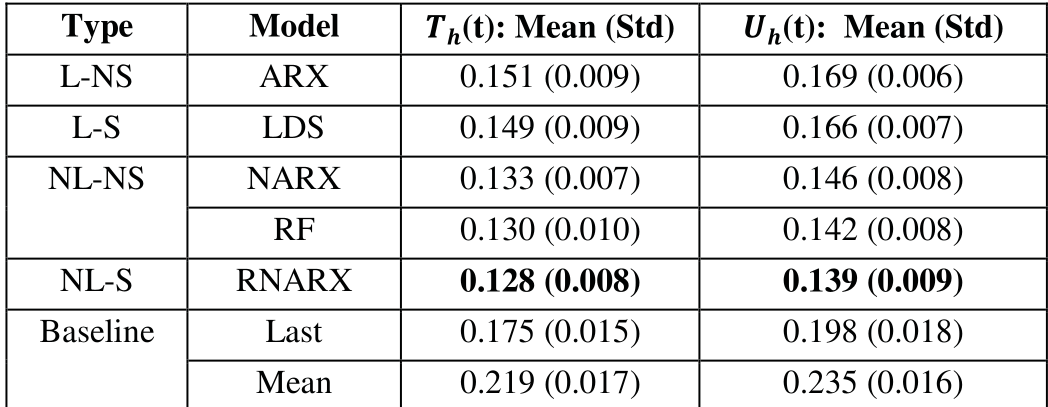
The paper systematically tests 4 types of models based on two axes: Linearity and State-Space (Memory).
- ARX/LDS: Linear models (baseline).
- NARX/RNARX: Non-linear models using Neural Networks.
Experiments & Results: What Actually Matters?
Using a massive dataset from the Arab Spring (16.1 million tweets), the researchers uncovered several high-impact insights:
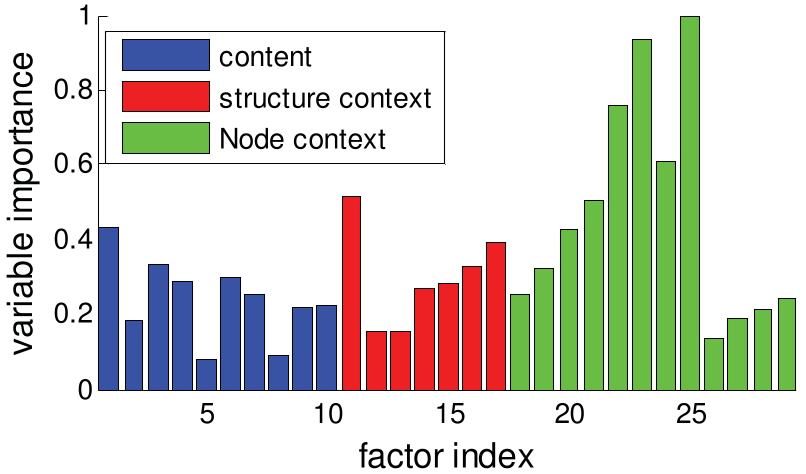
- Behavior Trumps Content: As shown in the "Variable Importance" analysis, "Trend Stimulus" and "Trend Activeness" are the most influential predictors. Essentially, a user's specific attention to a topic is a better signal than the general popularity of the topic.
- The Power of Non-Linearity: Moving from a linear ARX model to a non-linear NARX model dropped the MSE significantly (e.g., from 0.151 to 0.133).
- State-Space Benefits: Adding a "memory" component (LDS or RNARX) provided a slight but consistent edge, suggesting that while the immediate past is critical, the long-term history of a trend has a "decaying" influence.
Critical Analysis & Conclusion
Takeaway
The study confirms that social media dynamics are best captured by models that can handle complexity (Non-linearity) and maintain a sense of history (State-space). More importantly, it shifts the focus from what is being said to who is receiving the information (Stimulus).
Limitations
- Network Completeness: The authors admit they only had 10% of the Twitter stream, which may affect the "self-motivated" user metrics.
- Temporal Evolution: The study uses static decay coefficients (); however, in real-world scenarios, the "speed" of interest can change rapidly.
Future Outlook
As we move into an era of Algorithmic Feeds (like TikTok's "For You" page), the concept of the Trend Border becomes even more relevant. Future models will likely need to integrate real-time sentiment analysis with these non-linear behavioral frameworks to predict not just if a trend will grow, but how long it will stay relevant.