
From Global Models to Local Insight: Revolutionizing Dialog Evaluation with Collaborative Filtering
14152_Predicting User Satisfaction in Spoken Dialog System Evaluation With Collaborative Filtering.
This paper introduces a Collaborative Filtering (CF) approach to predict user satisfaction in Spoken Dialog Systems (SDS). By adapting item-based CF, researchers propose the ICFM and EICFM models to estimate ratings for unrated dialogs based on similar historical interactions, achieving a significant performance leap over the traditional PARADISE linear regression baseline.
TL;DR
Evaluating Spoken Dialog Systems (SDS) has long been a choice between the high cost of human surveys and the inaccuracy of global linear models. This paper introduces a Paradigm shift by applying Collaborative Filtering (CF) to dialog evaluation. By clustering similar interactions and separating user behavior from system performance, the proposed EICFM model boosts prediction accuracy () by nearly 45% over the industry-standard PARADISE framework.
The "Average User" Fallacy in SDS Evaluation
For decades, the PARADISE framework has been the North Star for SDS evaluation. It posits that User Satisfaction () is a linear combination of task success and dialog costs. While elegant, it suffers from a major flaw: it assumes a single linear relationship applies to every user and every context.
In reality, a "short dialog" might mean efficiency to one user but a system failure to another. This lack of nuance leads to low statistical "explained variability," meaning the models often fail to reflect how users truly feel.
The Methodology: Collaborative Filtering Meets Regression
The authors provide a clever intuition: if two dialogs "look" similar in terms of features (e.g., number of turns, recognition scores), they should receive similar satisfaction ratings.
1. ICFM (Item-based Collaborative Filtering Model)
Instead of one giant regression, ICFM uses K-means clustering to group dialogs.
- Step: Extract 10 interaction features (e.g., #Barge-in, Average Recognition Score).
- Step: Cluster the training data.
- Step: Train a local Linear Regression Model (LRM) for each cluster.
- Insight: Local experts are better than one global generalist.
2. EICFM (Extended ICFM)
The "Extended" version introduces a critical distinction between User Style and System Quality. Some features are dictated by the system (e.g., #SystemQuestions), while others reflect the user (e.g., #HelpRequests). EICFM builds separate models for these two dimensions and combines them using a weighted sum.
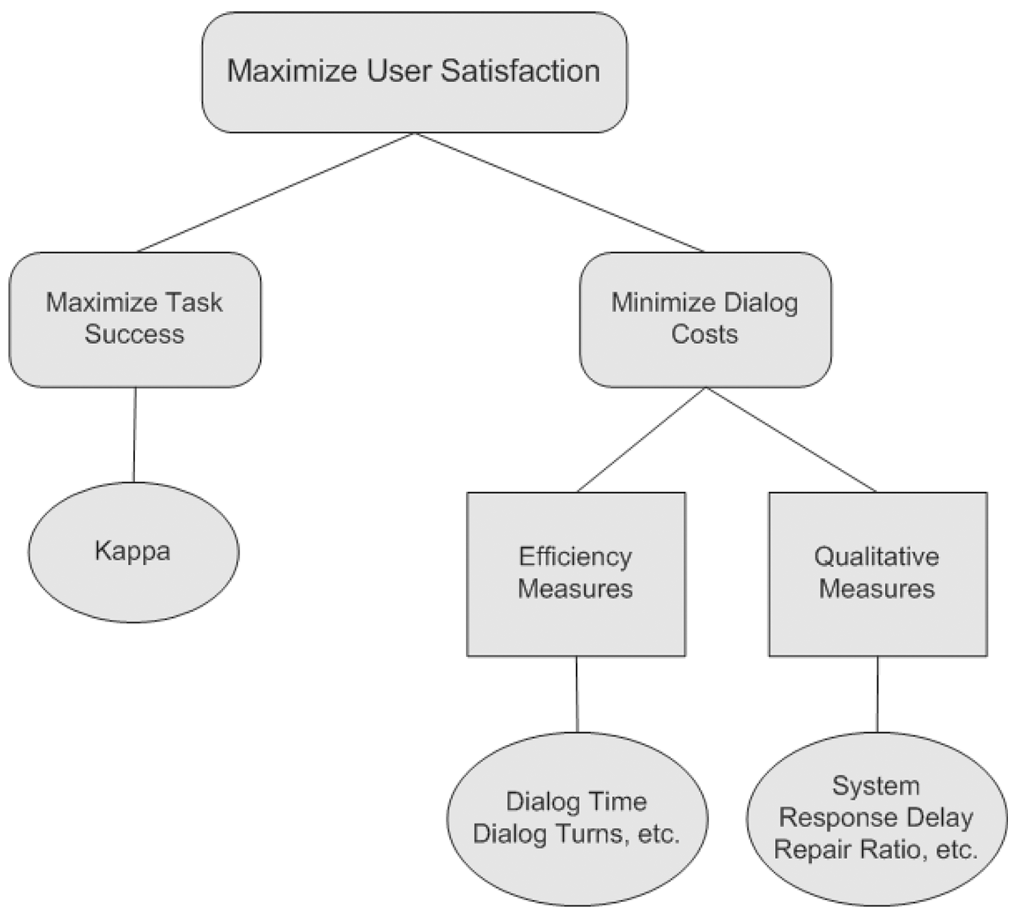 The conceptual framework of PARADISE, which the authors enhance using CF techniques.
Experimental Battleground: Let’s Go! and SDC 2010
The models were tested on real-world data from the Let’s Go! bus information system.
Key Findings:
- Predictive Power: EICFM reached an of 0.39, significantly outperforming the baseline LRM (0.27).
- System vs. User Impact: Interestingly, the authors found that system-related features weighed much more heavily (weight for user features gave best results), indicating that in information-seeking tasks, system reliability trumps user personality.
- Generalizability: When the model trained on Let's Go! was tested on completely different systems (SDC 2010), it maintained superior performance, proving it isn't just "overfitting" to one specific bot.
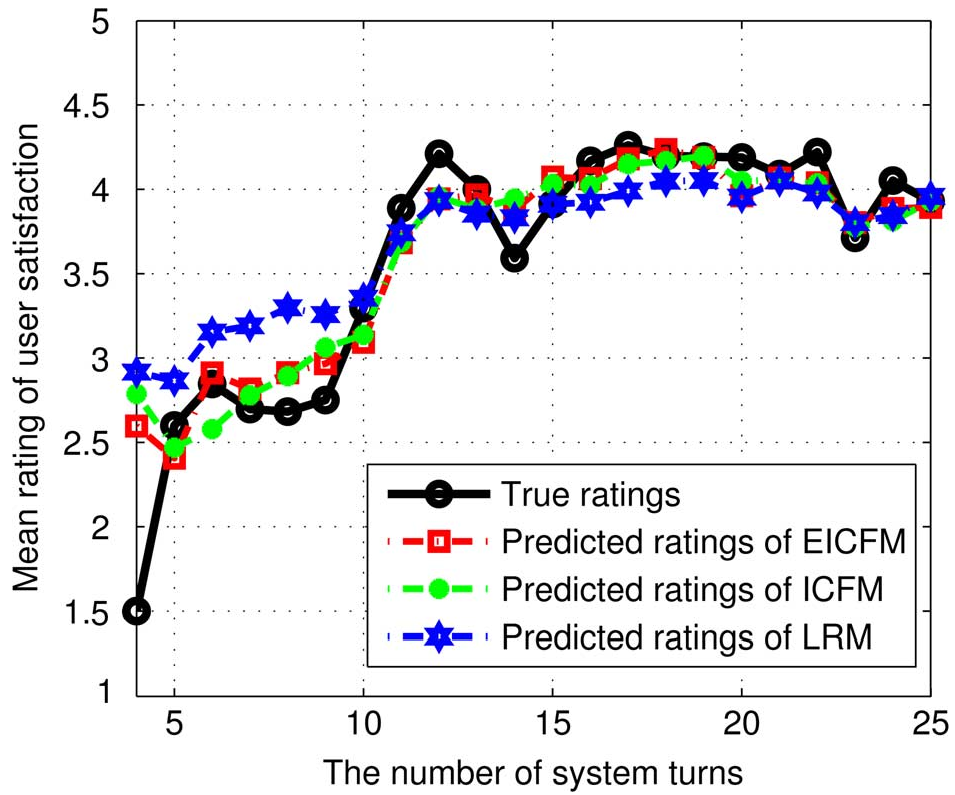 Comparison of R-squared values across different cluster counts (). EICFM (top line) consistently outperforms the baseline.
Deep Insight: Why Local Models Win
The success of this approach highlights an important truth in HCI (Human-Computer Interaction): Context is King. By clustering, the model implicitly captures different "dialog states" (e.g., a "struggling dialog" cluster vs. a "happy path" cluster).
The analysis reveals that users are most satisfied when they provide one piece of information at a time, guided by the system. Aggressive users who try to pack too much data into one turn often trigger recognition errors, leading to a sharp drop in satisfaction. Global models often "blur" these distinct behavioral patterns, whereas CF preserves them.
Conclusion & Future Horizon
This work demonstrates that we don't need "more" data to improve AI evaluation; we need "smarter" ways to segment the data we already have.
Limitations: The model currently uses linear regression within clusters. The authors suggest moving toward Bayesian Networks or Markov Decision Processes to uncover the latent factors of satisfaction. As we move toward LLM-based agents, the EICFM philosophy—separating the "User's intent" from the "System's response quality"—will be essential for building the next generation of evaluation benchmarks.