
Beyond the Questionnaire: Predicting Vocational Identity via Socio-Demographic ML
Predicting Vocational Personality Type from Socio-demographic Features Using Machine Learning Methods
This study utilizes supervised machine learning to predict RIASEC vocational personality types (Realistic, Investigative, Artistic, Social, Enterprising, Conventional) using only socio-demographic features. By leveraging a large-scale dataset (n=112,130), the researchers compared multiple architectures, finding that multi-label classification models focusing on label correlations achieved the highest predictive accuracy.
TL;DR
Can your age, education, and geography predict your career path better than a 100-question test? This paper demonstrates that supervised machine learning, specifically multi-label classification that accounts for label correlations, can effectively map socio-demographic features to RIASEC vocational personality types. Using a massive dataset of 112,130 respondents, the researchers achieved significant predictive accuracy (C-Index 13.95 vs 9.0 baseline), proving that our demographic background carries a surprisingly heavy "signature" of our professional interests.
The Shift from Explanation to Prediction
For decades, vocational psychology followed a standard routine: fill out a long survey, get a Holland Code (RIASEC), and find a matching job. As the authors note, psychology has historically prioritized explaining why someone fits a role. However, in the era of Big Data, the focus is shifting toward prediction.
The problem is efficiency. High-fidelity psychological labeling is "expensive" in terms of user time. If we can predict these labels using socio-demographic data—information already present in most social media profiles—we unlock massive potential for automated career counseling and targeted social network analysis.
Methodology: Exploiting the "Circumplex" Structure
The RIASEC model isn't just a list; it’s a circumplex. Scales like "Social" and "Enterprising" are naturally more correlated than "Social" and "Realistic." The researchers hypothesized that models ignoring these relationships would underperform.
They tested four primary approaches:
- Independent Regression: Predicting each of the 6 scales separately.
- Regression Chains: Predicting scales in a sequence where each subsequent model "sees" the predictions of the previous ones.
- Three-Letter Code Classification: Treating the top 3 interests as a single categorical string.
- Inferring Label Relations: Using graph-based clustering to find dependencies in the label space.
 The figure above illustrates the actual correlations found in the dataset, confirming the inter-dependencies between scales.
Key Insights: What Drives Interests?
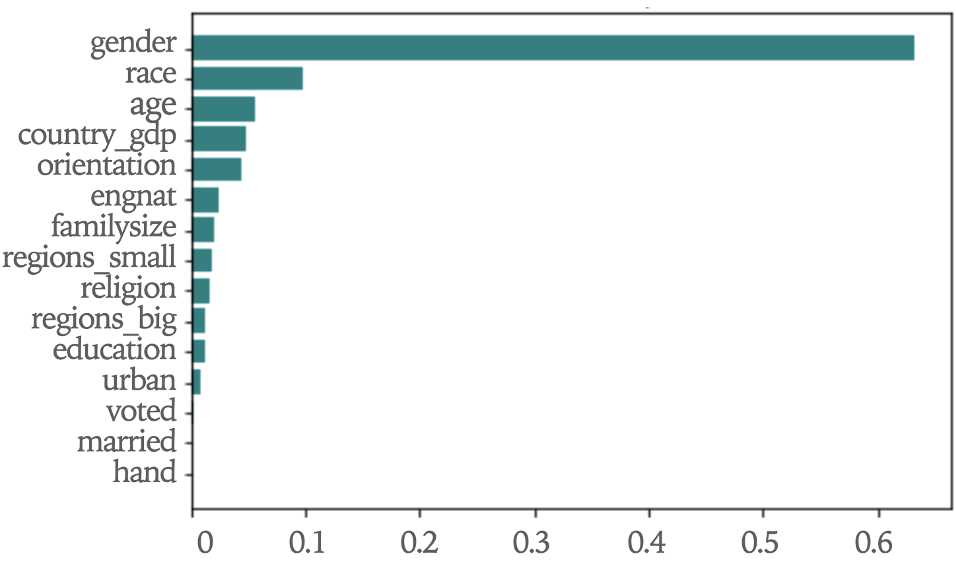
By using Gradient Boosting Regressors, the team performed feature importance analysis, revealing a fascinating divide:
- The Gender Factor: For the Realistic (R) scale (hands-on, mechanical work), gender was the overwhelming predictor.
- The Geo-Cultural Factor: For the Enterprising (E) scale (leadership, business), individual demographics mattered less than geography, GDP of the home country, and religion.
 Table 3: Principal Component Analysis showing how geographical, cultural, and economic dimensions represent the majority of feature variance.
Results and Performance
The breakthrough came with Label Relation Inference. By constructing a label co-occurrence graph (NetworkXLabelGraphClusterer), the model learned the "proximity" of professional interests.
- Baseline (Dummy): C-Index 9.0
- Independent Regression: C-Index 10.95
- Label Relation Inference: C-Index 13.95
The distribution of results showed that the model was notably successful at predicting the exact three-letter Holland code (C-Index 18) far more frequently than chance.
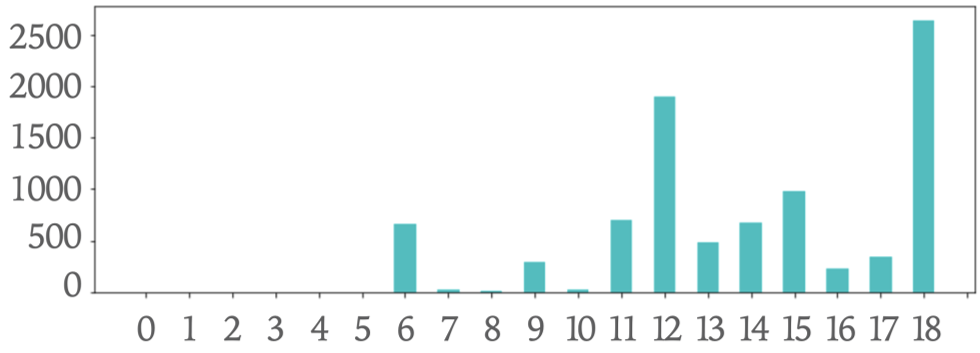 The right-shifted distribution in Figure 6 confirms the model's superior predictive power over the normal distribution of the dummy classifier.
Critical Analysis & Future Outlook
While the results are impressive, the study admits a significant limitation in its metric: the C-Index. This metric penalizes "swapped" letters heavily (e.g., predicting RSA instead of SRA), even though such profiles are practically identical in a counseling context.
The Takeaway: This research moves us closer to a "Career Robot" world. By integrating these ML models into social platforms, we can provide personalized career guidance to users without ever asking them to take a test. For researchers, it highlights that the structure of the output space (label correlations) is just as important as the input features when modeling human psychology.