
Adaptive PSO-SVM: Elevating Financial Distress Prediction in the Banking Industry
Prediction of corporate financial distress: an application of the America banking industry
This paper introduces an Adaptive Particle Swarm Optimization-Support Vector Machine (Adaptive PSO-SVM) hybrid model for corporate financial distress prediction. By implementing a novel Adaptive Inertia Weight (AIW) mechanism, the model achieves the state-of-the-art overall accuracy of 96.97% on US banking datasets.
TL;DR
Predicting bank failures is a high-stakes task where small accuracy gains save billions. This paper presents a hybrid Adaptive PSO-SVM model that optimizes both feature selection and SVM parameters. By abandoning static inertia weights in favor of a fitness-responsive adaptive mechanism, the researchers pushed prediction accuracy to a staggering 96.97%, outperforming traditional neural networks and statistical models.
Context: The Cost of Miscalculation
The 2008 financial crisis served as a brutal reminder that existing distress models were insufficient. From 2008 to 2011, the US saw nearly 400 bank failures compared to just 27 in the preceding seven years. The technical challenge lies in the high dimensionality of financial ratios and the non-linear nature of corporate failure. Traditional methods like Logistic Regression or standard ANN often fall into the trap of "Empirical Risk Minimization," leading to overfitting or local optima.
The Core Motivation: Beyond Static Optimization
While Support Vector Machines (SVM) are excellent for small-sample, non-linear classification due to Structural Risk Minimization (SRM), they are highly sensitive to two things:
- Feature selection: Which financial ratios actually matter?
- Hyperparameters: The regularization constant and kernel parameters.
The authors recognized that while Particle Swarm Optimization (PSO) can tune these, standard PSO often suffers from premature convergence. Their insight: the "Inertia Weight" ()—which controls how much a particle's previous velocity influences its next move—shouldn't just decrease linearly. It should "adapt" based on the improvement in fitness.
Methodology: The Adaptive Hybrid Architecture
The proposed framework utilizes a multi-stage pipeline:
- Iterative PCA: Filtering 31 initial financial ratios down to the 17 most significant ones (explaining 91.34% of variance).
- Adaptive Inertia Weight (AIW): The weight is updated at each iteration using the ratio of the current best fitness to the previous best fitness: This ensures that if a particle finds a significantly better area, the inertia adjusts to explore that neighborhood more effectively.
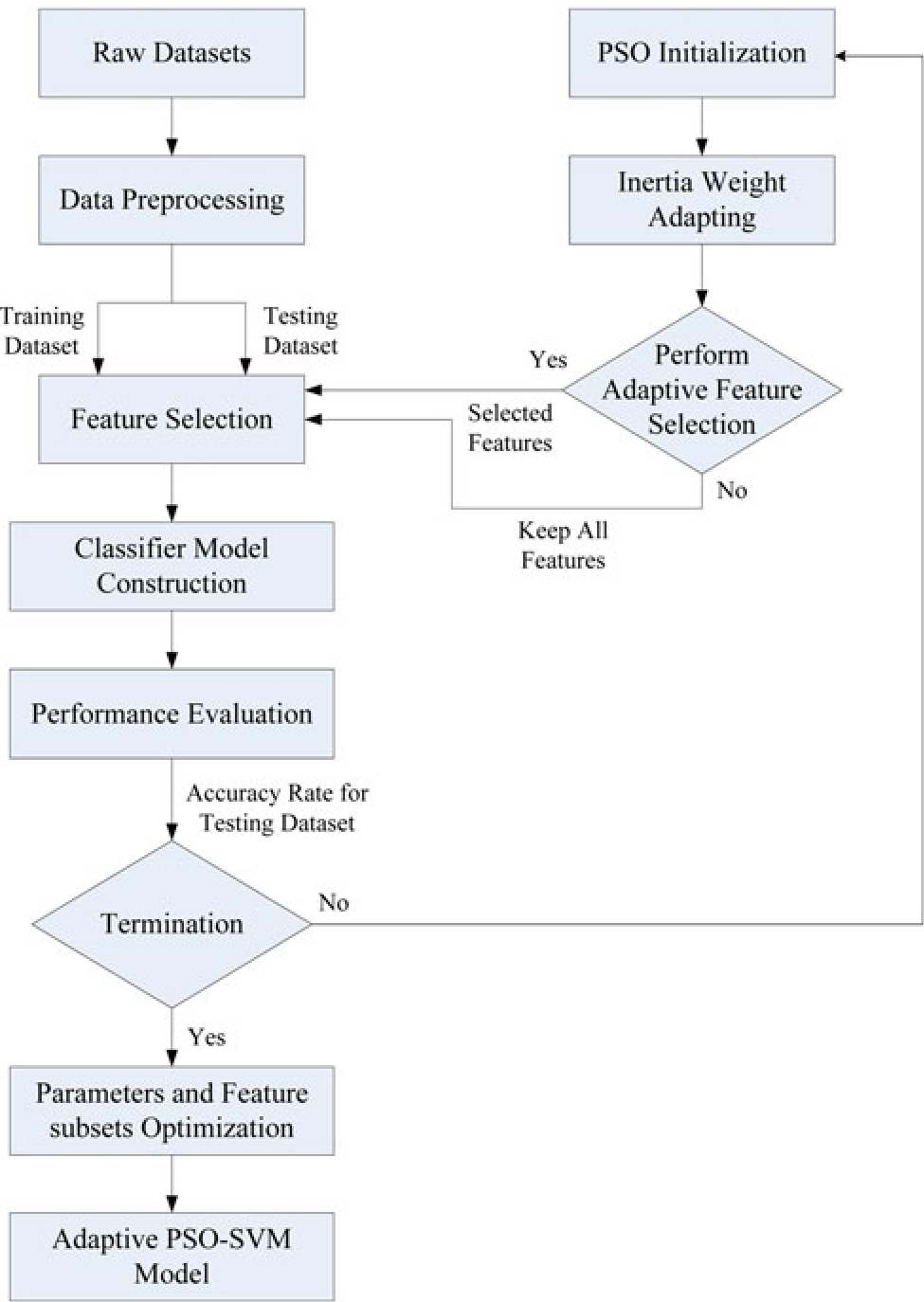
Figure 1: The integrated research architecture showing the flow from PCA preprocessing to the Adaptive PSO-SVM iteration loop.
Experimental Results & Benchmarking
The model was tested against a dataset of 54 American banks (including giants like Lehman Brothers and AIG).
1. Classification Performance
The Adaptive PSO-SVM dominated across all metrics:
- Overall Accuracy: 96.97% (vs. 75.76% for BPN)
- Sensitivity (Recall): 100% (It caught every single distressed bank in the test set)
- Precision: 94.44%
2. Algorithmic Robustness
To prove this wasn't just luck on one dataset, the authors tested the AIW-PSO against 6 benchmark functions (e.g., Sphere, Rosenbrock).
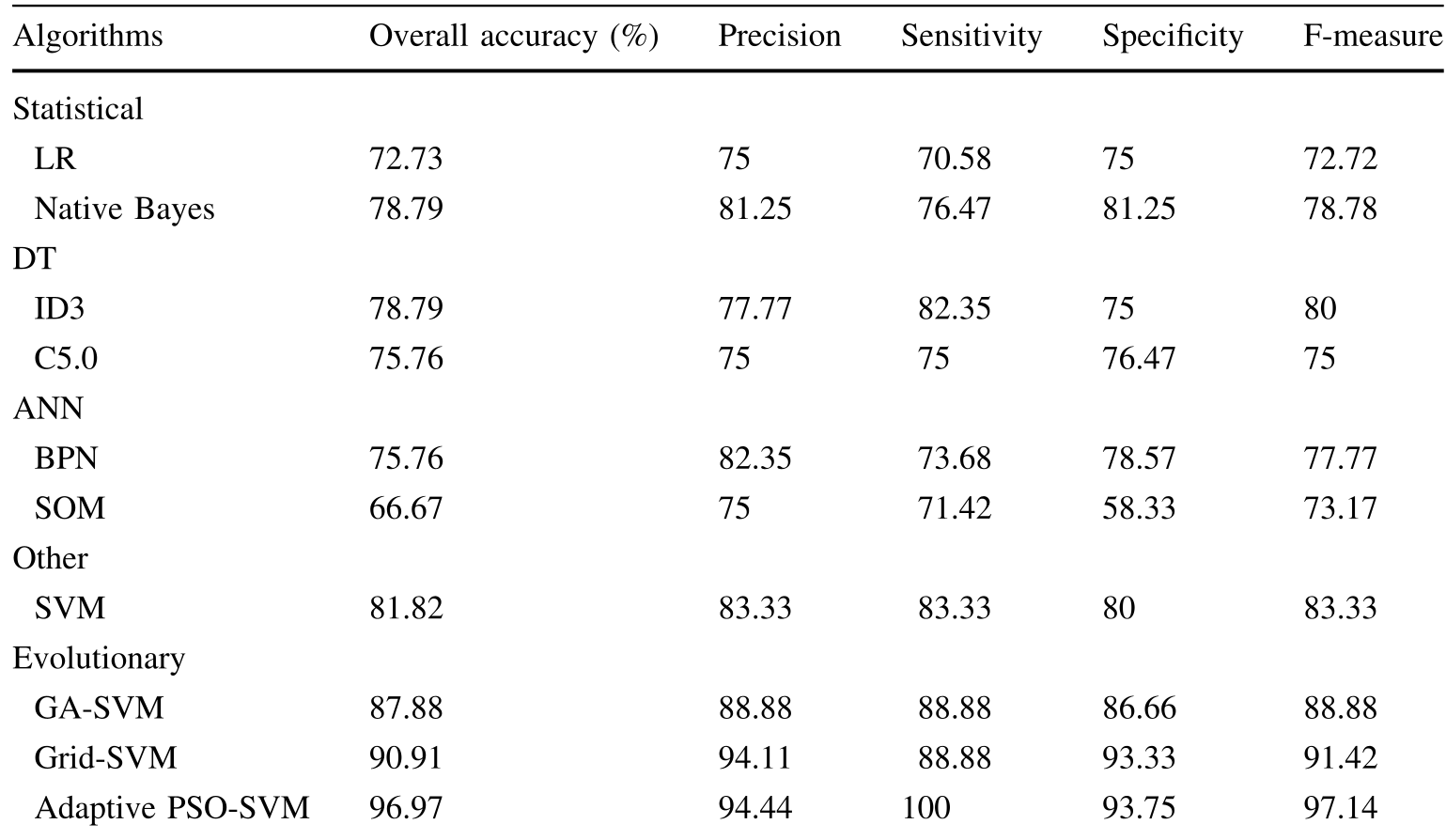
Table 1: Comparative performance shows the clear superiority of the Adaptive PSO-SVM over GA-SVM, Grid-SVM, and traditional AI approaches.
Critical Insight: Why it Works
The "magic" resides in the balance of exploration and exploitation. By making a function of the Evolutionary Speed, the particles don't just blindly slow down over time (as in Linear Decreasing Weight). Instead, they maintain momentum when they are "on to something," allowing the SVM to find the truly global optimal hyperplane in the feature space.
Conclusion & Future Outlook
This work demonstrates that for high-dimensional financial problems, Adaptive Meta-heuristics are no longer optional—they are essential. While the study focused on the 2006-2009 period, the methodology is scalable to modern "Big Data" financial environments. Future research could explore integrating this AIW approach with deep learning architectures or applying it to real-time liquidity monitoring.
Takeaway: If you are building a risk model, don't just tune your SVM; tune the optimizer that tunes your SVM.