
Dynamic Carrying Capacity: Cracking the Code of Social Virality
Prediction of information diffusion in social networks using dynamic carrying capacity
The paper proposes a Diffusive Logistic model utilizing non-linear Ordinary Differential Equations (ODEs) to predict information diffusion in social networks. By introducing a dynamic "carrying capacity" (K), the model accurately captures how news visibility changes—specifically when stories move to a platform's front page—achieving high predictive accuracy as validated on the Digg dataset.
TL;DR
Information doesn't just spread; it breathes. Current models often assume a fixed "ceiling" for how many people a piece of news can reach. This paper introduces a Diffusive Logistic Model with Dynamic Carrying Capacity, moving beyond static equations to account for real-world shifts in visibility, such as a story hitting the front page of Digg.
The "Static Ceiling" Fallacy
In classical epidemiology, the "carrying capacity" (K) is the maximum population an environment can sustain. When applied to social networks, researchers often treat K as a constant—perhaps the number of followers a user has.
However, the authors point out a glaring flaw: News isn't trapped in a silo. On platforms like Digg or Reddit, a story might start with a few hundred followers but suddenly explode when it transitions to a global feed. Conversely, it can wither the moment it becomes "old news." A static K cannot capture these phase shifts, leading to poor predictions of life-cycle dynamics.
Methodology: Evolution through Differential Equations
The core of the research lies in modifying the standard Logistic Growth model:
Instead of a fixed , the authors propose , a dynamic variable that changes based on the current state of influence.
The Phase Shift Insight
The model identifies three distinct carrying capacities:
- (Niche Phase): Visibility is limited to the immediate followers of the submitter.
- (Viral Phase): The story hits the front page, and the potential audience (carrying capacity) spikes.
- (Saturation Phase): Interest wanes, or the story is buried by newer content.
The transitions between these phases are modeled linearly, allowing the math to "flex" as the story moves through the network's ecosystem.
Experimental Results: Predicting the Digg "Burst"
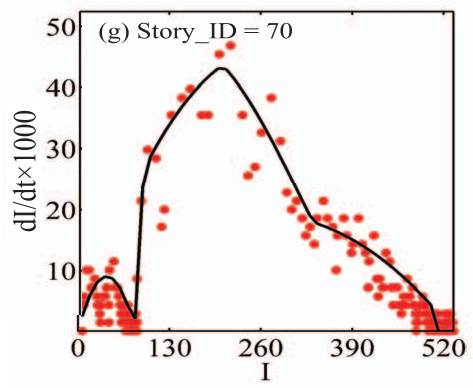
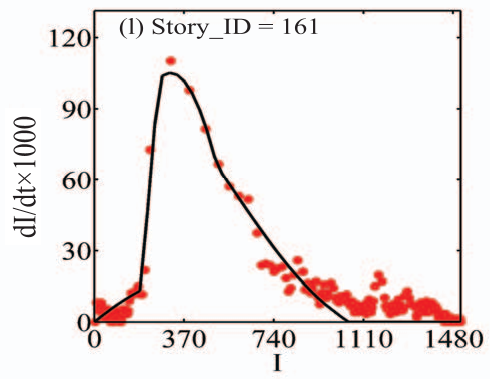
The authors tested their model against the Digg dataset (June 2009), analyzing 3,553 news stories and over 3 million votes. Using a Genetic Algorithm (GA) to tune the parameters, they mapped the predicted spreading rate against actual timestamps.
Key Findings:
- High Fidelity: The predicted curves (black lines) closely shadow the observed data (red dots), successfully capturing the "spike" in activity () that occurs when a story goes viral.
- Parameter Diversity: The research found that parameters like and the growth rate vary wildly between stories, proving that there is no "one size fits all" for virality—the content and the source's network structure are critical.
Critical Insight: Why This Matters
Most "viral" models focus on the intrinsic quality of the content (the value). This paper argues that the extrinsic environment (the value) is just as vital.
By treating carrying capacity as a dynamic variable, the authors have provided a mathematical framework for what we intuitively know: Platform algorithms determine reach as much as the content itself.
Limitations & Future Work
While robust, the model currently assumes a single peak (one "front page" event). In the modern era of multi-platform cross-posting (TikTok to Reel to X), information might experience multiple "resurrections." Future iterations could adapt this ODE framework to handle multi-peak carrying capacities and cross-network diffusion.
Conclusion
This work marks a significant shift from viewing social networks as static graphs to seeing them as dynamic, evolving ecosystems. For data scientists and platform architects, understanding the Dynamic Carrying Capacity is the first step toward accurately predicting—and perhaps mastering—the spread of information in the digital age.