
Forecasting Fear: Predicting the Perception of Security via Social Media Dynamics
Prediction of Perception of Security Using Social Media Content
This paper introduces a novel strategy for predicting the Perception of Security (PoS) in urban environments using a Hawkes point process model applied to Twitter data. The method quantifies PoS via NLP-based sentiment analysis and forecasts future fluctuations by integrating social media dynamics with external covariates like protests and public events.
TL;DR
Researchers have developed a mathematical framework using the Hawkes Point Process to predict the Perception of Security (PoS) in real-time. By analyzing Twitter sentiment and city-wide events (like soccer matches or protests) in Bogotá, the model doesn't just measure how people feel now—it anticipates how those feelings will propagate through social networks.
Background Positioning: This work bridges the gap between traditional urban sociology (surveys) and modern computational social science, moving from static quantification to dynamic, interpretable forecasting.
The "Why": Why Surveys Fail and Social Media Matters
Perception of Security is a subjective, volatile metric. Unlike actual crime rates, PoS is driven by fear, third-party information, and environmental quality.
- The Lag Problem: Traditional surveys are annual or semi-annual. By the time the data is processed, the public mood has shifted.
- The Cascade Problem: A single negative event can be amplified 100x through retweets, creating a "ripple effect" of fear that traditional metrics miss.
The authors argue that social media acts as a "digital nervous system" of the city, where the retweeting phenomenon functions like a self-excitatory physical process.
Methodology: The Hawkes Process Unpacked
The core innovation is the application of a Self-Excitatory Hawkes Process to split the intensity of PoS-related tweets () into two distinct logic streams:
1. The Background Rate ()
This captures "original" thoughts. It is modeled as a function of external covariates:
- Temporal Factors: Weekdays, timeslots.
- City Events: Soccer matches (Millonarios/Santa Fe), citizen protests, and festive dates.
2. The Excitation Kernel ()
This models the Retweets. The authors recognize that not all tweets are equal. A tweet's power to "excite" future posts depends on:
- Influence: The follower count of the user.
- Sentiment: Negative PoS posts (feelings of insecurity) have a stronger impact than positive ones.
- Temporal Decay: A power-law distribution that governs how quickly interest in a tweet fades.
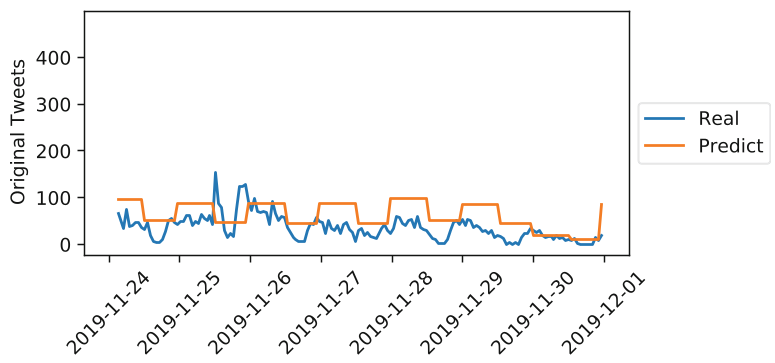 Figure 1: The model (orange) effectively tracks the oscillating pattern of actual tweets (blue) while identifying the weight of specific covariates like protests.
Experiments and Insights
The model was tested using data from Bogotá (2019-2020), a period marked by significant social unrest.
- Predictive Accuracy: While the model struggles to capture extreme "spikes" (amplitudes) of viral events, it excels at following the daily oscillating patterns of public discourse.
- Interpretability: Unlike "black-box" deep learning models, the Hawkes process explains why the rate increased. For instance, the study found that citizen protests were the strongest positive predictor of insecurity sentiment, while festive dates actually decreased PoS-related chatter.
- Performance: The model achieved a Pearson coefficient of 0.17, significantly outperforming linear regression baselines (0.08), proving that the self-excitatory nature of social media is key to accurate forecasting.
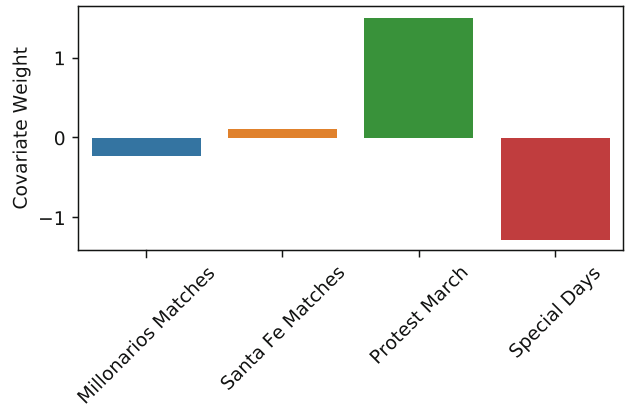 Figure 2: MAE and Pearson correlation results showing the stability of the proposed Hawkes model across different time folds.
Critical Insight: The "Fear Bottleneck"
The study highlights a critical psychological phenomenon: Negative sentiment is more infectious. By incorporating the "Sentiment Score (S)" into the retweet influence function, the model acknowledges that insecurity spreads faster than security. This makes the Hawkes process uniquely suited for "fear of crime" modeling compared to standard Poisson processes which treat all events as independent.
Conclusion & Future Work
The proposed framework provides a "competitive predictive performance while keeping high levels of interpretability." For city planners, this means the ability to anticipate shifts in public mood before they manifest in physical unrest or economic downturns.
Limitations: The model currently underestimates high-amplitude viral events. Future iterations could benefit from integrating Graph Neural Networks (GNNs) to better map the specific network topology of influential accounts beyond simple follower counts.
Takeaway: Security is as much about information as it is about incidents. Monitoring the digital cascade is no longer optional for modern urban governance.