
TRNN: Deciphering the "Clock" Behind User Behavior via Time-Aware Embeddings
Predictive Analysis by Leveraging Temporal User Behavior and User Embeddings
The paper introduces TRNN (Time-aware Recurrent Neural Network), a framework designed to model user behavior and generate general-purpose user embeddings from interaction logs. By integrating dual temporal features into a standard LSTM, it achieves SOTA results in next-action prediction and cross-domain tasks like conversion and product preference prediction.
TL;DR
Predicting what a user will do next—or whether they will eventually buy a product—is the "Holy Grail" of digital marketing. This paper argues that when an action happens is just as important as what happens. The authors propose TRNN (Time-aware Recurrent Neural Networks), a model that treats the time gaps between clicks as first-class citizens. By doing so, they not only predict the next click more accurately but also create "User Embeddings"—dense mathematical profiles—that outperform industry standards like Doc2Vec and BoW in predicting long-term business metrics.
The "Time" Problem in User Behavior
Most recommendation algorithms treat user actions like words in a sentence. However, human behavior isn't just a string of tokens.
Consider this: A user adds a jacket to their wishlist and then places an order 5 minutes later. Now imagine a user who wishlists a jacket and disappears for 5 weeks before returning. In a standard RNN, these sequences look identical. In reality, the 5-minute gap signals high intent (conversion), while the 5-week gap suggests the interest has likely cooled.
Existing SOTA methods like DeepCare or TLSTM were designed for clinical data (where events like "doctor visits" are infrequent and periodic). They struggle with the "noise" and high frequency of web logs—where a user might refresh a page 10 times in a minute.
Methodology: Coding Time into the RNN
The core innovation of TRNN is its simplicity and effectiveness. Instead of re-engineering the complex internal gates of an LSTM cell, the authors augment the input representation .
1. Dual-Temporal Features
Every action is concatenated with two values:
- : The time gap between the current and previous action (clipped to session boundaries).
- : The total time elapsed since the start of the session.
2. Sequence-Level Dropout
To handle the "repetitive clicking" habit of users, the authors introduced a dropout mechanism that removes random actions from the sequence during training. This prevents the model from over-fitting on specific, redundant patterns (like a user hitting 'Back' and 'Forward' repeatedly).
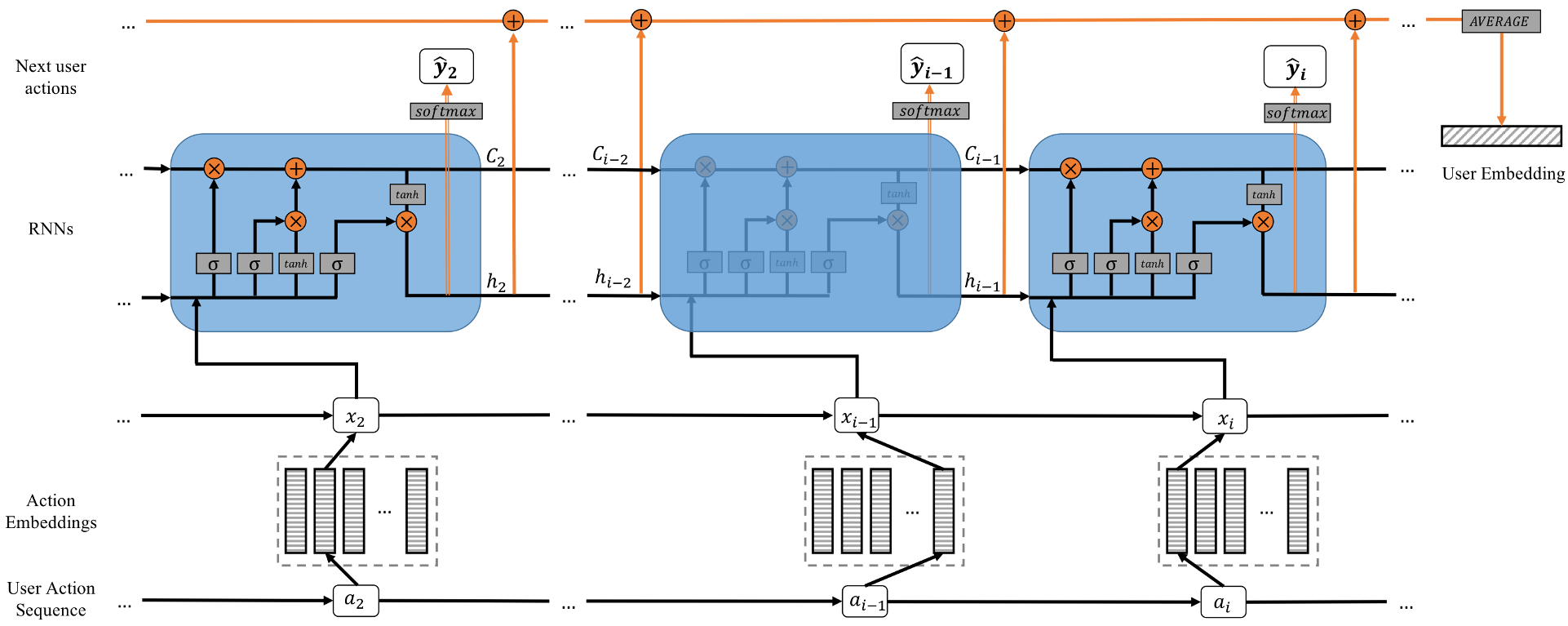 Figure 1: The TRNN framework. Note how temporal features are injected directly into the input layer before the LSTM processing.
Experiments: Superior Predictive Power
The authors tested TRNN on two large-scale datasets from "Company A" (Web logs) and "Company B" (Mobile/Cross-channel logs).
Next Action Prediction
TRNN significantly outperformed -gram models and standard RNNs. More importantly, it beat the previous time-aware champions (DeepCare and TLSTM). On Company A, it achieved an Acc@1 of 46.23%, a clear margin over the baselines.
The Power of General Embeddings
One of the most valuable outputs of TRNN is the User Embedding. By performing max-pooling across the TRNN hidden states, the authors created a fixed-length vector representing the user's entire history.
- Conversion Prediction: Using these embeddings in simple logistic regression beat BoW and TF-IDF models, which have much higher dimensionality (10,000 vs 400).
- App Preference: TRNN embeddings were dramatically more effective than Doc2Vec, showing that co-occurrence isn't enough; order and timing are the true signals of user preference.
 Figure 2: TRNN vs Baselines for User Conversion. TRNN (bottom row) achieves the highest AUC while maintaining a compact embedding size.
Critical Insight & Industry Value
The genius of this paper lies in its realization that user behavior data is fundamentally different from NLP or Clinical data. It is noisier and more clustered.
Key Takeaways:
- Temporal context is a "Compressor": By knowing the time gap, the model can "ignore" redundant actions and focus on the transitions that actually lead to a purchase.
- Embeddings are Transferable: A TRNN trained to predict the next click creates a representation that is "smart" enough to predict a purchase days later, or even predict which mobile app a user likes.
Limitations: The model still relies on a fixed session threshold (6 hours). In a world of "always-on" mobile usage, defining the "start" and "end" of user intent remains a fuzzy challenge that future Attention-based models might solve more dynamically.
Conclusion
TRNN proves that in the realm of predictive analysis, the "When" is just as potent as the "What." For practitioners in digital marketing and recommendation systems, this work provides a robust blueprint for turning raw, messy logs into high-value user representations.