
Towards Predictive Analytics in Mental Health: Leveraging Swarm Intelligence to Combat Online Radicalization
Towards Predictive Analytics in Mental Health Care
The paper introduces a social data analytics pipeline and a Particle Swarm Optimization Influence Maximization (PSO-IM) algorithm designed to identify influential nodes within social networks to predict mental health-related risks, specifically online radicalization. By integrating context analytics with behavioral modeling, the framework achieves higher accuracy in influence spread compared to traditional Memetic algorithms.
Executive Summary
TL;DR: This paper presents a sophisticated social data analytics pipeline that identifies key influencers in social networks to predict mental health issues and extremist radicalization. By combining a novel Particle Swarm Optimization Influence Maximization (PSO-IM) algorithm with Context Analytics, the researchers can pinpoint individuals who facilitate the spread of harmful ideologies with higher efficiency than previous SOTA methods like Memetic algorithms.
Background: Within the academic landscape, this work transitions Influence Maximization (IM) from its traditional roots in viral marketing to the critical domain of Predictive Mental Health Care. It bridges the gap between pure graph theory and computational psychology.
Problem & Motivation: Beyond Viral Marketing
Traditional Influence Maximization focuses on "What" is spreading—usually a product or a meme. However, in the context of mental health and security, the "Why" and "Who" are more critical. Prior works often treated social networks as simple topological structures, ignoring the rich Content (what people say) and Action (how they interact) dimensions.
The authors identified two major barriers:
- Context Blindness: Standard IM algorithms don't understand the sentiment or psychological state behind a post.
- Scalability Bottlenecks: Finding the optimal subset of influential nodes is NP-hard. Existing greedy approaches are too slow for massive networks like Twitter.
Methodology: The Cognitive Graph and PSO-IM
The core innovation lies in the Cognitive Graph, which models users not just as nodes, but as entities with psychological attributes.
1. The Multi-Dimensional Pipeline
The framework enriches raw data using a "Knowledge Lake," extracting:
- Affective Features: Anxiety, anger, and negative emotions.
- Cognitive Features: Causation, discrepancy, and insight.
- Activity Features: Follower counts and posting frequency.
2. The PSO-IM Algorithm
To solve the search space problem, the authors use a three-step process:
- Pre-processing: Building a weighted graph based on word co-occurrence.
- Clustering: Using modularity-based unfolding to group users into communities, narrowing the "seed" candidates.
- PSO Optimization: A particle swarm explores the 2-hop influence spread, seeking to maximize the "fitness" (the expected number of influenced nodes).
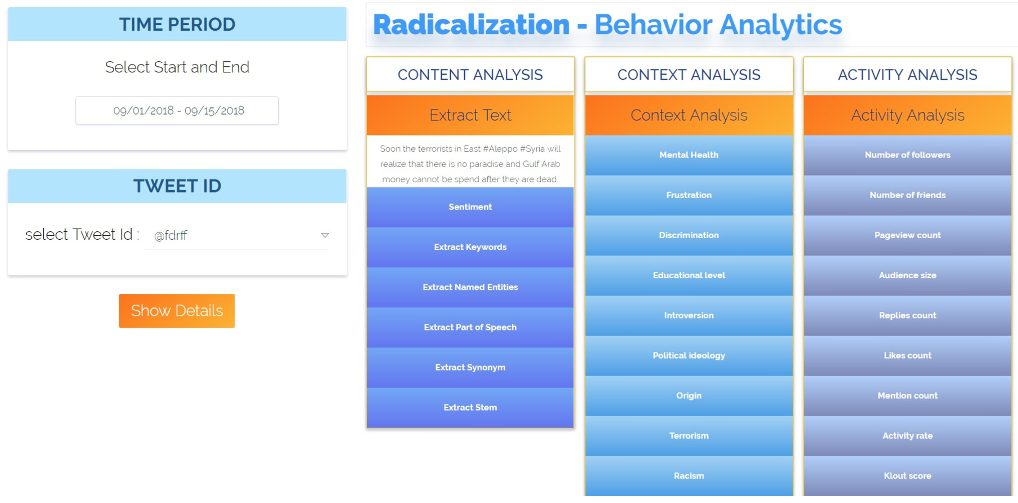 Figure 1: The software prototype showing the integration of behavioral disorder analysis and radicalization identification.
Experiments & Results: Efficiency at Scale
The researchers validated their approach using the Dolphin dataset (small-scale) and a Twitter ISIS Proponents dataset (large-scale).
Key Findings:
- Superior Spread: In the Twitter dataset, PSO-IM significantly outperformed the Memetic algorithm. As the network size grows, the performance gap widens, proving PSO-IM's scalability.
- Radicalization Quantification: By applying "Context Analytics" (Algorithm 2) to the seeds identified by PSO-IM, the system calculated rates for criteria such as Introversion, Discrimination, and Attitude towards Terrorism.
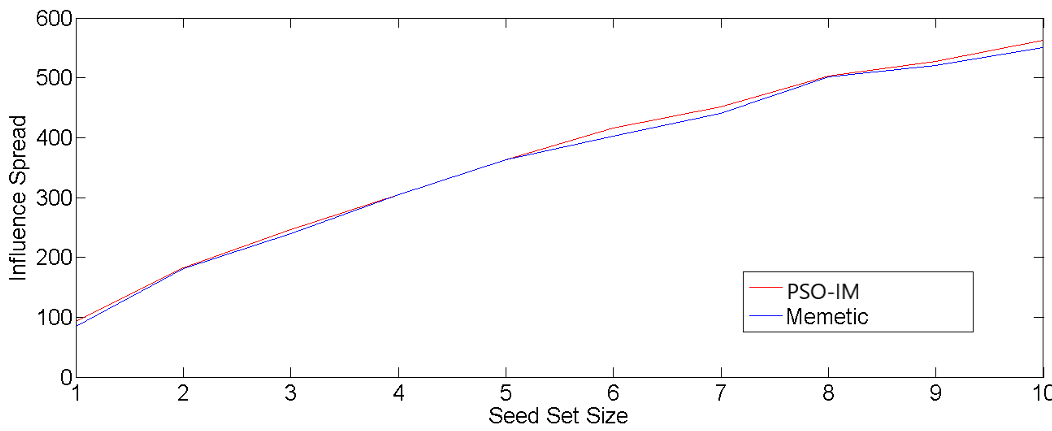 Figure 2: Influence spread comparison between PSO-IM and Memetic algorithms on large-scale social data.
| Criterion | Influence on Radicalization |
|---|---|
| C3 (Religion) | Strong propagation in extremist clusters |
| C4 (Anti-Western) | Highest consistent rate in ISIS seed nodes (~24%) |
Critical Analysis & Conclusion
Takeaway: This work proves that Influence Maximization is not just for selling products; it is a viable tool for public health and safety. By incorporating psychological metadata into the graph, the model becomes "context-aware."
Limitations: While powerful, the "Knowledge Base" approach relies on predefined dictionaries. Future iterations could benefit from Large Language Models (LLMs) to capture the nuances of radical language that evolve to bypass keyword filters.
Future Outlook: The integration of Trust Prediction models is the next frontier. Understanding not just who is influential, but who is trusted within a radicalized echo chamber, will significantly sharpen the accuracy of these predictive analytics.