
Predictive Fairness for Social Good: Breaking the Misdemeanor Cycle in Los Angeles
Case Study: Predictive Fairness to Reduce Misdemeanor Recidivism Through Social Service Interventions
This paper presents a case study in collaboration with the Los Angeles City Attorney’s Office to build a recidivism prediction system for misdemeanor offenses. The authors developed a machine learning framework that prioritizes individuals for supportive social service interventions, focusing on high-risk chronic offenders while operationalizing predictive fairness to mitigate racial disparities.
TL;DR
In a landmark collaboration with the Los Angeles City Attorney’s Office, researchers have developed a machine learning system to identify individuals at high risk of misdemeanor recidivism. Unlike punitive risk scores (like bail algorithms), this system is assistive, triggering tailored social service interventions. By focusing on Recall Parity as a core fairness metric, the team demonstrates that we can achieve equitable service distribution across racial groups with negligible impact on predictive efficiency.
Background & Motivation: The "Revolving Door"
The criminal justice system is frequently the primary—but least equipped—contact point for individuals suffering from homelessness, mental illness, and substance abuse. In Los Angeles, a small "chronic" population cycles in and out of jail for low-level misdemeanors.
The LA City Attorney’s R2D2 unit was designed to break this cycle through diversions and social services. However, social workers cannot prepare complex case histories for over 1.5 million individuals. They need a way to focus their limited "desk time" on the 150 people most likely to return in the next six months.
The Fairness Framework: Why Recall Matters
Most academic debates on algorithmic bias focus on False Positives (e.g., the ProPublica COMPAS investigation) because being wrongly flagged as "high risk" in a punitive setting (like bail) leads to direct harm.
However, in an assistive program, the authors argue the paradigm shifts:
- False Positives are merely "wasted resources" (preparing a plan for someone who doesn't return).
- False Negatives represent the real harm: a vulnerable individual misses out on life-changing support.
Therefore, the team prioritized Recall (Equality of Opportunity)—ensuring that the "benefit" of being identified for help is distributed fairly across racial and ethnic groups.
Methodology: Operationalizing Equity
The researchers built a binary classifier using features like prior charges, age of first arrest, and frequency of recent interactions. While the model was highly accurate, initial audits showed that Hispanic individuals were underrepresented in the top 150-risk pool relative to their actual recidivism rates.
To solve this, they implemented Algorithm 1: Balancing Recall Across Groups. Instead of a single global threshold, the system uses group-specific thresholds to ensure that a similar percentage of actual recidivists from each group are captured by the model.
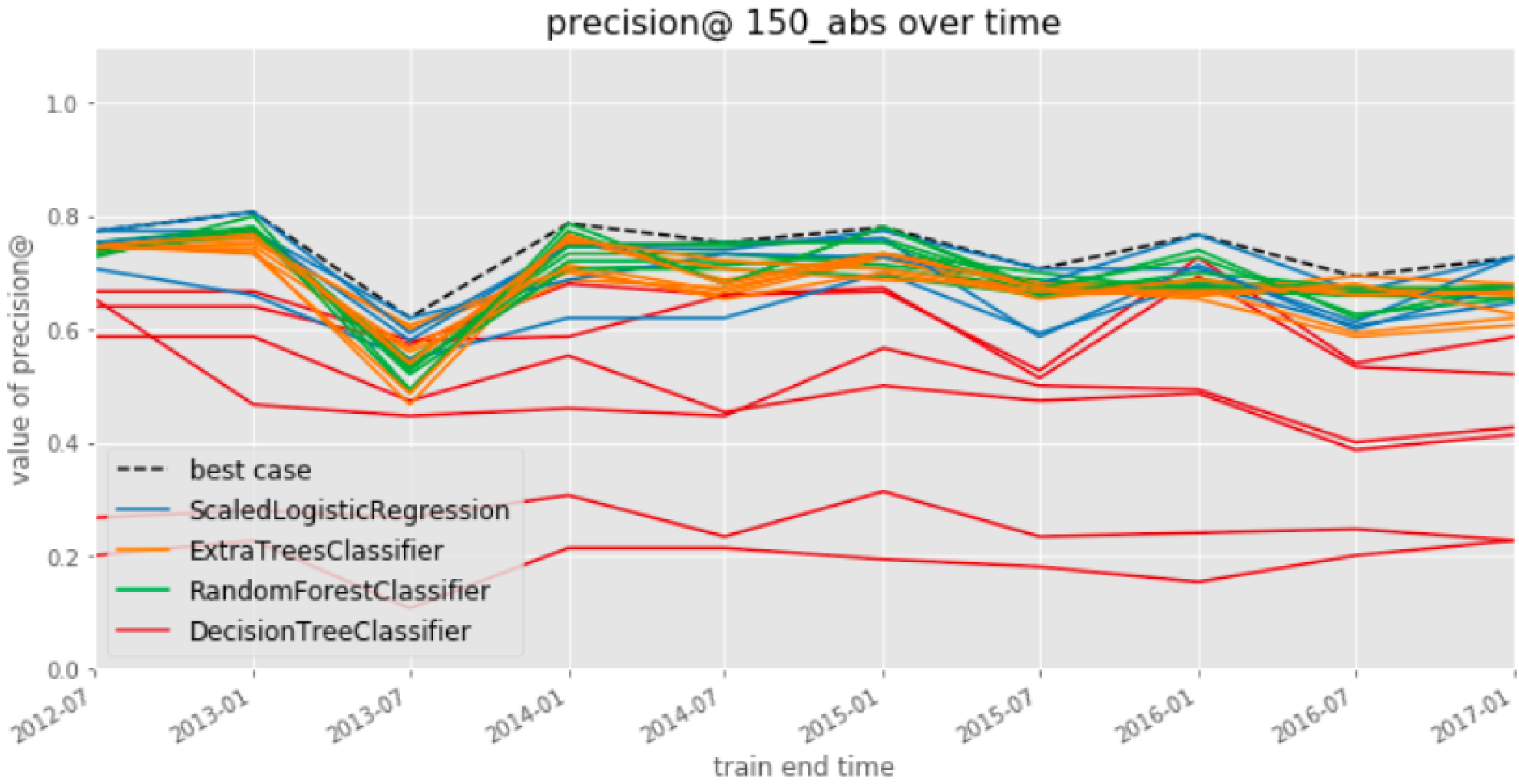 Figure 1: Comparison of various ML architectures (Random Forests, Logistic Regression) over time, showing stable precision around 70%.
Experimental Results
The "Efficiency vs. Equity" trade-off is often cited as a barrier to fair AI. This study proves that trade-off is often smaller than feared:
- Baseline Precision: 72.7% (Purely efficiency-driven).
- Equitable Precision: 70.7% (After balancing recall for Black, White, and Hispanic groups).
A mere 2% drop in precision enabled a significantly more equitable distribution of social services.
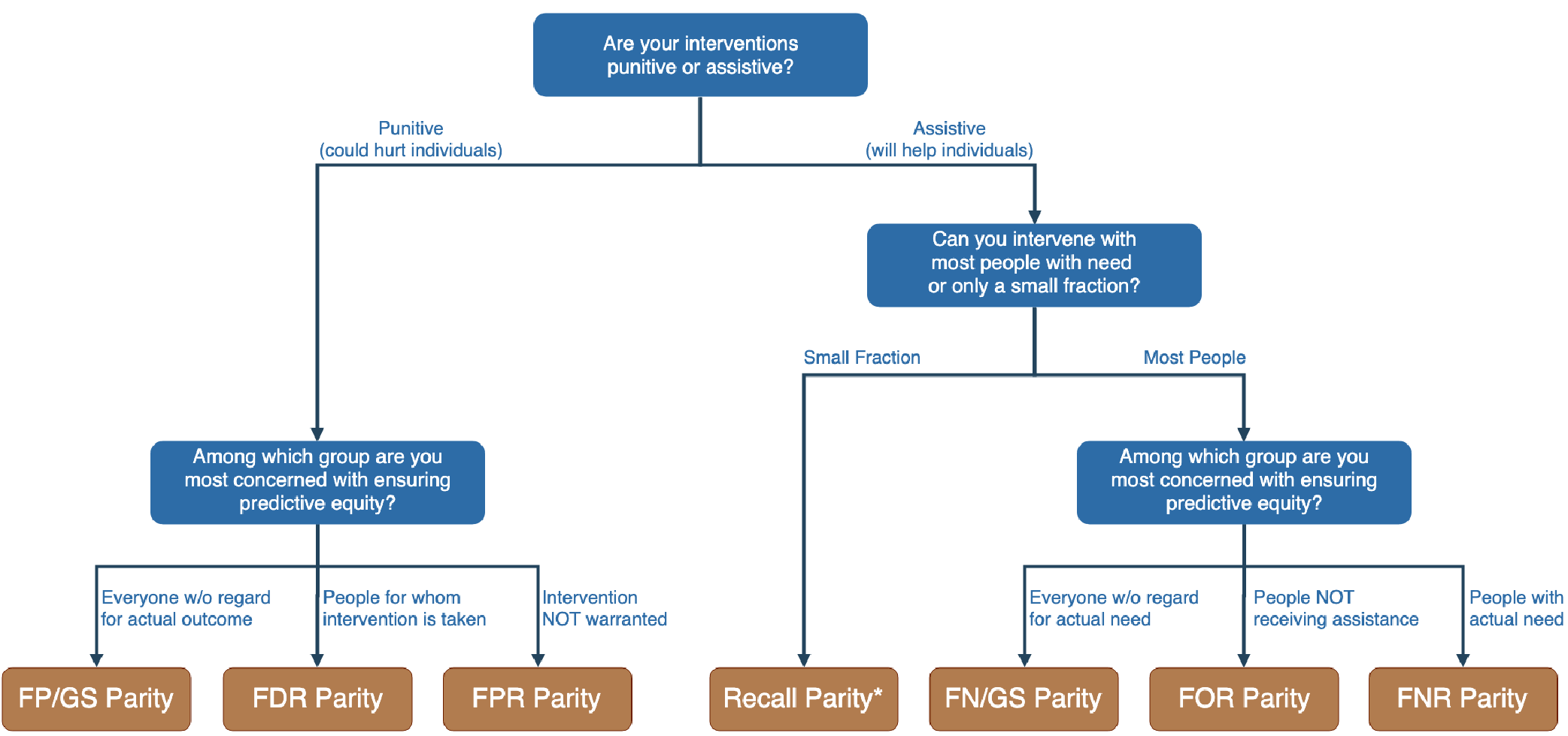 Figure 2: The authors' decision tree for choosing a fairness metric. For small benefit-allocation programs, Recall/FNR Parity is the gold standard.
Critical Insights & Future Outlook
The core takeaway is that fairness is not a one-size-fits-all mathematical formula. It is a policy choice. In this case, the authors provided the LA City Attorney with several "knobs" to turn:
- Scale Up: Keep the 150 highest-risk individuals and add more from underrepresented groups (requires 50% more staff).
- Re-allocate: Maintain the 150 cap but swap some individuals to ensure racial parity (the more cost-effective choice).
Limitations
- Label Bias: The model predicts "future arrest/booking," which is a proxy for crime but is influenced by policing patterns.
- Intervention Efficacy: The study assumes that being selected actually helps the individual. If the social services are ineffective or coercive, the fairness logic must be re-evaluated.
Conclusion
This study serves as a masterclass in Translational Data Science. It moves beyond the "what" of accuracy to the "how" of societal impact, providing a blueprint for how government agencies can use AI to promote equity rather than just automate existing status-quo disparities.