
From Optimization to Prediction: Rethinking How Teams Form in Social Networks
Predictive Team Formation Analysis via Feature Representation Learning on Social Networks
The paper introduces Predictive Team Formation (PTF), a novel formulation that shifts team formation from theoretical cost-optimization to a ground-truth prediction task. The authors propose two embedding-based methods, Biased-n2v and Guided-n2v, which leverage representation learning to recommend experts who are likely to actually collaborate, outperforming traditional Steiner-tree based optimization methods.
TL;DR
Most team formation algorithms focus on minimizing "communication cost" via Steiner Tree variants, but they rarely ask: Would these people actually work together? This paper shifts the paradigm to Predictive Team Formation (PTF). By using advanced node embedding techniques (Biased-n2v and Guided-n2v), the authors can predict future team members with much higher accuracy than traditional optimization methods, proving that social "intuition" captured in latent space beats rigid cost-minimization.
The "Reality Gap" in Team Formation
For over a decade, the academic approach to forming a team from a social network was treated as a graph optimization problem: find a set of nodes that cover all required skills while minimizing the distance between them.
However, the authors point out two critical flaws:
- Rigidity: Existing algorithms often break if you try to give them a specific set of pre-existing members (designated experts).
- Adoption Uncertainty: A team with a low "graph distance" might have zero chemistry. Optimization scores don't guarantee that an expert will accept an invitation to join.
The authors' insight is simple: History repeats itself. If we can learn the latent representation of how experts navigate skills and past collaborations, we can predict the "missing pieces" of a team based on existing "designated members."
Methodology: Guiding the Random Walk
The paper proposes two extensions to the popular node2vec algorithm to capture the nuances of professional collaboration.
1. Biased-n2v: Modeling Individual Topic Bias
Not all experts are equal. Some are generalists; others are niche specialists. The authors use Kullback-Leibler (KL) divergence to calculate a "topic bias" for each expert. This bias is then used to weight the edges in the social network. A random walker is less likely to jump to an expert with a highly idiosyncratic topic preference unless there's a strong historical reason, thus capturing the "collaboration compatibility."
2. Guided-n2v: The Heterogeneous Expertise Graph
The most powerful contribution is the Heterogeneous Expertise Graph, which connects experts to other experts, experts to skills, and skills to other skills.
 Figure 1: Conceptual illustration of nodes and skills in a social collaboration context.
In Guided-n2v, the transition probability of the random walk is controlled by three parameters (). These parameters guide the walker to decide whether to explore similar skills or stick to known collaborators, effectively allowing the model to learn that "Expert A is like Expert B because they share niche skills," even if they haven't worked together yet.
Experimental Insights: Data Doesn't Lie
The authors tested their approach on two massive datasets: DBLP (Computer Science co-authorship) and IMDb (Movie cast collaborations).
SOTA Comparison
The results were clear: Feature representation learning (node2vec variants) crushed traditional optimization-based methods (CoverSteiner, EnhancedSteiner) in terms of Recall.
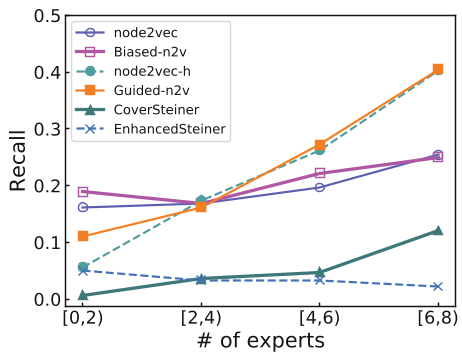 Figure 2: Performance comparison (Recall) on the DBLP dataset against optimization baselines.
The "Density" Secret
One of the most interesting findings in the ablation study was the impact of Social Density () among designated members.
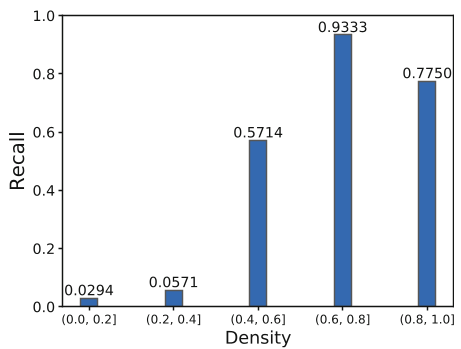 Figure 3: Impact of social density on prediction recall.
If the initial seed members of a team are already well-connected, the model's ability to predict the rest of the team skyrockets. This suggests that the "social core" of a team provides a much stronger signal for future growth than the list of required skills alone.
Critical Analysis & Future Outlook
Takeaway: This paper successfully bridges the gap between graph theory and social reality. By moving from "finding an optimal team" to "predicting a likely team," it makes the technology applicable to LinkedIn-style expert recommendations.
Limitations:
- The distance measure used for recommendation is simple distance in the embedding space. Future work could use more complex scoring functions or MLP-based rankers.
- The model assumes skills are static, but in the real world, experts acquire new skills over time.
Future Prospect: As Graph Neural Networks (GNNs) mature, the "Guided Random Walk" logic could be replaced by Heterogeneous Graph Transformer (HGT) architectures to capture even deeper semantic relationships between skills and tasks.