
cp-EDF: Optimizing Real-Time Scheduling by Controlling the Preemptor
Preempt a Job or Not in EDF Scheduling of Uniprocessor Systems
The paper introduces "Controlled Preemption" (CP), a novel scheduling policy for Earliest-Deadline-First (EDF) systems that accounts for non-zero preemption delays. By shifting the control mechanism from the preempted job to the preempting job, the proposed cp-EDF algorithm optimizes task schedulability and outperforms traditional fully-preemptive and non-preemptive EDF approaches.
TL;DR
In real-time systems, preemption isn't free—it costs context-switching time. While traditional EDF (Earliest Deadline First) is theoretically optimal, it fails when preemption delays are high. This paper introduces cp-EDF, which uses a Controlled Preemption (CP) policy. Unlike previous methods that limit how many times a job can be preempted, CP controls which jobs are allowed to preempt. This simple shift in perspective improves system schedulability by up to 7.4%.
The "Preemption Penalty" Problem
In academic theory, we often assume preemption is instantaneous. In reality, saving registers and flushing caches creates a "preemption delay" ().
- Fully-Preemptive EDF (fp-EDF): Always preempts. If is high, the CPU wastes all its time switching rather than executing.
- Non-Preemptive EDF (np-EDF): Never preempts. High-priority tasks get stuck behind "elephant" low-priority tasks and miss their deadlines.
- The SOTA Gap: Existing "Limited Preemption" (lp-EDF) tries to fix this by capping the number of times a job is preempted. However, this often over-estimates the overhead, leading to a pessimistic analysis that rejects perfectly valid schedules.
Methodology: The cp-EDF Approach
The core insight of this paper is that it is mathematically cleaner and more effective to regulate the preempting job.
The CP Policy
Each task is assigned a parameter :
- : Jobs of can preempt any lower-priority job.
- : Jobs of cannot preempt; they must wait for the current job to finish.
By adjusting for every task, the system can behave like fp-EDF (all ), np-EDF (all ), or anything in between.
Schedulability Analysis
The authors derive a generalized Demand Bound Function (DBF) that accounts for both the execution time and the preemption overhead triggered by tasks where .
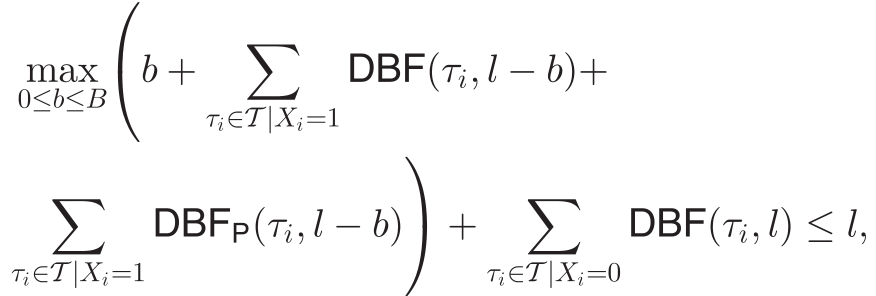 The generalized schedulability test: It balances the blocking time (b) and the preemption-augmented demand.
Experiments and Results
The researchers tested cp-EDF against 100,000 constrained-deadline and 100,000 implicit-deadline task sets.
Key Findings:
- Superior Performance: cp-EDF consistently finds valid schedules that fp-EDF and lp-EDF miss, particularly when preemption delays are significant.
- Algorithm Efficiency: While finding the "optimal" set of parameters is potentially exponential, the authors' Heuristic Algorithm (Algorithm 3) performs within 0.01% of the optimal result but runs in pseudo-polynomial time.
- Incomparability: Interestingly, cp-EDF excels in constrained-deadline systems, while lp-EDF is slightly better for implicit deadlines, suggesting that a hybrid "selector" approach is best for industry applications.
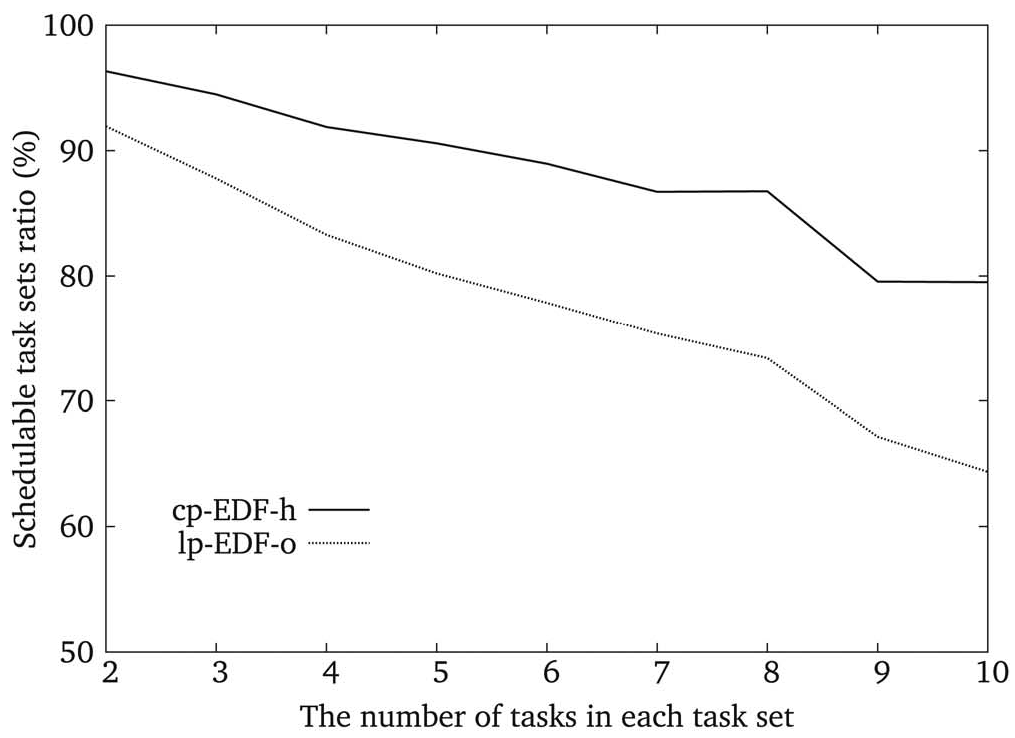 Fig 1: Schedulable sets across varying delays. Note how cp-EDF (solid/dashed lines) maintains higher schedulability as preemption delay increases.
Critical Insight & Future Outlook
The traditional "limited preemption" approach suffered from over-estimation. By focusing on the preemptor, cp-EDF provides a much tighter bound on system demand.
Limitations: Currently, this model assumes a constant delay . In modern processors with complex hierarchies, depends on the cache state of both the preemptor and the preempted task. The authors acknowledge this and point toward a future "unified" policy that controls both sides of the preemption event.
Takeaway for Engineers: If your embedded system is struggling with high context-switch overhead on a uniprocessor, don't just increase your task periods—consider a "Controlled Preemption" strategy to keep the CPU working on high-value tasks instead of switching between them.