
PTPP: Balancing Personalization and Privacy in Location-Based Social Networks
A preference-aware trajectory privacy-preserving scheme in location-based social networks
The paper introduces PTPP (Preference-aware Trajectory Privacy-Preserving), a novel scheme for Location-Based Social Networks (LBSNs) that protects sensitive user trajectories. It utilizes a hierarchical clustering approach and an iterative HITS-based algorithm to model user preference, achieving superior data utility and efficiency compared to traditional k-anonymity methods.
TL;DR
As Location-Based Social Networks (LBSNs) like Foursquare and Twitter become ubiquitous, the risk of "lifestyle leakage" grows. This paper proposes PTPP, a framework that doesn't just hide where you are, but understands why certain locations are more sensitive than others. By modeling user preference through familiarity and popularity, it delivers high privacy without sacrificing the utility of personalized recommendations.
The Problem: One Size Does Not Fit All
Most trajectory privacy research treats every coordinate equally. However, in the real world, a visit to a generic gas station (High Popularity, Low Familiarity) carries much less privacy risk than a frequent visit to a specialized medical clinic (Low Popularity, High Familiarity).
Existing methods fail because:
- Semantic Blindness: They don't see the "Home" or "Work" label behind the GPS dot.
- Context Ignorance: They ignore whether a user is an "expert" in a certain location type.
- Rigid Precision: Uniform k-anonymity often "over-blurs" data, making the resulting service useless.
Methodology: The PTPP Framework
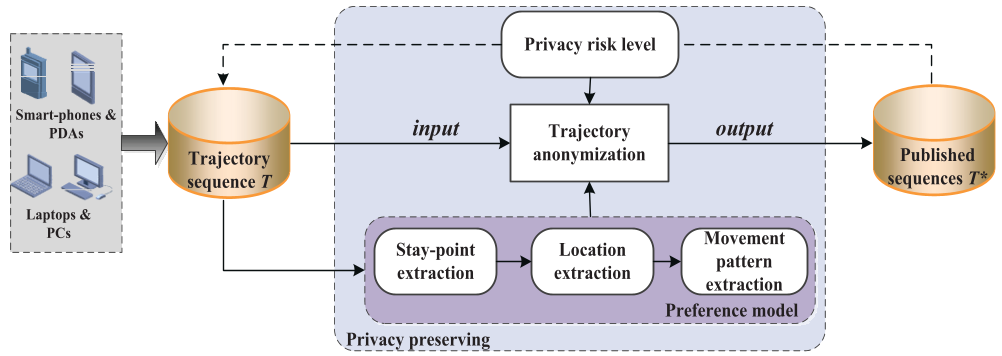
The researchers break the problem down into a pipeline that transforms raw GPS noise into a privacy-aware trajectory.
1. The Hierarchical Extraction
Raw GPS points are clustered into Stay-points (regions where users linger) and then into Locations (semantic entities like "Shopping Mall"). This two-step clustering provides initial obfuscation.
2. Modeling Preference via HITS
The core innovation lies in using the HITS (Hypertext Induced Topic Search) algorithm. In this context:
- User Familiarity (Hubs): Users who visit many locations of a certain type are "Hubs" of that semantic category.
- Location Popularity (Authorities): Locations visited by many "familiar" users become "Authorities."
Through an iterative process, the system calculates a weight for how sensitive a specific visit is based on how much it reveals about the user’s unique habits.
3. Adaptive Anonymization
Instead of a single rule, PTPP defines four risk quadrants:
- NFP (Non-Familiar/Popular): Low risk. No protection needed.
- NFNP (Non-Familiar/Unpopular): Moderate risk. Use Fake Data to hide the user.
- FP (Familiar/Popular): Preference risk. Use Spatial Cloaking (k-anonymity) within the same category.
- FNP (Familiar/Unpopular): Critical risk. Use Inhibition (delete the record entirely).
Experimental Validation
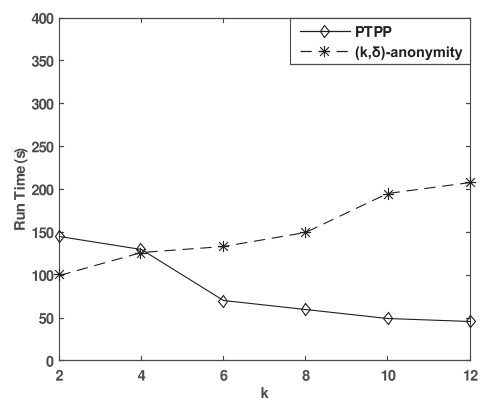
Using the GeoLife dataset (Beijing GPS logs) and POI data, the authors compared PTPP against the standard (k, δ)-anonymity.
Data Utility
The "Information Loss" metric clearly favors PTPP. Because PTPP only "blurs" or "deletes" points that are statistically sensitive, the overall trajectory remains much closer to the original path, preserving the utility for LBSN service providers.
Efficiency
Interestingly, while PTPP has a higher "startup cost" due to stay-point and pattern extraction, its running time scales better than traditional methods. As the privacy requirement () increases, PTPP’s targeted approach becomes faster than the heavy computational clusters required by standard k-anonymity.
Critical Insight & Conclusion
PTPP proves that Privacy is Semantic. By understanding the relationship between a user's intent (familiarity) and the environment's nature (popularity), we can move away from "brute-force" encryption toward "intelligent" privacy.
Limitations: The current model focuses on static semantic types. Future iterations must account for the temporal context (velocity and direction) to prevent attackers from "calculating" the true location through physics-based tracking.
Final Takeaway: For developers of social apps, this paper offers a roadmap to provide personalized "Check-in" features that respect the nuances of human privacy.