
PROFILR: Solving the Privacy-Profit Paradox in Geosocial Networks
14242_${rm PROFIL}_{R}$ Toward Preserving Privacy and Functionality in Geosocial Networks.
This paper introduces PROFILR, a cryptographic framework for constructing Location Centric Profiles (LCPs) in geosocial networks. It utilizes Benaloh’s homomorphic cryptosystem and Zero-Knowledge Proofs (ZKP) to enable aggregate statistics collection while maintaining k-privacy and verifying user location and data correctness.
TL;DR
Geosocial networks (GSNs) like Yelp and Foursquare create a fundamental tension: users want privacy, but venues want data for targeted advertising. PROFILR is a framework that allows venues to build Location Centric Profiles (LCPs)—aggregate statistics of their patrons—without ever seeing an individual's raw data. By combining additive homomorphic encryption with Zero-Knowledge Proofs, it ensures that stats are only revealed once a crowd (k-users) has gathered, and that no user can "cheat" the system with fake data.
The Problem: Money vs. Privacy
In the current GSN ecosystem, your check-in is a double-edged sword. It earns you rewards (badges, discounts), but it also creates a permanent, decodable trace of your habits.
- Privacy Leakage: Providers often sell raw or poorly anonymized trace data to third parties.
- The Integrity Gap: If a system is made private/anonymous, users might submit "fake check-ins" or bias the results for financial gain.
- High Overhead: Traditional Secure Multi-Party Computation (SMPC) is often too heavy for mobile devices.
Methodology: The Cryptographic "Bucket"
The core of PROFILR is the transformation of a user profile into a set of encrypted counters. Instead of saying "I am a 25-year-old male," a user's device interacts with a venue's "encrypted bucket."
1. Homomorphic Aggregation
PROFILR uses the Benaloh cryptosystem. Because it is additively homomorphic, if you have an encrypted counter representing 5 people, a new user can increment that counter by 1 without ever knowing the current value or the decryption key.
2. ZK-CTR: The "No-Cheat" Proof
How do we know a user didn't increment the "Senior Citizen" counter and the "Teenager" counter at the same time? PROFILR introduces ZK-CTR (Zero-Knowledge Counter Proof). The user proves to the venue: "I have incremented exactly one counter in this set, and I haven't changed any other data," without revealing which counter was changed.
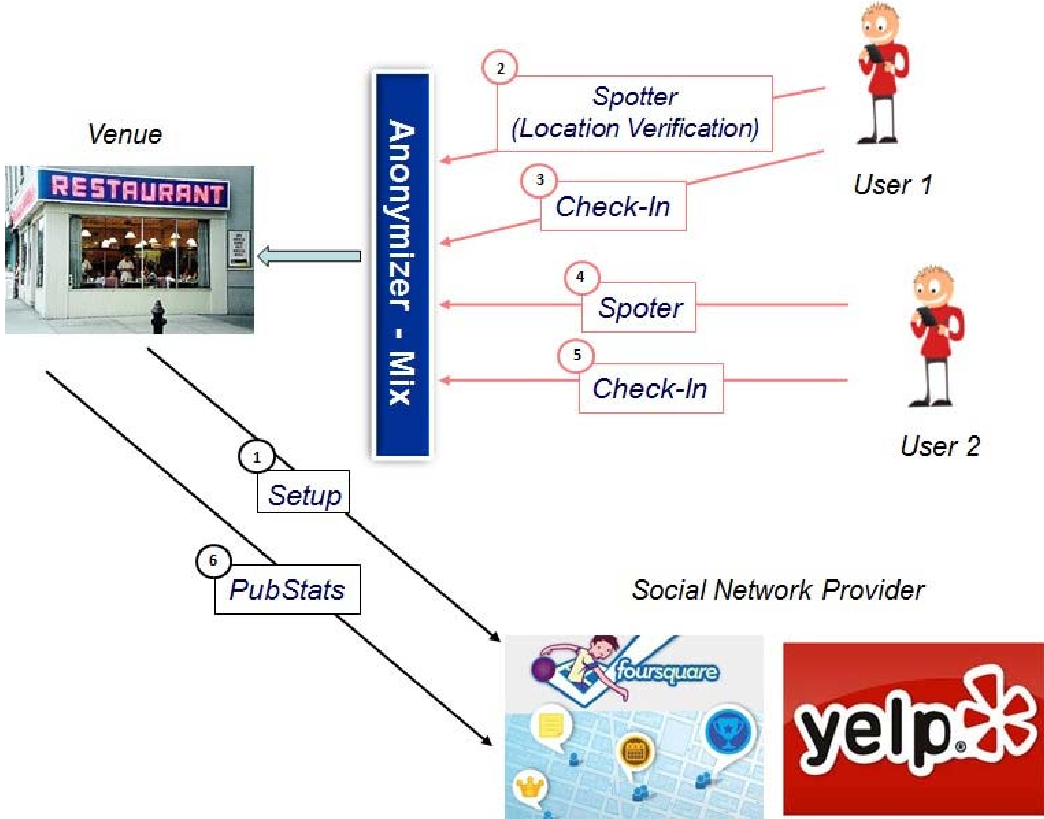 Figure 1: The PROFILR Protocol Flow - showing the interaction between User, Venue, and Provider.
3. Threshold Decryption
To ensure privacy, the venue cannot decrypt the counters immediately. The decryption key is split using Shamir's Secret Sharing. Only when users have checked in are there enough "key shares" to reconstruct the key and view the aggregate results. This is the definition of k-privacy.
Experimental Validation
The authors tested PROFILR on legacy hardware (800MHz Android devices) to prove its real-world viability.
- Efficiency: Even with 1024-bit encryption, the "Spotter" and "CheckIn" phases are fast enough for a retail environment.
- Security vs. Speed: There is a linear trade-off between the number of ZK-proof rounds and the time taken. 30 rounds provide a "one-in-a-billion" security guarantee in under 4 seconds.
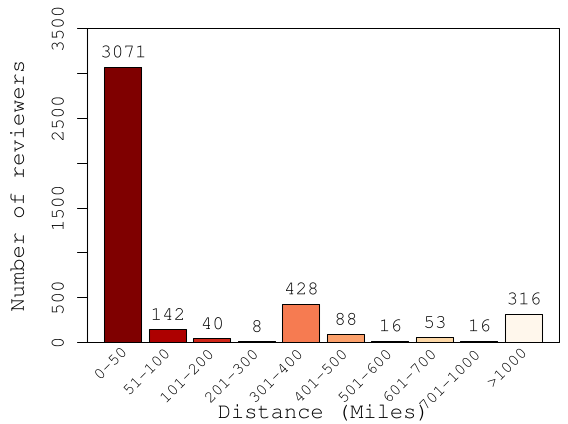 Figure 2: Real-world application - Visualizing the home-city distribution of Yelp reviewers without exposing individual identities.
Deep Insight: Beyond Venues
One of the most innovative sections of the paper is the Snapshot LCP. It describes a decentralized mode where user devices form an ad-hoc network (via Wi-Fi/Bluetooth) to calculate the "vibe" of a group in a park or a protest, without any central server or venue hardware. It’s a pure peer-to-peer privacy-preserving statistic engine.
Conclusion & Limitations
PROFILR effectively bridges the gap between the need for data and the right to privacy. However, it does rely on the assumption that the GSN provider and the venue do not collude. If the provider (who holds the master key) and the venue (who sees the encrypted sequence) team up, k-privacy could be compromised. Future work in this area likely involves specialized hardware (like TEEs) or even more robust Differential Privacy layers to mitigate collusion risks.
Takeaway: PROFILR proves that you don't have to choose between a tailored user experience and your personal privacy—math can protect both.