
Deciphering Digital Walls: Taxonomy and Evolution of Privacy in Online Social Networks
Preserving Privacy in Online Social Networks
This paper presents a comprehensive taxonomy of privacy requirements for Online Social Networks (OSNs) and evaluates contemporary cryptographic solutions. It categorizes privacy risks into three dimensions—information type, audience, and usage—while comparing SOTA frameworks like Persona and EASiER against criteria like dynamic revocation and fine-grained access control.
TL;DR
As Online Social Networks (OSNs) transitioned from niche communities to global infrastructure, the "trust-all" centralized model became a systemic vulnerability. This paper provides a rigorous taxonomy of OSN privacy requirements—focusing on the transition from provider-managed security to user-centric cryptographic control—and benchmarks SOTA solutions like ABE and IBBE against the realities of dynamic social relationships.
The Core Tension: Utility vs. Autonomy
The fundamental paradox of OSNs lies in the "core functionality": constructing public profiles and viewing connections. This visibility, while driving network effects, creates a playground for Information Seekers and Third-Party Developers. The authors identify a "transparency gap" where users treat platforms like Facebook as trusted intermediaries, ignoring that OSN providers often claim universal licenses to distribute user content.
The motivation for this research stems from the failure of simple "Access Control Lists" (ACLs). In the real world, relationships are non-disjoint (a friend can be both a 'Classmate' and a 'Close Friend') and dynamic (friendships end or evolve). Traditional centralized databases struggle to reflect these shifts without compromising privacy to the system administrator.
Methodology: The Requirements of a Private OSN
The authors break down privacy into three critical "Wh-questions":
- WHAT is shared (content sensitivity).
- WHO sees it (audience segmentation).
- HOW it is used (downstream control).
To solve these, they propose a taxonomy of requirements (Fig 1) centered on the removal of the Trusted OSN Provider. The goal is a "Privacy-by-Design" architecture where the provider serves only as a "blind" storage or relay hub.
The Hierarchy of Access Control
- Fine-grained: Ability to segregate friends into overlapping groups (e.g., Alice sharing a photo with {Classmates Family}).
- Flexible: Defining policies using Boolean logic (AND/OR/NOT).
- Dynamic: Real-time revocation of access without re-encrypting the entire historical database.
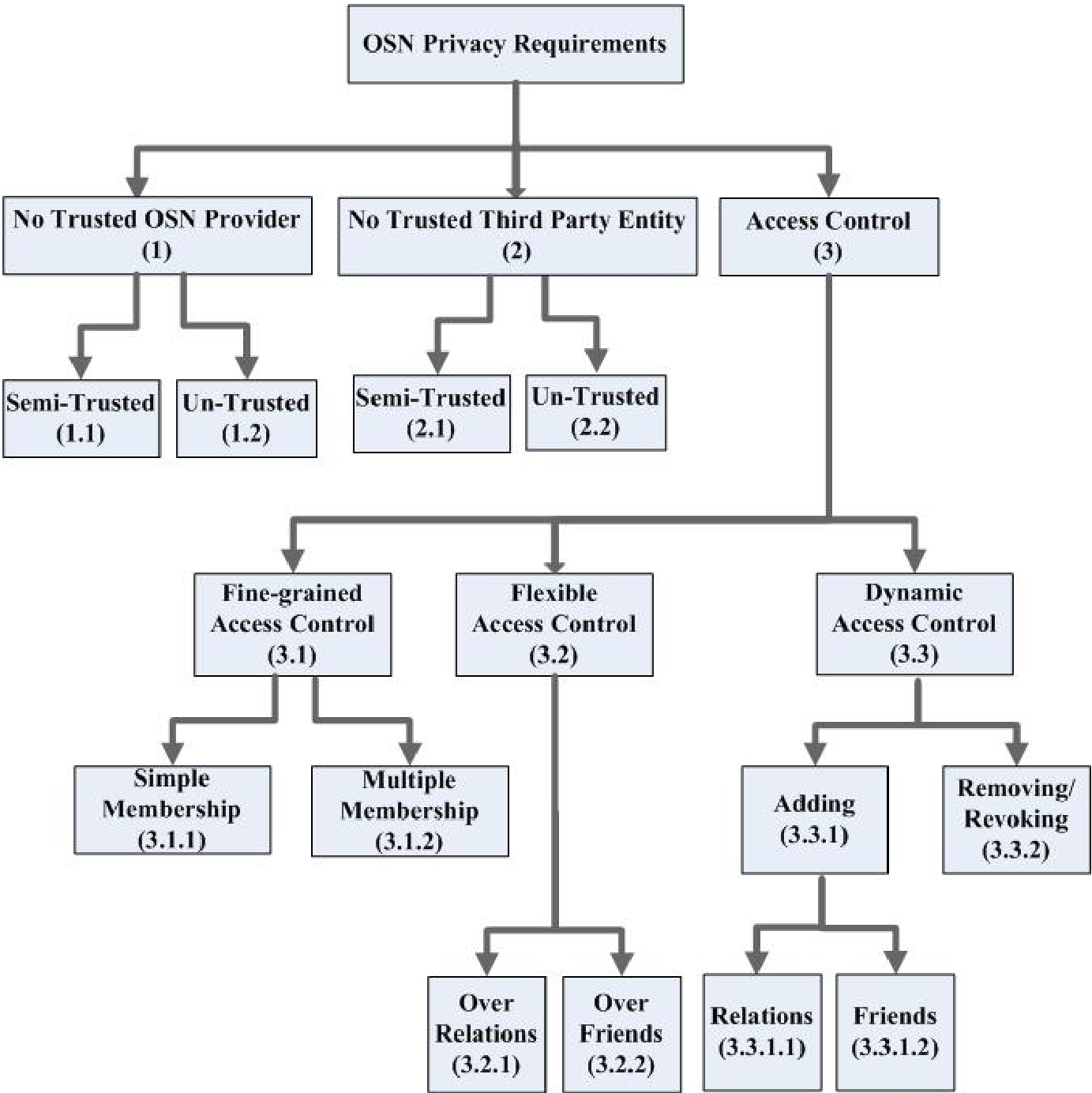 Figure 1: Taxonomy of privacy requirements in OSNs.
Solution Spotlight: Cryptographic Guardrails
The paper reviews several landmark approaches that attempt to solve the "Honest-but-Curious" provider problem:
- FaceCloak & NOYB: These methods focus on obfuscation—sending "fake" data to the OSN while storing real, encrypted data elsewhere. However, they lack the sophisticated group-logic required for complex social circles.
- EASiER (Architecture for Revocation): Utilizes Attribute-Based Encryption (ABE) and a proxy. While powerful for revocation, it traditionally lacks the flexibility to define new groups on the fly.
- IBBE-Based Scheme: The most robust theoretical model reviewed. By generating symmetric keys per data item and wrapping them in Identity-Based Broadcast Encryption, it allows Alice to grant or revoke access instantly, though the paper notes it faces efficiency hurdles in high-traffic environments.
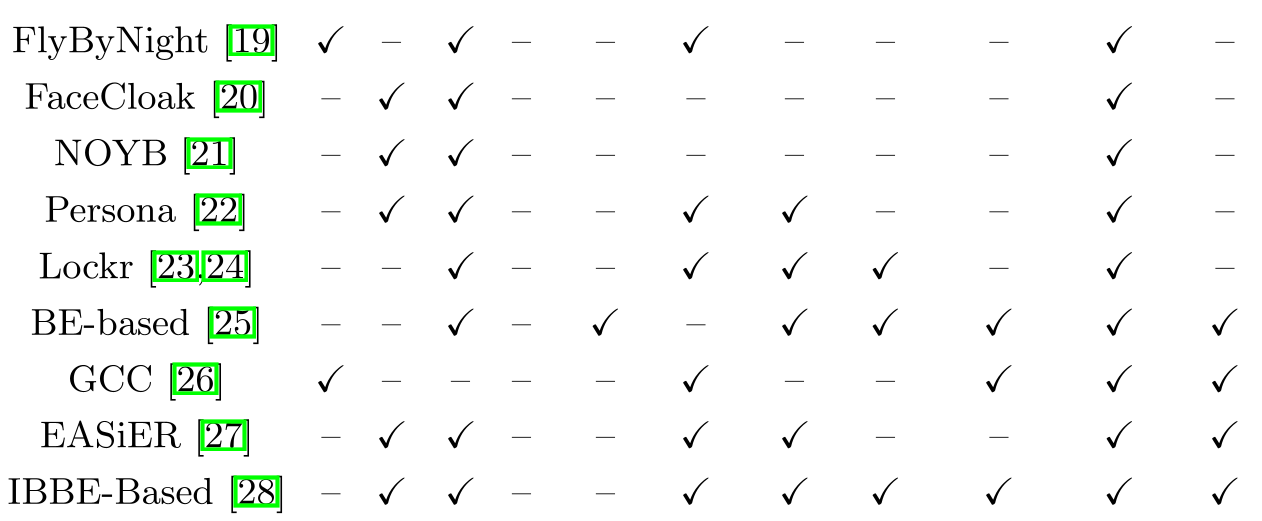 Table 1: Feature comparison across leading cryptographic OSN frameworks.
Critical Insight & SOTA Analysis
The "Battle Matrix" (Table 1) reveals a striking reality: only the IBBE-Based and BE-Based schemes manage to provide dynamic role management and flexiblity. Most earlier works (FlyByNight, FaceCloak) were essentially "digital vaults"—good for storage, but poor for the fluid nature of social interaction.
The primary bottleneck remains Key Management. When a user's relationship changes (e.g., Alice removes Bob from 'Close-Friends'), the system must ensure Bob cannot decrypt future posts while potentially maintaining access to past ones. This "Forward/Backward Secrecy" in an asynchronous environment is the "Holy Grail" of OSN privacy.
Conclusion: Toward a Decoupled Future
The authors conclude that the path forward lies in the decoupling of Service and Data. By treating the OSN as an "untrusted carrier," we place the power of consent back into the cryptographic keys held by the user.
While this 2011 work predates the explosion of Zero-Knowledge Proofs (ZKPs) and modern decentralized identifiers (DIDs), it sets the stage for the current "Web3" privacy discourse by proving that Access Control must be mathematical, not just policy-based.
Takeaway: If you aren't managing your own keys, you aren't managing your privacy; you are merely renting it from the OSN provider.