
The Physics of Teamwork: Preventing Catastrophe through Thermodynamic AI
Preventing (Another) Lubitz: The Thermodynamics of Teams and Emotion
This paper introduces a quantum-mechanical and thermodynamic framework to model team dynamics, proposing Maximum Entropy Production (MEP) and Least Entropy Production (LEP) as key performance metrics. It explores how AI can intervene in high-stakes environments—specifically citing the Germanwings Flight 9525 tragedy—by detecting "emotional" or dysfunctional team states through computational models of interdependence.
TL;DR
Can the laws of thermodynamics and quantum mechanics prevent the next pilot-induced air disaster? This paper argues that teamwork isn't just a social construct—it's a physical system. By modeling human teams using Least Entropy Production (LEP) as a "ground state" and internal conflict as "excited states," the author proposes an AI framework capable of detecting when a team (like a cockpit crew) is becoming dysfunctional and taking autonomous control to save lives.
Background: Beyond the Illusion of the Rational Actor
For decades, social science has leaned on Game Theory and rational models to explain teamwork. Yet, these models historically fail. Why? Because they assume individuals act independently. This paper argues that Interdependence—the very core of a team—creates a "measurement problem" similar to quantum mechanics. When humans work together, their actions and observations become "entangled," leading to a bistable reality where focusing on skills (action) inherently increases uncertainty in interpretation (situational awareness).
The Core Insight: Teams as Thermodynamic Engines
The author posits that a well-functioning team seeking a solution is effectively exploring a "solution space."
- LEP (Least Entropy Production): The ideal stable state where the division of labor is so efficient it forms a "complete circuit."
- MEP (Maximum Entropy Production): The state where a team is successfully searching and competing to solve complex, ill-defined problems.
- The Problem of Consensus: Surprisingly, the paper argues that "Consensus Rules" (CR) often suppress the MEP needed for innovation, placing weak arguments on equal footing with strong ones and leading to organizational stagnation.
Methodology: The Quantum-Biological Bridge
The paper uses a sophisticated mathematical approach to define "Emotional States" as metrics:
1. The Measurement Problem
Using Fourier pairs, the author shows that standard deviation in skills () and interpretations () are inversely related. As a team gets better at a specific task, they often become "blind" to the broader context, necessitating a dispassionate observer (like an AI).
2. Modeling Conflict with Operators
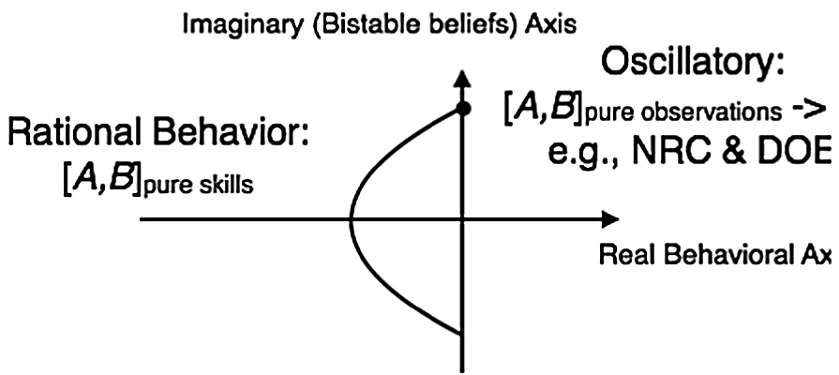
When two team members (or tribes) agree, their mathematical operators commute (the difference is zero). When they clash, the operators become orthogonal, creating "oscillations" or social dynamics.
3. Neutral Agents and Limit Cycles
Drawing from biology (Lotka-Volterra equations), the model shows that "neutrals" are essential. They act as entangled agents that moderate conflict and decide the direction of the organization.
Preventing "Another Lubitz"
The most provocative application is the Germanwings Flight 9525 crash, where co-pilot Andreas Lubitz intentionally crashed the plane.
- The AI Intervention: If an AI system monitors the "entropy" of the cockpit, it would recognize the "excited state" (extreme conflict or deviation from the ground state) between the pilot and co-pilot.
- Temporary Command: Instead of remaining a passive tool, the AI—detecting that the "social circuit" has broken—would place the aircraft in a safe mode, potentially overseen by ground controllers, overriding malevolent or incompetent human input.
Experimental Evidence: Conflict vs. Innovation
The paper validates this by looking at patent applications. In regions or times of high internal conflict (e.g., the Intifada in Israel), the "Maximum Entropy Production" of the society drops, leading to fewer patents—a measurable decline in the "search for solutions."

Critical Insight & Future Outlook
The genius of this work lies in treating emotion as a team metric rather than an individual psychological state. By quantifying "elevated states" as entropy, we move away from subjective surveys toward hard-data monitoring.
Limitations: Implementing this requires high-fidelity, real-time data on human interaction, which raises significant privacy and ethical concerns regarding "AI Overlords" in the workplace.
Future Work: The next step is perfecting the AI's ability to distinguish between "productive conflict" (MEP) and "destructive conflict" (transitioning away from the ground state). If successful, this could revolutionize not just aviation, but submarine operations, autonomous trucking, and surgical teams.
Takeaway: We are moving toward a world where AI doesn't just work for us; it manages the physical and thermodynamic stability of the entire team.