
PCDSA: Decoding Market Price Shocks through the Lens of Social Influence Propagation
Price Shock Detection With an Influence-Based Model of Social Aention
The paper introduces PCDSA (Periodic Cumulative Degree of Social Attention), a novel metric for detecting stock price shocks by modeling social influence propagation through a jump-diffusion process. Analyzing 40 active stocks in the Chinese market (Weibo data), the authors demonstrate that social attention significantly predicts future cumulative abnormal returns (CAR).
TL;DR
Is the "noise" on social media actually a signal for the next market crash or rally? This paper proposes PCDSA, a measurement that tracks how financial information "jumps" and "diffuses" through social networks like Weibo. By considering not just who is talking, but how their influence cascades over time, the researchers successfully predicted abnormal stock returns with high accuracy, outperforming traditional sentiment or volume-based metrics.
Background: Beyond the Efficient Market Hypothesis
In a perfectly efficient market, all information is reflected in stock prices. However, the Chinese stock market has long been noted for its semistrong-form inefficiency. This gap creates "Price Shocks"—abnormal returns that the Capital Asset Pricing Model (CAPM) simply cannot explain.
The authors argue that these shocks are driven by Social Attention. But attention isn't a static snapshot; it’s a dynamic process. If a highly influential user posts about a stock, that information doesn't hit everyone at once—it propagates through a network and lingers in the collective memory.
The Methodology: Modeling the "Jump-Diffusion" of Attention
The core innovation lies in shifting from "Spot Attention" to "Periodic Cumulative Attention."
1. The Influence Model
Instead of treats all users as equal, the model calculates the influence of user on user based on their historical interactivity (replies, reposts). It defines a recursive Confidence level for each user:
- If your friends interact with your posts frequently, your Self-Influence () increases.
- This creates a transition matrix that tracks how likely a piece of news is to jump from one node to another.
2. Time-Effect (The Gamma Distribution)
Information is perishable. The authors use a Gamma Distribution to model the lifecycle of a post:
- The Jump: Influence spikes almost immediately after posting.
- The Diffusion: It then slowly decays as it reaches the "fringes" of the network.
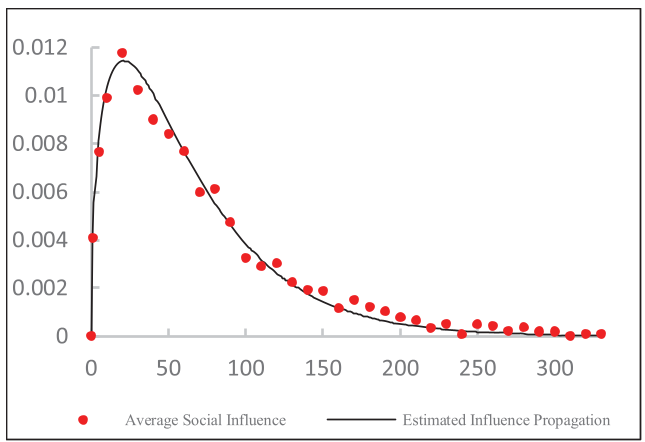 Figure: The Gamma distribution used to estimate the Periodic Time Effect (η) and Cumulative Effect (H).
Experiments: Predictive Power and Ranking
The researchers tracked 40 blue-chip stocks over six months, processing over 139,000 Weibo articles.
Key Finding 1: Social Attention Leads Price Shocks
The regression results showed that PCDSA is a significant predictor of abnormal returns for the upcoming 5 trading days. Interestingly, the relationship is asymmetric: social attention has a much stronger impact on positive price shocks than negative ones, likely due to short-selling restrictions in the Chinese market.
Key Finding 2: Superior Ranking Performance
The study framed price shock detection as a ranking problem: "Which stocks will experience the most extreme movements tomorrow?"
- PCDSA achieved an NDCG score significantly higher than simple post counts.
- The model remains stable across 11 different business sectors, proving it isn't just picking up "tech hype."
 Table: Comparison of NDCG scores showing PCDSA's superior ranking stability.
Critical Insight: The Return of the "Uninformed" Trader?
The study highlights a fascinating theoretical point: The positive correlation between attention and abnormal returns suggest that social media is dominated by uninformed (noise) traders. When they congregate around a stock, they push the price away from its fundamental value, creating the very "shocks" this model detects.
Conclusion
This paper provides a robust mathematical framework for quantifying "Social Attention." By moving away from simple sentiment analysis—which is often prone to linguistic noise—and focusing on Influence Topology, the authors provide a powerful tool for modern quantitative finance.
Future Work: As LLMs (Large Language Models) become better at parsing financial nuance, combining PCDSA’s structural influence modeling with deep semantic analysis could provide the "Holy Grail" of market trend prediction.