
PriGuardTool: Formalizing Privacy as a Semantic Commitment in Social Networks
PriGuardTool: A Tool for Monitoring Privacy Violations in Online Social Networks (Demonstration)
PriGuardTool is a Web-based multiagent monitoring system designed to detect privacy violations in Online Social Networks (OSNs) using a commitment-based semantic framework. It leverages OWL 2 ontologies and SPARQL queries to represent user privacy expectations and automatically identify breaches, even those resulting from hidden metadata like geotags.
TL;DR
PriGuardTool is a specialized monitoring interface that treats social media privacy not just as a set of toggles, but as a formal commitment between the platform and the user. By using semantic web technologies (Ontologies and SPARQL), it can detect "sneaky" privacy violations—such as a photo leaking your location via a geotag even when you've requested your location stay private.
Context & Positioning
Published in AAMAS '16, this work sits at the intersection of Multiagent Systems (MAS) and Privacy Engineering. While most social networks rely on static Access Control Lists (ACLs), PriGuardTool introduces a dynamic agent that represents the user, constantly auditing the environment to ensure the "social contract" of privacy hasn't been breached.
The Problem: Why Privacy Settings Aren't Enough
The authors identify a critical gap in Online Social Networks (OSNs). Privacy isn't just about who can see a post; it's about the information flow.
- User Error: Accidental public sharing.
- Co-privacy: A friend tags you in a post you'd rather keep private.
- Inference: Sharing a "medium" (like a photo) that contains "metadata" (like a geotag) which reveals "location."
Standard tools struggle with the last point because they don't "understand" that a Photo + Geotag = Location.
Methodology: The PriGuard Model
The core innovation is the use of Commitments. A commitment represents a promise. In this tool:
- Debtor: The Social Network (OSN).
- Creditor: The User.
- The Promise: "If user X is my friend, they should NOT be able to see my location."
System Architecture
The system workflow follows a clear pipeline:
- Domain (Ontology): Defining what "Friends," "Posts," and "Locations" are using OWL 2.
- Rules (Datalog): Defining how information spreads (e.g., "If you share a post, people can see it").
- Violation Statements: Converting these into SPARQL queries.
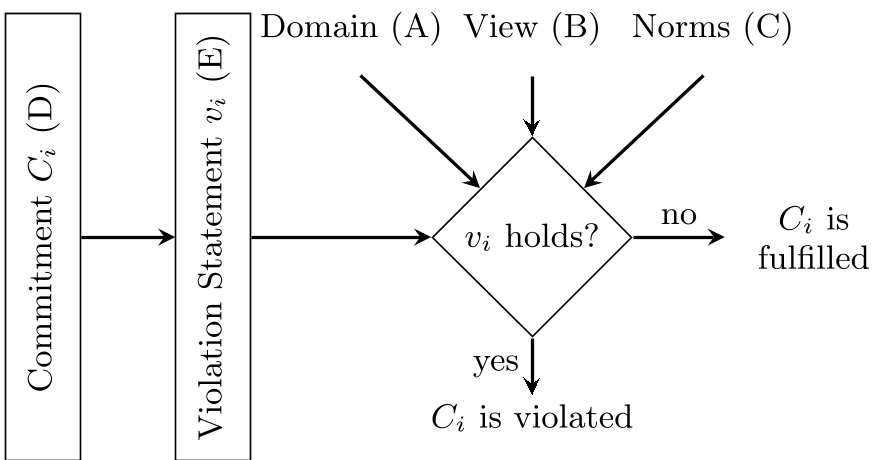 Figure 1: The PriGuard architecture showing the flow from Domain Knowledge to Violation Detection.
Implementation: Turning Logic into Action
How does a user actually use this? The PriGuardTool provides a Web interface where users define their "groups" and "concerns."
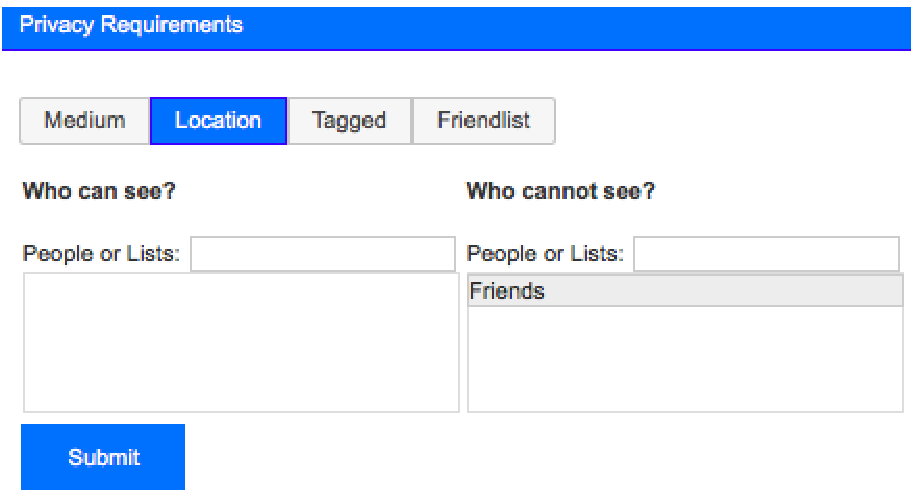 Figure 2: The interface allows users to declare specific prohibitions (e.g., "Friends cannot see my location posts").
When a conflict occurs—for instance, if a user accidentally puts a friend in both the "Allowed" and "Restriced" lists—the tool employs a conservative inductive bias: it defaults to the more restrictive setting to prevent accidental leakage.
Detection via SPARQL
When the system checks for violations, it runs queries like the one below:
sparql SELECT ?x ?p WHERE { ?x osn:isFriendOf osn:dennis . ?p osn:isAbout osn:dennis . ?p rdf:type osn:LocationPost . FILTER EXISTS {?x osn:canSeePost ?p} }
This query looks for cases where a friend can see a post that is semantically classified as a LocationPost, even if the user didn't explicitly tag it as such.
Experimental Insights
The demonstration showcased four real-life scenarios, specifically targeting inference-based violations. In the "Dennis" case mentioned in the paper, the tool successfully flagged a photo post because the underlying ontology recognized the hasGeotag property, linking the photo to the restricted LocationPost class.
Critical Analysis & Conclusion
Takeaway: PriGuardTool shifts the burden of privacy monitoring from the human to an automated agent that understands the meaning of data.
Limitations:
- Scalability: Running complex SPARQL queries and DL reasoning across millions of social media posts is computationally expensive.
- Global View: The tool assumes the agent has a "view" of the network, which might be limited by the very privacy APIs it tries to monitor.
Future Outlook: This work pre-dates the massive rise of Large Language Models (LLMs). A modern evolution of PriGuardTool would likely replace manual ontology building with LLM-based semantic parsing, allowing for even more nuanced detection of privacy breaches in natural language text.