
No "One-Size Fits All": Decoupling Incentive Structures in Mobile Crowdsourcing
No “One-Size Fits All” Towards a principled approach for incentives in mobile crowdsourcing
The paper "No 'One-Size Fits All': Towards a Principled Approach for Incentives in Mobile Crowdsourcing" presents a comparative study of incentive structures in mobile crowdsourcing. Through a 2-day experiment with 96 participants, it evaluates how Weighted Lottery and Micro-Payments independently affect recruitment, compliance, and user effort.
TL;DR
In the world of mobile crowdsourcing, developers often treat incentives (like money or points) as a magic bullet. However, this paper reveals that how you pay is just as important as how much you pay. By comparing Micro-Payments and Weighted Lotteries, the researchers found a striking trade-off: Lotteries are great for getting people through the door (Recruitment), but guaranteed Micro-Payments are far superior for getting them to actually do the work (Compliance).
Background: The Wild West of Incentives
Mobile crowdsourcing leverages our smartphones to sense everything from noise pollution to wireless signal strength. But there’s a catch: humans are fickle. If the incentive doesn't match the effort, the data dies. To date, most researchers have used incentives in an "ad-hoc" fashion—picking a reward system based on intuition rather than empirical evidence. This paper seeks to move toward a principled approach, treating incentive selection as a design requirement rather than an afterthought.
The Experiment: Tech Hunt
The authors staged a 2-day virtual scavenger hunt called "Tech Hunt" at a Microsoft Research conference.
- Day 1 (Micro-Payments): Users earned a guaranteed $5 for every 5 tasks.
- Day 2 (Weighted Lottery): Users earned one raffle ticket for a $50 prize for every 5 tasks.
The researchers tracked 96 participants using instrumented mobile devices to measure exactly how these financial structures altered their behavior.
Methodology & Architecture
The study focused on three "Success Pillars":
- Recruitment: Can we attract enough users?
- Compliance: Do they finish the tasks they start?
- User Effort: How much time and physical energy do they spend?
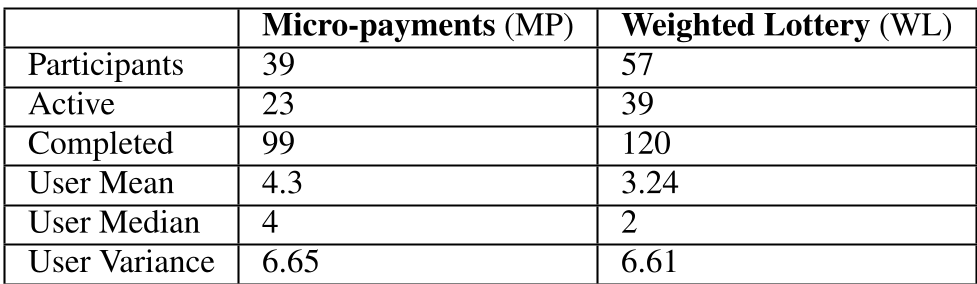 Table 1: The Weighted Lottery recruited 57 users vs. 39 for Micro-Payments, but the "productivity" per user shifted in the opposite direction.
Key Results: Quantity vs. Quality
The results exposed a fundamental divergence in user psychology based on the incentive structure:
1. The Lottery Hook
Weighted Lotteries are a recruitment powerhouse. The "lure of the big win" drove a 46% increase in total recruitment. For apps that only need a user to "show up" (like passive GPS tracking or background Wi-Fi scanning), lotteries provide the best ROI for growth.
2. The Micro-Payment Grind
While fewer people signed up for Micro-Payments, those who did were much more productive. The median task completion for Micro-Payments was 4, compared to just 2 for the Lottery.
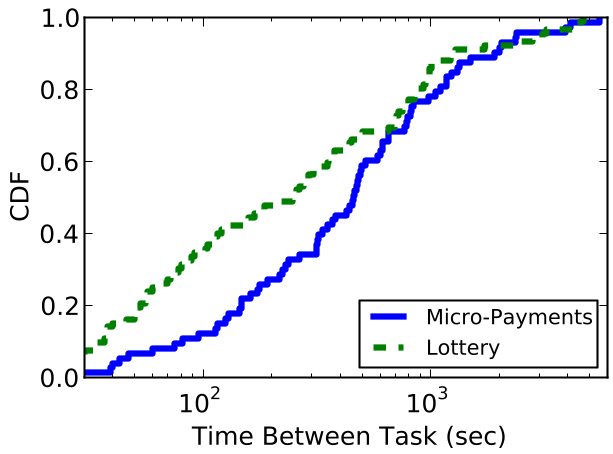 (a) Micro-Payment participants demonstrated longer active engagement windows, as shown in the CDF of active user sessions.
3. The ROI Surprise
Perhaps the most shocking finding for project managers is the cost efficiency. The Micro-Payment group produced nearly the same volume of data (82% of the lottery's total) but cost only 1000. The guaranteed nature of Micro-Payments seems to drive a higher "Return on Investment" for the publisher.
Deep Insight: Why the Difference?
The authors argue that the Weighted Lottery creates a "threshold effect." Once a user completes enough tasks to enter the pool (or feels their probability of winning is "good enough"), their motivation to continue drops off a cliff. Conversely, Micro-Payments provide a constant marginal utility—every additional set of tasks has a clear, guaranteed value, encouraging users to keep working until they hit the system's hard cap.
Critical Analysis & Conclusion
Takeaway
If your app requires active human effort (taking photos, scanning codes), go with Micro-Payments. If your app requires massive numbers of passive participants (traffic data, environmental sensing), a Lottery is your best bet to overcome the initial hurdle of user acquisition.
Limitations
The study was conducted in a corporate conference environment with a specific demographic (tech-savvy employees). User behavior might differ in less affluent or less technical populations. Furthermore, the "magnitude" of the rewards (raffle vs. coffee card) could play a role that the structure alone doesn't account for.
Future Outlook
This work serves as a foundation for a "Principled Approach." Future systems should be able to dynamically toggle incentive structures based on real-time needs—switching to lotteries when coverage is low and moving to micro-payments when data density/quality needs a boost.