
Priority Rank: A Unified Theory for Social Network Generation
Priority rank model for social network generation
The paper introduces the Priority Rank Model, a unified framework for social network generation that replaces rigid, hard-coded rules with a flexible ranking mechanism based on distance functions. By simply redefining the distance function, the model can replicate classic network types (Erdös-Rényi, Watts-Strogatz, and Barabási-Albert) and generate complex, realistic noise-inclusive networks.
TL;DR
Researchers have developed the Priority Rank Model, a versatile network generator that replaces specialized algorithms with a single, elegant mechanism: ranking potential neighbors by a flexible "distance" function. Whether you need a random network, a small-world graph, or a scale-free system, this model achieves it by simply changing how "distance" is defined, successfully bridging the gap between idealistic mathematical models and the messy reality of human social behavior.
The Rigidity Trap: Why Traditional Models Fail
For decades, researchers have relied on "Brand Name" models like Erdös-Rényi (ER) or Barabási-Albert (BA). While mathematically beautiful, these models are often "too perfect." They operate on hard-coded rules—like constant probability or strict preferential attachment—that fail to capture the noise, imbalance, and idiosyncratic choices inherent in human social interactions. In the real world, we don't pick friends based on a global coin toss; we pick them from a ranked list of suggestions, interests, or local contexts.
Methodology: The Power of Ranking
The core insight of the Priority Rank model is derived from Queuing Theory. Humans often use priority lists to cope with information overload. The authors translate this into a three-step generative process:
- Distance Calculation: Define a distance function (this can represent physical distance, similarity in taste, or even social status).
- Ranking: For a new vertex, rank all existing vertices from "closest" to "farthest."
- Probabilistic Selection: Select a neighbor where the probability is inversely proportional to its rank : .
The Universal Generator
The beauty of this approach is its universality. By changing the distance function, the model "morphs" into different classical architectures:
- Random Distance Erdös-Rényi (Random Graph).
- Attribute/Euclidean Distance Watts-Strogatz (Small World).
- Inverse Degree Distance Barabási-Albert (Preferential Attachment).
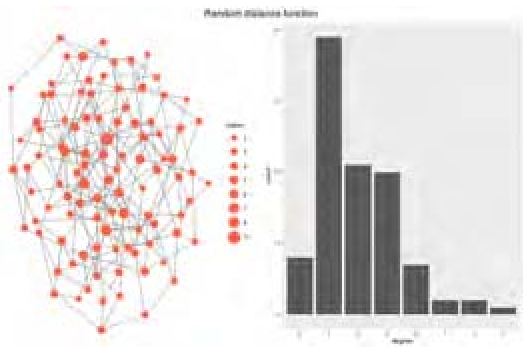 Figure 1: Visual comparison of networks generated by (a) Random, (b) Attribute-based, and (c) Degree-based distance functions.
Experiments: Proving the Mimicry
The authors validated their model by comparing four key centrality measures: Degree, Closeness, Betweenness, and Clustering Coeffecient.
As shown in the comparison plots below, the Priority Rank model (right-hand panels) tracks the classical models (left-hand panels) with remarkable accuracy. Specifically, in the Preferential Attachment simulation, the Priority Rank model replicated the degree and betweenness distributions of the Barabási-Albert model almost perfectly, proving that global "hubs" can emerge naturally from simple local ranking rules.
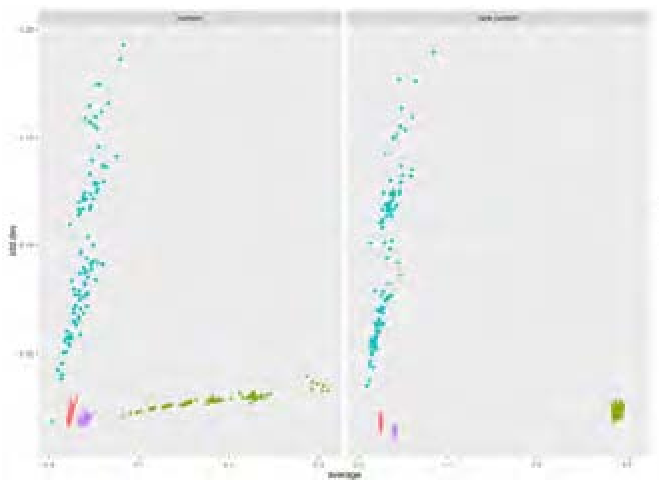 Figure 2: Statistical comparison between original models (left) and the Priority Rank model (right).
Deep Insight: Why It Matters
The Priority Rank model is more than just a "Swiss Army Knife" for graph generation. It provides a theoretical bridge. It suggests that the diverse structures we see in social networks aren't necessarily caused by different mechanical rules, but by the same cognitive process—ranking—applied to different types of "social distance."
Limitations and Future Work
While promising, the current study is a "preliminary introduction."
- Scalability: The experiments were conducted on small networks (). Whether the harmonic normalization holds efficiently for millions of nodes remains to be seen.
- Real-world Fitting: The next frontier is "inverse modeling"—given a real dataset from X (formerly Twitter) or Facebook, can we discover the latent distance function that produced it?
Conclusion
By moving away from hard-coded topologies and toward a distance-agnostic ranking framework, the Priority Rank model offers a more robust foundation for simulating the complexity of human society. It reminds us that in the digital age, our social structures are increasingly defined by the algorithms that rank our suggestions—and this model gives us a tool to study that influence.