
Social Media Aggregators: The Invisible Privacy Trap in Your Pocket
A Privacy Assessment of Social Media Aggregators
This paper presents a comprehensive privacy assessment of 13 popular Social Media Aggregators (SMAs) across Google Play, iTunes, and Cydia. It introduces a three-step methodology—examining data permissions, auditing privacy policies, and mapping traceability—to identify significant gaps in transparency and user control within apps that consolidate multiple social network accounts.
TL;DR
Social Media Aggregators (SMAs)—apps like Hootsuite or Buffer that let you manage multiple social accounts in one place—are convenient but carry massive hidden privacy risks. This paper reveals that a large portion of these apps lack privacy policies, and even when they have them, there is a "broken" link between what they say they do and the controls they actually give you. 45% of the data actions studied were completely invisible and uncontrollable by the user.
Background: The Consolidation Crisis
Most users today are "socially fragmented," maintaining active profiles across Facebook, Twitter, LinkedIn, and more. SMAs solve the friction of switching apps and save phone resources (RAM, battery). However, while a Facebook app usually can't see your Twitter activity, an SMA sees everything. This work is a crucial "reality check" in the academic coordinate system of mobile security, shifting focus from single-app permissions to the dangers of data concentration.
The "Broken" Trust: Methodology
The authors didn't just look at what permissions the apps asked for; they performed a Traceability Analysis. They broke down the privacy policies into 14 "implications" across four categories: Collection, Purpose, Access, and Retention.
They then checked if the app's interface actually showed these actions (Transparency) and if it allowed the user to stop them (Control).
Mapping the Disconnect
- Complete Mappings: The interface clearly explains the data use and provides a toggle.
- Partial Mappings: Vague terms like "personal information" are used, or only some data can be controlled.
- Broken Mappings: The policy says it collects data (like "Server Logs" or "Traffic Data") but the app gives the user zero visibility or choice.
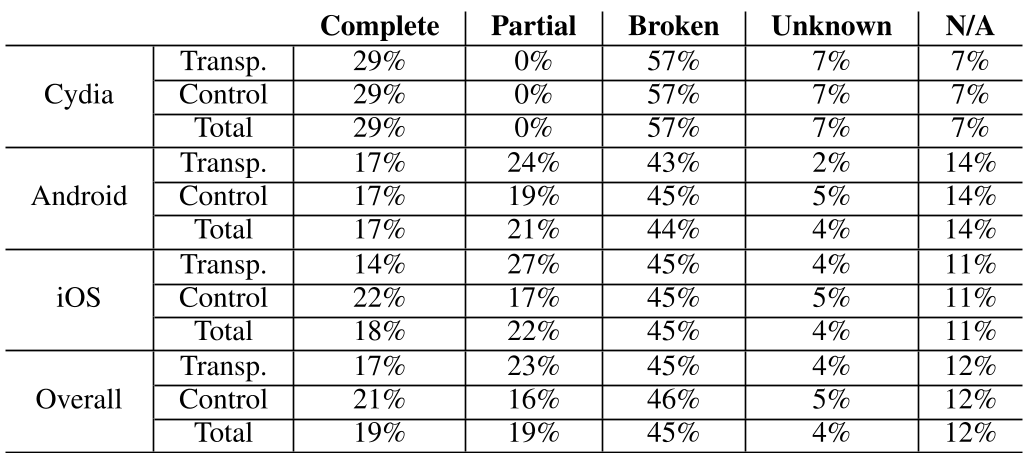 Figure 1: Summary of traceability findings showing the high percentage of 'Broken' mappings across platforms.
Key Insights from the Data
1. The Policy Vacuum
Despite app store rules, 5 out of 13 SMAs had no privacy policy at all. While they might claim they don't access "Identity" data, the research shows they still access photos, location, and social activity—data that is undeniably personal.
2. Social Media Permission Overreach
SMAs often act as a man-in-the-middle. Some apps (marked with a '*' in the study) didn't even disclose what social data they were accessing because they simply embedded a web browser view, essentially granting the app the ability to "see" every click and message within that frame.
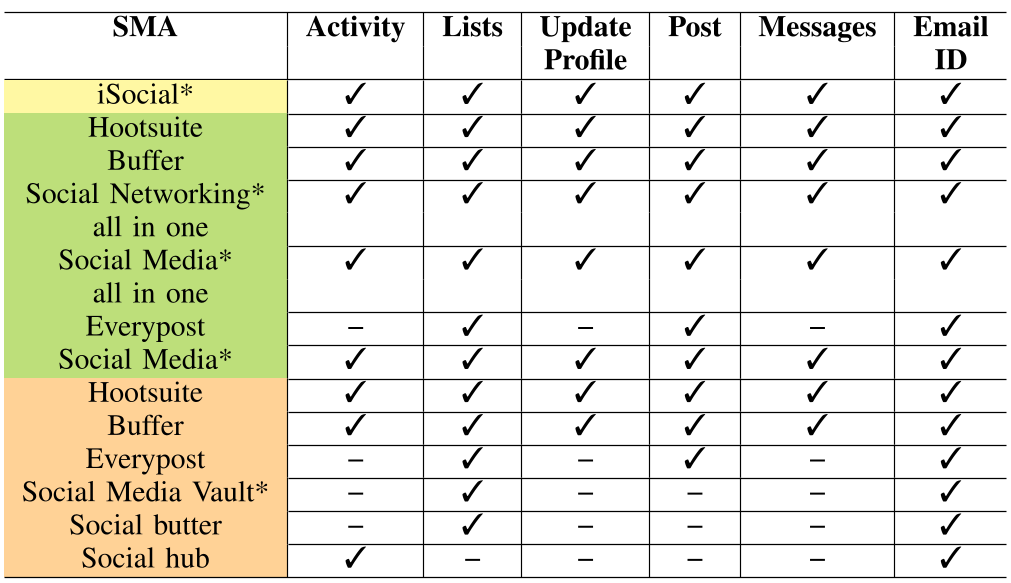 Figure 2: Analysis of the specific social media data types (Activity, Lists, Messages) accessed by various SMAs.
3. The Traffic Data Loophole
One of the most concerning findings is "Traffic Data" (IP addresses, device IDs, browser types). Almost all SMAs collect this for "internal use" or "advertising," but because it's labeled as "non-identifiable," it is almost never transparent or controllable in the user interface.
Critical Analysis & Future Outlook
The paper effectively argues that current app store vetting is a "toothless tiger." Even the "mature" apps like Hootsuite, which perform better than their peers, still operate with ambiguous traceability for internal data usage.
Takeaways for the Industry:
- Automated Consistency: Developers need tools like AutoPPG to automatically generate privacy policies based on their code to ensure they stay compliant.
- Beyond All-or-Nothing: Mobile OS developers (Google/Apple) must move away from "all-or-nothing" permissions. We need granular controls that let users use an SMA for posting without necessarily letting it track their location or contacts.
- Institutional vs. Social Privacy: While this paper focuses on Institutional Privacy (how companies use data), future work must look at Social Privacy—how these aggregators might accidentally leak data between your different social circles.
Conclusion
This assessment is a wake-up call. When we choose convenience through aggregation, we often unknowingly trade away a holistic view of our digital footprint. Until developers bridge the gap between their legal "fine print" and their "UI toggles," users should treat Social Media Aggregators with significant caution.