
PAFR: Balancing Friendship Discovery and Absolute Privacy in Social Networks
PAFR: Privacy-Aware Friends Retrieval over Online Social Networks
This paper proposes PAFR (Privacy-Aware Friends Retrieval), a novel scheme designed for Online Social Networks (OSNs) that enables users to securely retrieve and rank friends based on profile keywords. By leveraging a dual-server model and homomorphic encryption, it achieves state-of-the-art privacy for identities, content, and friend closeness without sacrificing search functionality.
TL;DR
Online Social Networks (OSNs) face a fundamental paradox: users want to find friends based on shared interests (profiles), but sharing these profiles with service providers leads to massive privacy leaks. PAFR (Privacy-Aware Friends Retrieval) solves this by introducing a dual-server model where one server manages the "who" and the other manages the "what," ensuring that neither can see the full picture. It allows users to search and rank friends by "closeness" while keeping profiles, identities, and relationship strengths fully encrypted.
Context: The Privacy Crisis in Modern OSNs
From the Cambridge Analytica scandal to localized data breaches, the centralized nature of OSNs makes them prime targets for "honest-but-curious" service providers or malicious attackers. Traditional solutions like searchable encryption (SE) struggle in social contexts because they typically handle single-user databases. When multiple users with different keys are involved, standard SE protocols often lead to "collusion leakage"—where a single compromised friend can expose the entire network's search patterns.
Methodology: The Core Innovations
The genius of PAFR lies in its architectural decoupling and its specific use of cryptographic primitives to handle the multi-key problem.
1. The Dual-Server Model
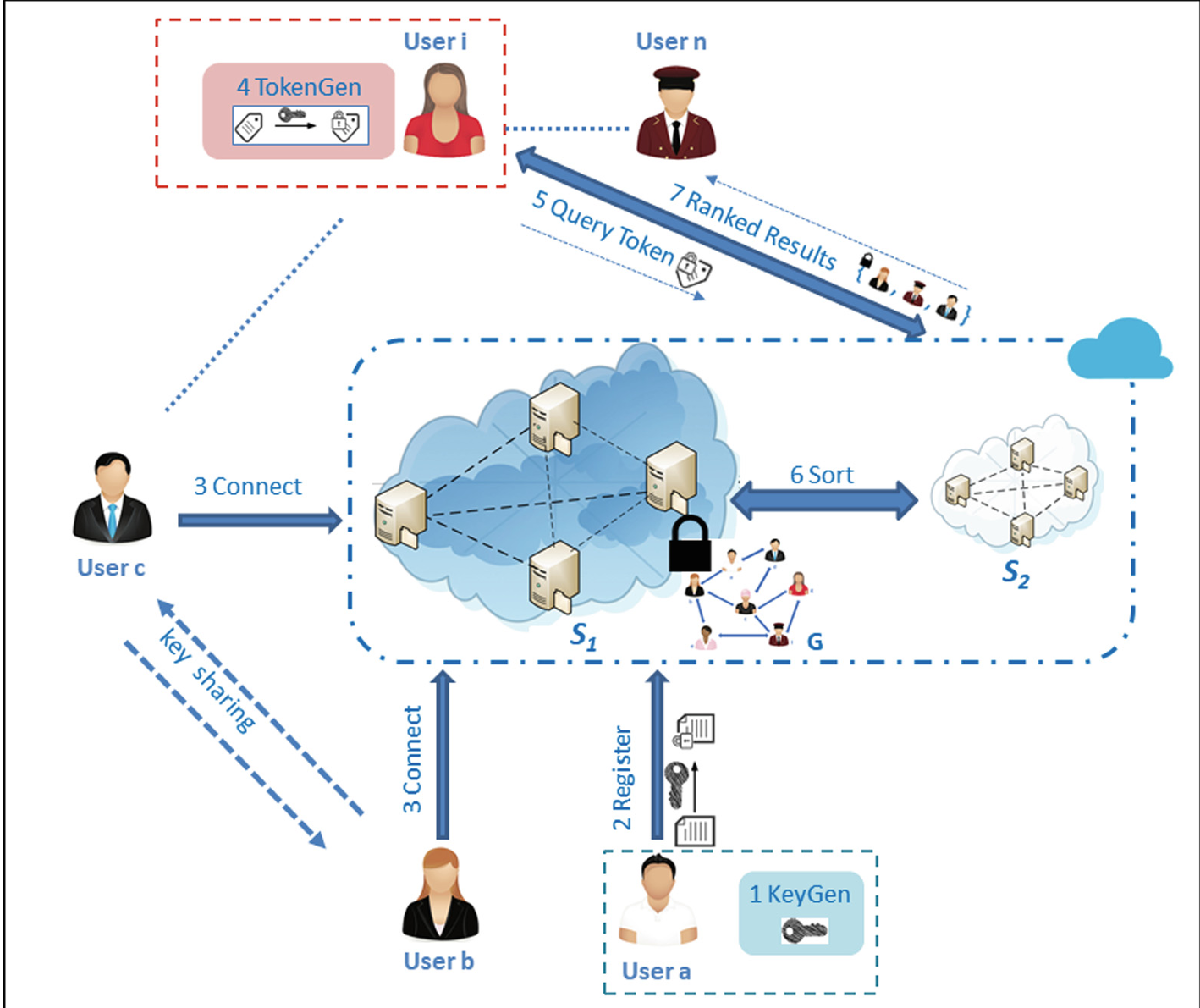
Instead of one "God-mode" server, PAFR splits the load:
- Server 1 (S1): Stores the global graph and homomorphic public keys. It acts as the "Identity & Structure" keeper.
- Server 2 (S2): Acts as a proxy, storing encrypted profile "tokens" and individual friendship sub-graphs.
By keeping these two non-colluding, the system ensures that S1 knows the social connections but not the profile content, while S2 sees the search matches but doesn't know which global user they belong to.
2. Oblivious Friend Connection
When Alice adds Bob, the system performs a profile transformation. Using a logic similar to the Diffie-Hellman-based Private Set Intersection (PSI-DH), Bob's encrypted profiles are transformed into a version specifically searchable by Alice. This prevents the "token collusion" problem found in previous multi-key searchable encryption schemes.
3. Secure Ranking via EncSort
Finding a friend isn't enough; we often want the closest friend. However, "closeness" values are sensitive. PAFR utilizes Paillier Homomorphic Encryption and a protocol called EncSort.
- The Problem: How do you sort numbers you can't see?
- The Solution: S1 and S2 interactively sort the encrypted closeness values. They use a Batcher's Sorting Network where comparisons are made using homomorphic subtractions and blinding factors. S1 (holding the secret key) helps evaluate results without ever seeing the actual closeness scores or the friend IDs being moved.
Performance and Security Analysis
The authors provide a rigorous security proof under the Adaptive L-Semantically Secure framework. This means that as long as the underlying math (DDH problem, Paillier's CPA-security) holds, the amount of information leaked to the servers is mathematically bounded.
Key Experimental Findings:
- User Efficiency: Most of the heavy lifting is offloaded to the servers. The user only performs a light O(q) operation for query generation.
- Accuracy: Unlike schemes using Locality Sensitive Hashing (LSH) or Bloom Filters, which have false positives, PAFR offers 100% accurate ranking because it operates on exact encrypted values.
- Ranking Overhead: The sorting phase takes rounds. While this is a slight increase over non-secure sorting, the parallelization capabilities of the dual-server model make it highly practical for modern hardware.

Critical Insight & Future Outlook
PAFR successfully navigates the "Multi-Key Search" bottleneck. The shift from a single-server trust model to a dual-server collaborative model is a robust design pattern that reflects the industry's move towards "Zero-Knowledge" infrastructure.
Limitations: The current model assumes servers S1 and S2 do not collude. In a real-world adversarial environment, a stronger model (Malicious Adversary) might be required, where servers could potentially feed false data during the sorting process.
Conclusion: PAFR provides a blueprint for the next generation of privacy-first social networks. By combining homomorphic encryption with smart architectural divisions, we can finally have a social world that is both connected and truly private.