
Scaling Privacy: Bridging Semantic Web and PubSub for Distributed Networks
Privacy-Aware and Scalable Content Dissemination in Distributed Social Networks
The paper introduces a privacy-aware extension to Google’s PubSubHubbub (PuSH) protocol for Distributed Social Networks (DSN). By integrating Semantic Web technologies like RDF, SPARQL, and the Privacy Preference Ontology (PPO), it enables fine-grained, dynamic content dissemination while maintaining the scalability of a decentralized publish-subscribe architecture.
TL;DR
The paper tackles the dual challenge of scalability and privacy in Distributed Social Networks (DSNs). By extending Google's PubSubHubbub (PuSH) protocol with Semantic Web technologies (RDF, SPARQL, PPO), the authors created a system where users can broadcast content to dynamically defined subsets of their network. This allows for fine-grained privacy without the management overhead of static groups.
Context: The Decentralization Dilemma
As users migrate from centralized behemoths like Twitter or Facebook to decentralized alternatives (SMOB, Diaspora, Mastodon), they encounter a trade-off. Centralized systems offer ease of use but "own" user data. Decentralized systems provide ownership but often lack the sophisticated, fine-grained privacy controls users expect.
Prior to this work, DSNs mostly relied on simple "public" vs. "protected" settings. If a user wanted to share a post only with "Project X members," they would have to manually maintain lists—a process that doesn't scale as social graphs grow and evolve.
The Core Insight: The "Semantic Hub"
The authors' "Aha!" moment was realizing that PubSubHubbub is excellent for scale but "privacy-blind." By turning the Hub into a Semantic Hub, it can act as an intelligent filter.
1. The Distributed Social Graph (SSG)
Instead of a simple database of subscribers, the Semantic Hub maintains a graph based on FOAF (Friend of a Friend) profiles. When a user subscribes, the Hub fetches their FOAF data via WebID, building a rich map of interests and relationships.
2. SPARQL-as-a-Policy
Instead of checking a checkbox, a publisher defines an Access Space using a SPARQL query.
- Example Query:
SELECT ?user WHERE { ?user foaf:interest dbpedia:SemanticWeb } - This query is embedded directly into the RSS/Atom feed.
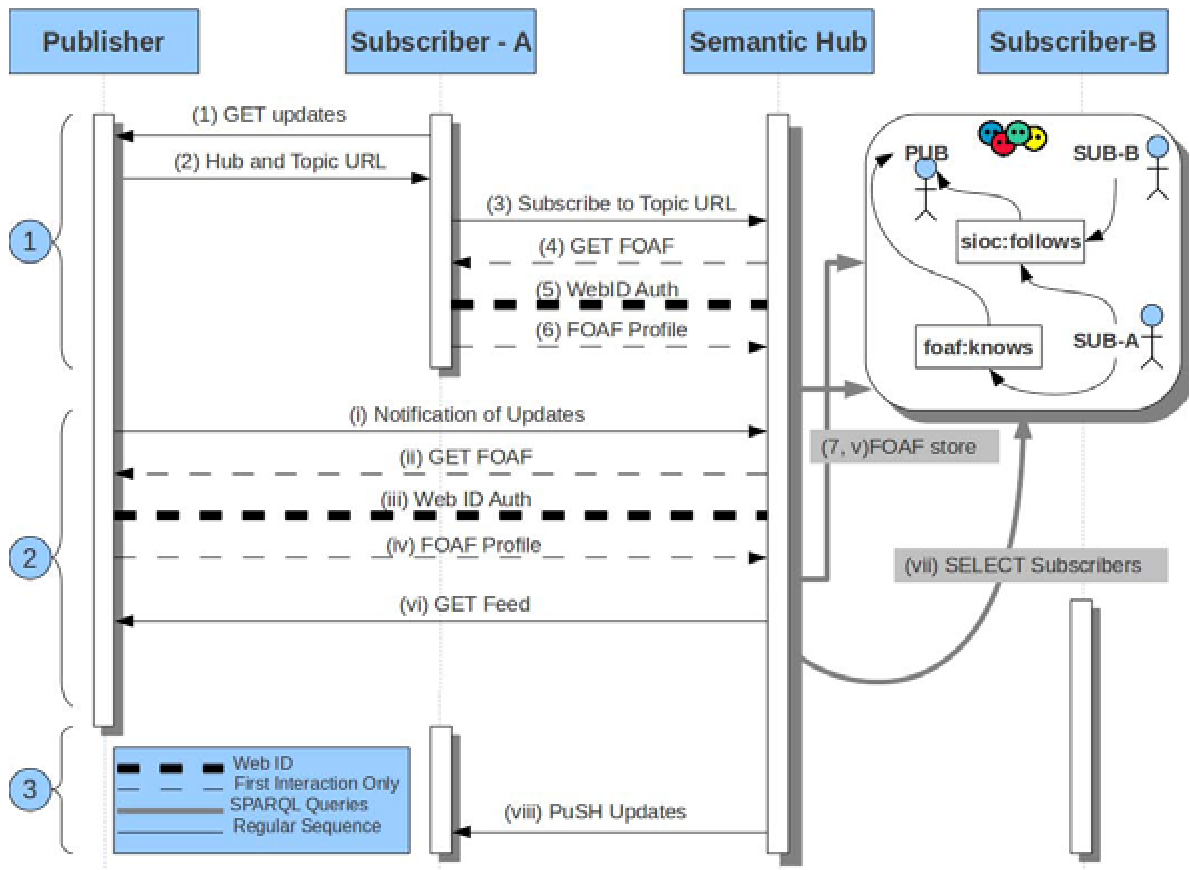 In this architecture, the Semantic Hub fetches the feed, extracts the SPARQL privacy rule, and filters the subscriber list in real-time.
Methodology: From Feed to Filtered Push
The process follows a clean, four-step lifecycle:
- Subscription: Users authenticate via WebID; the Hub caches their profile in a Triple Store.
- Publication: The publisher creates a post and attaches a PPO (Privacy Preference Ontology) rule.
- Extraction: The Hub receives an update notice, pulls the feed, and parses the
<privacy>element. - Dissemination: The Hub executes the SPARQL query against its social graph. It pushes the content only to those who match, stripping out the privacy metadata to ensure the rules themselves remain private.
Use Case: Semantic Microblogging (SMOB)
The authors integrated this into SMOB, a microblogging environment. They simplified the complex SPARQL generation through a user-friendly GUI. Users can tag posts with "semantic hashtags" (liked to Linked Open Data) and set rules like: "Only share posts tagged #RDF with followers interested in Semantic Web."
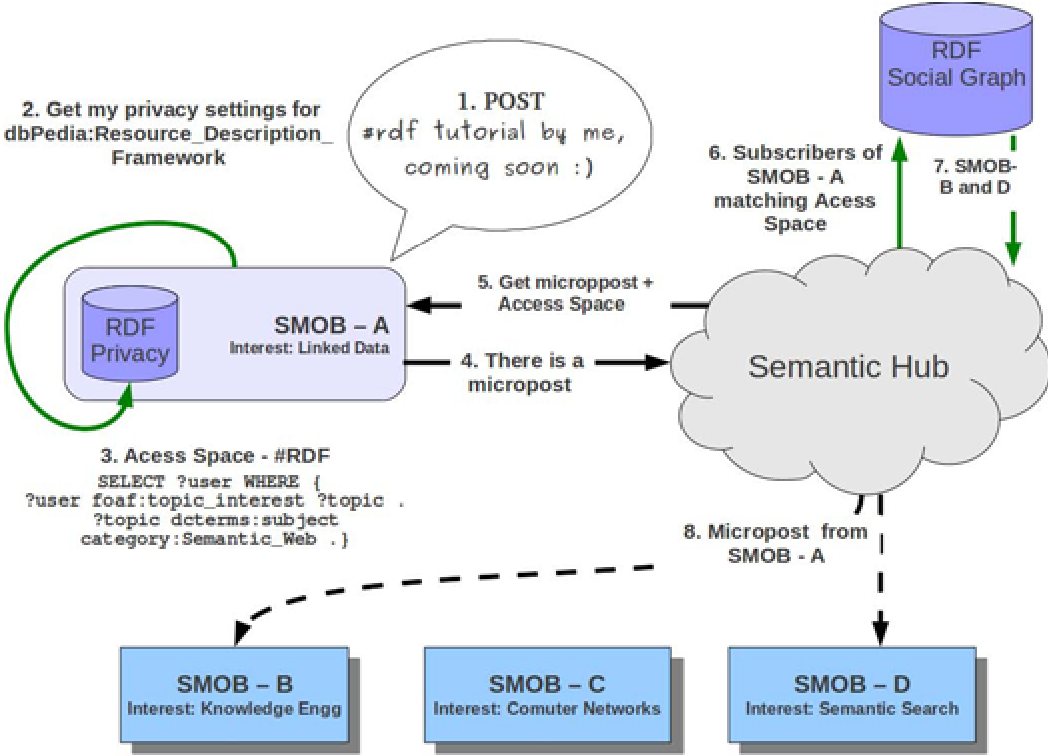 The implementation demonstrates how social interactions like 'following' are mapped to PuSH subscriptions and SIOC accounts.
Critical Insight & Results
The beauty of this approach lies in its Inductive Bias: the privacy is based on attributes rather than identities. If a new follower joins and lists "Semantic Web" as an interest, they automatically begin receiving relevant private posts without the publisher lifting a finger.
Key Results:
- Automation: Reduced user burden by automating group management through dynamic queries.
- Interoperability: By using standardized vocabularies (SIOC, FOAF, PPO), the system remains application-agnostic.
- Efficiency: The overhead of running SPARQL queries was negligible compared to the network latency of the "push" operations.
Conclusion and Limitations
While the paper successfully bridges the gap between Web 2.0 pragmatism and Semantic Web depth, it acknowledges a few hurdles. Most notably, the "Semantic Hub" is a point of trust—it must see the social graph to filter it. Future work implies moving toward mobile-first and sensor-data (GPS) dissemination, where the challenge of intermittent connectivity will test the limits of the PubSub model.
Ultimately, this work moves us closer to a "Privacy-by-Design" Social Web, where our data is shared intelligently, not just distributed blindly.