
Graph Privacy: Why Removing Your Name is Not Enough in the Social Web
Privacy challenges and solutions in the social web
This paper provides a comprehensive taxonomic overview of privacy vulnerabilities in social network data publication, categorization of attacks into identity, link, and content disclosure, and an evaluation of anonymization techniques such as random perturbation and k-anonymity.
TL;DR
Modern social networks are goldmines for researchers and marketers, but releasing this data "safely" is a mathematical minefield. This paper explores why simply removing names (de-identification) fails against structural attacks and reviews advanced graph-anonymization techniques—like edge perturbation and k-anonymity—to protect our digital footprints.
The "Anonymity" Illusion
Most users assume that if a social network removes their name, phone number, and ID from a dataset, their privacy is protected. The reality is far more sinister. Because social networks are modeled as graphs (nodes for people, edges for friendships), your unique "social fingerprint"—the specific pattern of who you know and how many friends they have—is often enough to identify you in a crowd of millions.
The Taxonomy of Disclosure
The researchers categorize privacy threats into three distinct tiers:
- Identity Disclosure: An attacker knows you have exactly 4 friends. They look for a node in the "anonymous" graph with a degree of 4. If only one exists, you are caught.
- Link Disclosure: Even if your identity is hidden, the fact that two people are connected might be sensitive (e.g., a whistleblower talking to a journalist).
- Content Disclosure: Combining structural data with demographic "labels" (age, zip code) to triangulate a user's identity.
The Structural Fingerprint
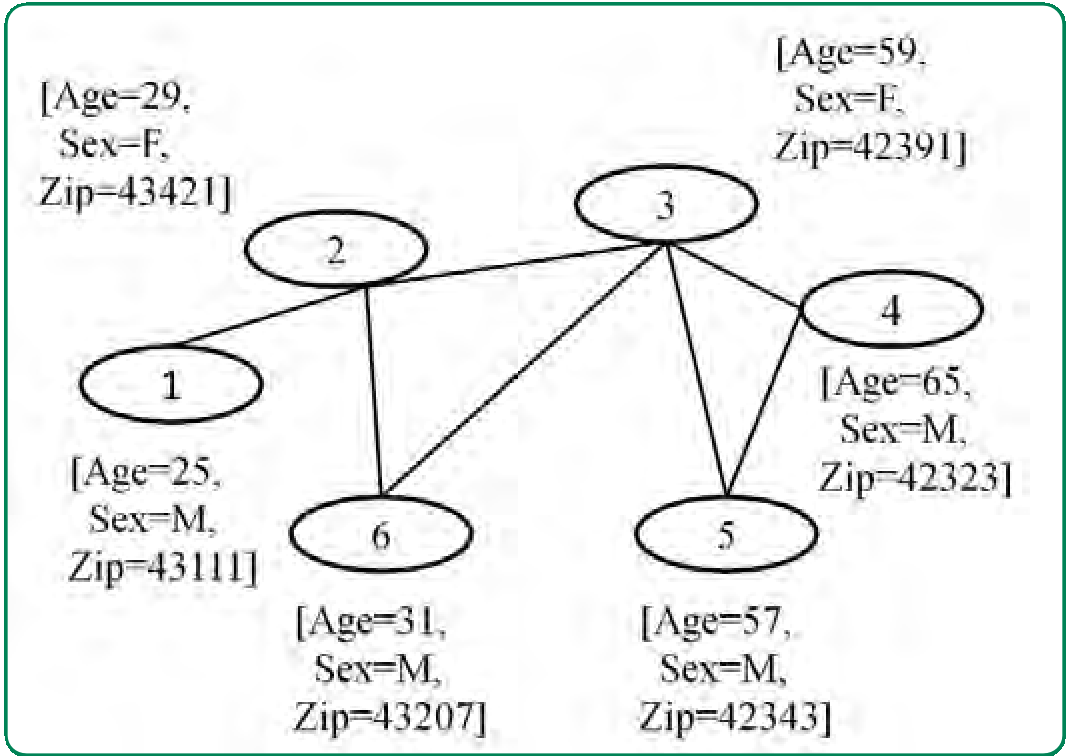 Figure 1: Even after removing names (b), the unique connections of "Brad" or "Mary" make them identifiable if the attacker has external knowledge of their friend counts.
Methodology: How to Break a Graph to Save Privacy
The paper reviews several "surgical" modifications to graph data that aim to confuse attackers without destroying the value of the data for researchers.
1. Random Perturbation
This involves adding or deleting edges ( edges) to change the graph's structure. If an attacker looks for a person with 10 friends, but the algorithm has randomly added 2 more, the "fingerprint" no longer matches.
- The Insight: By injecting "noise" into the topology, we create a set of "possible" original graphs, making it impossible for an attacker to be certain of a match.
2. K-Anonymity and Grouping
Instead of individual nodes, the algorithm groups users into "supernodes."
- The Goal: Ensure that for any individual node, there are at least other nodes that look identical in terms of their degree or neighborhood structure.
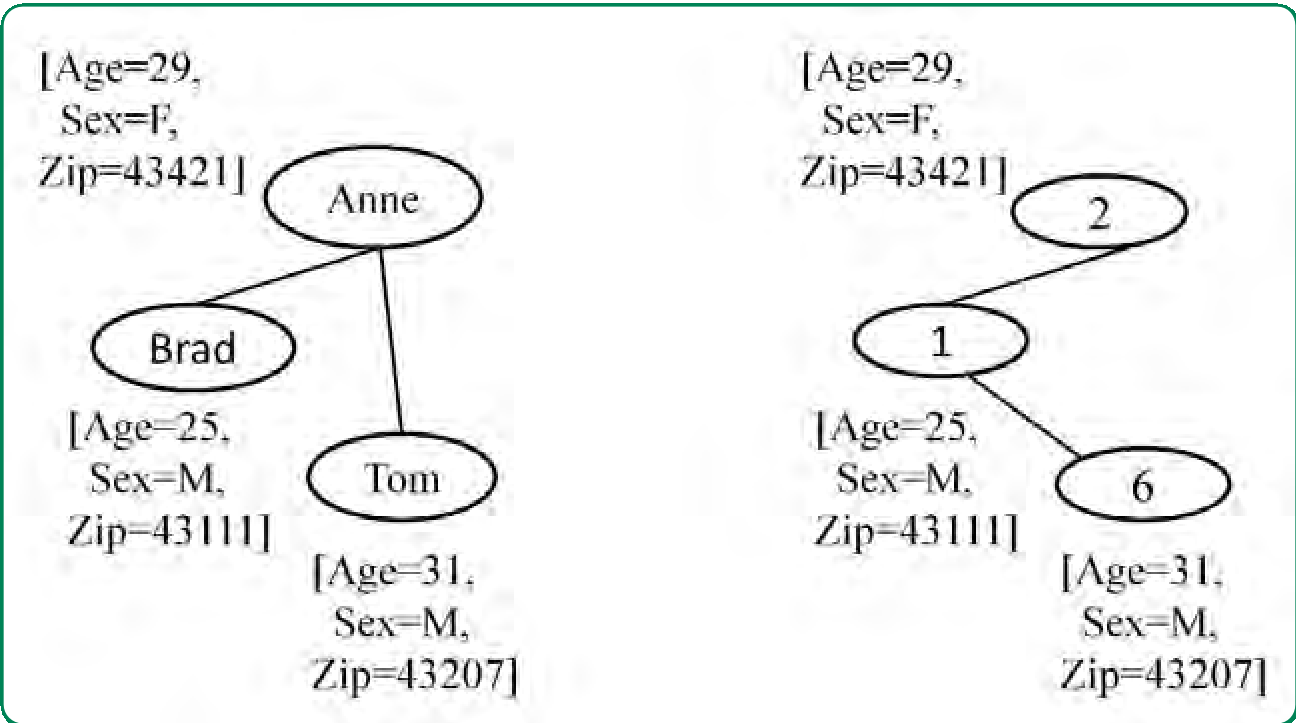 Figure 2: By deleting the edge between Anne and Tom and adding one between Brad and Tom, the attacker can no longer distinguish Anne from other users.
Experimental Reality Check
The paper cites alarming results from real-world datasets like LiveJournal. In "Passive Attacks," creating just seven fake accounts allows an attacker to compromise approximately 2,400 friendship links. Even more concerning, "bribing" a tiny fraction of users (0.006%) can reveal the immediate relationships of 80% of the entire network.
Conclusion: The Path Forward
The core takeaway is that relational privacy graph privacy. While we have mastered protecting rows in a table (k-anonymity), protecting nodes in a complex, evolving graph is much harder.
Future Outlook: The industry is moving toward "Privacy-Preserving Data Publication" (PPDP) that doesn't just mask data but generates synthetic graphs that share the statistical properties of the original without the individual identity risks. As social networks become more dynamic, our privacy algorithms must move faster than the hackers trying to deanonymize us.