
Towards Privacy in Context-Aware Recommendation Systems: A Hierarchical Approach
Towards Privacy in a Context-Aware Social Network Based Recommendation System
The paper proposes a hierarchical privacy architecture for "Instant Knowledge" (IK), a context-aware social recommendation system for enterprises. It utilizes a decentralized structure of IK nodes to provide anonymity, unlinkability, and pseudonymity while matching knowledge seekers with providers.
TL;DR
In the modern enterprise, "who you know" and "what you are doing" are valuable data points for recommendation engines. However, this context-awareness is a privacy nightmare. This paper introduces a hierarchical architecture that uses decentralized nodes and transaction pseudonyms to shield user identities, ensuring that the further away a requester is in the organization, the less they know about the specific identity of the knowledge provider.
The Tension Between Context and Privacy
The "Instant Knowledge" (IK) system is designed to harvest both explicit and implicit knowledge—location, current applications, and roster ties—to find the perfect expert for a specific query.
The fundamental problem is one of Linkability. If a central service knows that "User A" is an expert in "Smart Grids" and is currently at "Location X," an attacker can easily de-anonymize the user or track their habits. The authors argue that privacy isn't just a binary "on/off" switch but a gradient influenced by the social and organizational distance between actors.
Methodology: The Hierarchical Privacy Shield
The core of the solution is a tree-like hierarchy of IK nodes. Instead of a single central server, the system distributes the recommendation and data collection logic.
1. Data Aggregation & Proportional Distance
As data moves up the hierarchy (from local nodes to the root), it is systematically aggregated.
- Local Level: Within a small department, users might be willing to share more.
- Higher Levels: As data moves to the "Root Node," individual identities are replaced by group identifiers. A tie vector between two users becomes a tie vector between two departments.
2. Transaction Pseudonyms (Transaction Pseudonymity)
During a Knowledge Provider (KP) request, the IK nodes do not return real names. Instead, they provide a set of Transaction Pseudonyms.
- If a user targets a "distant" group, they only see a pseudonym representing that group.
- The actual mapping to a specific human only happens at the last possible second when the query is routed back down the hierarchy to the local node.
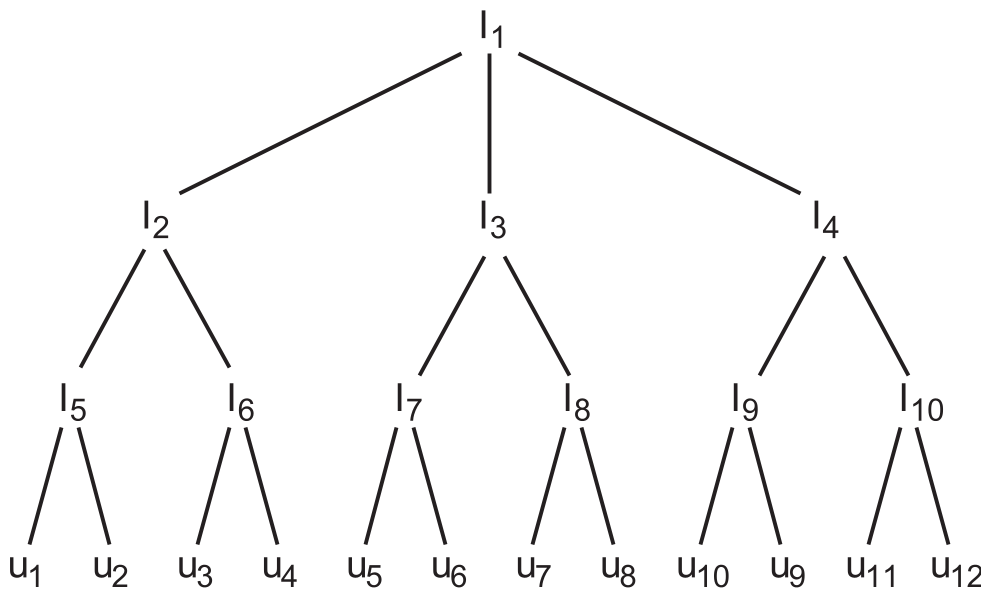 Figure 1: The hierarchical structure showing how users (u) are managed by local nodes (I) which aggregate data upwards.
Why This Approach Works
The beauty of this architecture lies in its Inductive Bias toward organizational structure:
- Robustness against Compromise: To unmask a user, an attacker must compromise every single IK node along the path between the requester and the provider. A single local compromise only exposes that specific cluster.
- Dynamic Flexibility: Distant groups stay "blurry." The system doesn't pick a specific person until the query is actually sent, allowing the system to adjust to who is currently online or available without constantly updating a central, privacy-leaking database.
Critical Analysis & Conclusion
Takeaway
The paper shifts the focus from "preventing data collection" to "controlling data use at the point of recommendation." By aligning privacy strength with organizational distance (Proportional Distance Reservation), it achieves a "Privacy by Default" state without sacrificing the utility of a context-aware system.
Limitations
- Latency: Routing queries and replacing pseudonyms at every hop in a deep hierarchy introduces computational and network overhead.
- Inference Attacks: While identities are hidden, the "Recommendation Metric" itself could potentially leak information if an attacker sends multiple targeted queries to see how metrics change.
Future Outlook
As we move toward more decentralized "Edge AI," the principles found in this IK architecture—specifically the use of hierarchical nodes to aggregate and pseudonymize context—will be vital for building trustworthy enterprise assistants that don't act as corporate spyware.