
PDM: Evaluating the Invisible Borders of Social Media Stories
Privacy Evaluation of Online Social Network Stories Feature: An Empirical Study with PDM
This paper presents an empirical evaluation of the Privacy Design Model (PDM), a framework designed to assist OSN designers in modeling user-to-system privacy discourse. The study evaluates the PDM's efficacy through prospective designers' analysis of the "Stories" feature in Facebook, Instagram, and WhatsApp.
Executive Summary
In the evolving landscape of Online Social Networks (OSNs), the introduction of "ephemeral" content—like the Stories feature found on Instagram, Facebook, and WhatsApp—has introduced new complexities for user privacy. This paper evaluates the Privacy Design Model (PDM), an epistemic framework aimed at helping designers understand and communicate privacy requirements.
Positioning: This work is an empirical extension of the PDM, moving beyond theoretical validation to test its practical utility and usability among prospective designers (computer science students). It bridges the gap between Human-Computer Interaction (HCI) and functional privacy management.
Problem & Motivation
Why do users often find their privacy compromised even when they think they've configured their settings correctly? The authors argue the fault lies in the Designer-to-User Discourse. Existing systems often rely on privacy models that do not align with human intuition or communication patterns.
Drawing on Altman’s Privacy Regulation Theory and Petronio’s Communication Privacy Management, the paper posits that privacy isn't just a "locked door" (security) but a dynamic "negotiation of boundaries" (communication). The authors identified a need to test if the PDM could actually help designers identify these subtle communication failures in modern, fast-paced media sharing features like "Stories."
Methodology: The PDM Framework
The core of the PDM rests on eight dimensions that define the "privacy state" of any shared information. The study tasked 12 participants with evaluating three major platforms using these dimensions:
- Source of Information: Who triggers the share?
- Communication Space: Where does the data live (Profile, Public, or User-specific)?
- Indivudal’s Information: Broken down into Expression (free text/media vs. predefined) and Content (degree of personality).
- Temporal Persistence: Is the data permanent or ephemeral (limited)?
- Audience: Who can see it?
- Notification: Does the system tell the user when others interact with their data?
- Discourse: Does the system highlight or initiate info sharing?
- Dissemination: Can others re-share the data?
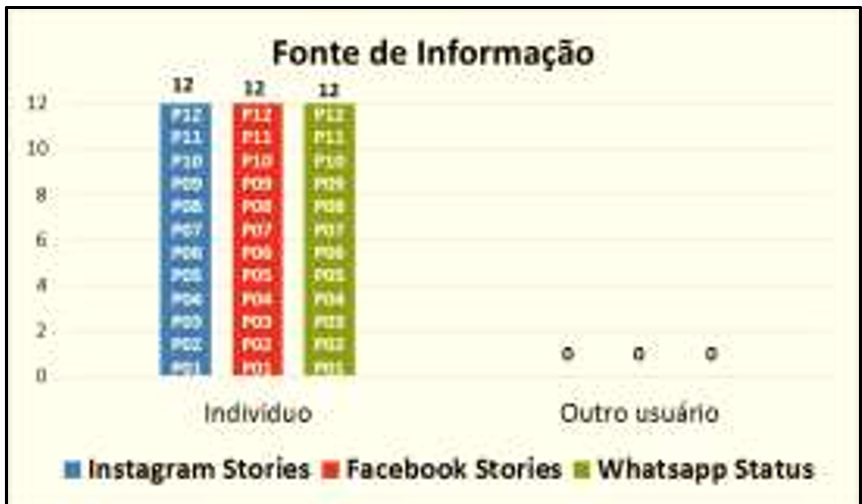 Figure: The distribution of participant assessments for the 'Source' dimension, showing high clarity in user-initiated sharing.
Key Results & Insights
The study utilized the Technology Acceptance Model (TAM) to measure two critical metrics: Perceived Ease-of-Use (PEOU) and Perceived Usefulness (PU).
The Semantic Ambiguity Challenge
The results revealed a fascinating disconnect. While participants agreed on the "Source" (Figure 1), they diverged significantly on Communication Space and Discourse.
- The "Stories" Paradox: For "Discourse," many participants associated "Highlight" with the UI placement (top of the feed) rather than the system's initiative to share info.
- Notification Gaps: Participants noted that while apps claim "complete" notification, they fail to notify users of hardware-level actions like screenshots, which technically bypasses the app's privacy controls.
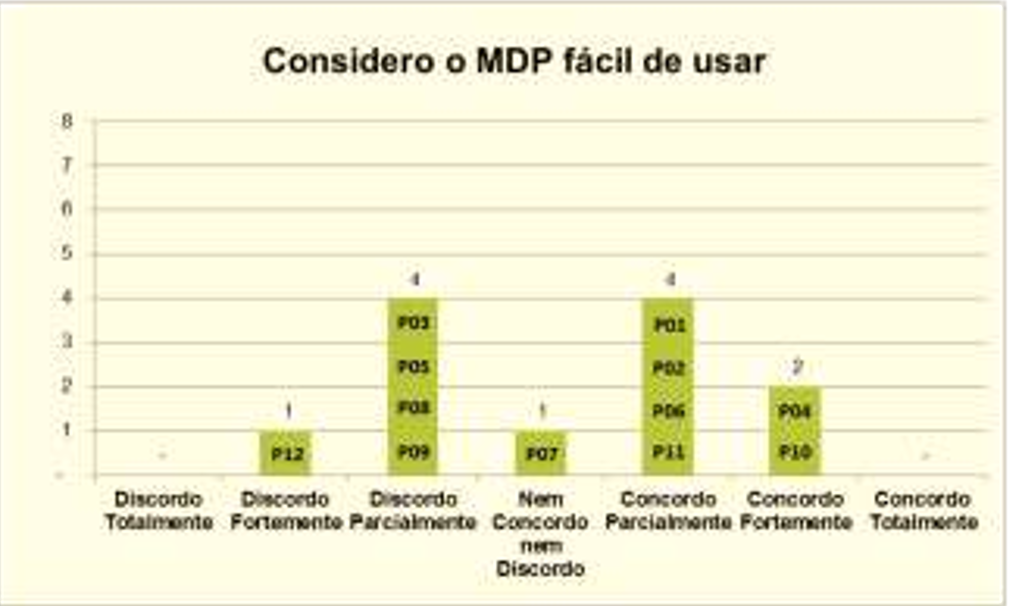 Figure: The TAM survey results show that while the model is useful, the 'Ease of Use' suffered from terminological friction.
Quantifying Value
Despite the learning curve, the Utility of the model was rated highly. One participant noted: "The PDM allows me to clearly verify privacy points that I hadn't noticed before." This validates PDM as a potent epistemic tool—it changes how designers think about the product.
Critical Analysis & Conclusion
The SOTA Takeaway
The PDM represents a shift from "Privacy as Security" to "Privacy as UI/UX Design." The study confirms that even technically proficient individuals (Computer Science students) struggle to map privacy concepts consistently without a structural framework.
Limitations
- Terminology: Concepts like "Discourse" and "Control" are still too academic and lead to divergent interpretations.
- Platform Specificity: The model struggles to account for third-party functions (like OS screenshots) that operate outside the designer's immediate UI discourse but significantly impact the user's privacy state.
Future Outlook
The authors suggest that the future of PDM lies in evolutionary refinement: simplifying terminology and perhaps integrating it into automated inspection techniques. For researchers, the next step is applying this to Multimodal AI interactions, where privacy boundaries are even more blurred than in simple photo sharing.