
The Social Cost of Asking: Optimizing Awareness to Shield Privacy in Social Search
Privacy Exposure of Online Social Search
This paper investigates "Online Social Search" (OSS) and the inherent privacy risks associated with passing sensitive queries through social chains. The authors propose a random-walk-based referral model and derive a "Square-root Distribution" for node awareness that achieves the unique Nash equilibrium for minimizing system-wide privacy exposure.
TL;DR
Online Social Search (OSS) harnesses the "Small World" phenomenon to find expert answers through friends. However, every hop in the chain exposes your identity and query to others. This paper introduces a mathematical framework to minimize this Privacy Exposure Degree (PED) by optimizing how "aware" we are of our friends' expertise, proving that a Square-root Distribution of awareness is the most efficient way to protect privacy.
Background: Trust vs. Privacy
When you search on Google, you are anonymous to the crowd but visible to a corporation. In OSS (like the Aardvark platform), you ask a friend, who asks a friend. While this builds a "web of trust," it creates a massive privacy leak: every intermediate node knows exactly what you are asking. The authors define the problem as a trade-off:
- Flooding finds experts fast but annoys everyone.
- Compact Routing saves effort but increases the number of hops, thereby increasing privacy exposure.
The Core Insight: The "Awareness" Intelligence
The authors equip nodes with Intelligence of Awareness. A node can have three states regarding a neighbor for a question :
- Expert: knows has the answer.
- Layman: knows does not have the answer.
- Uncertain: has no idea.
Since human cognitive capacity is limited, the sum of a node's awareness across all subjects is constant (). The question then becomes: Which subjects should we focus our "awareness" on to minimize the total hops a question takes?
Methodology: The Square-root Rule
The authors modeled the referral process as a random walk. Using Lagrangian multipliers to solve the optimization problem, they discovered a striking relationship. To reach the minimum PED, a node’s awareness level () for a question should follow:
Where is the Expert Density (how common experts are for that topic).
The Intuition: If a topic is rare (low ), you should invest more awareness into knowing who is an expert in it. This prevents "blind" wandering through the network for rare questions, which is the primary cause of high privacy exposure.
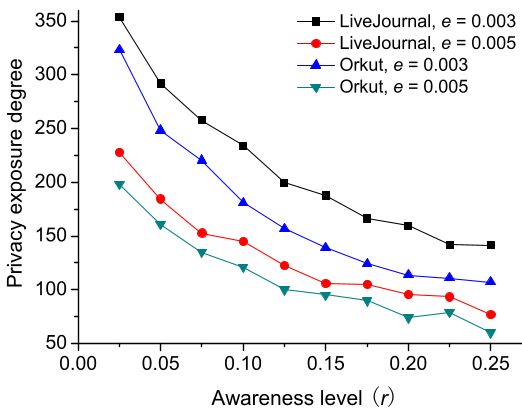 Fig 1: As awareness (r) or expert density (e) increases, the number of exposed nodes (PED) drops exponentially.
Experimental Validation: Orkut vs. LiveJournal
The researchers tested their model using real-world data from Orkut and LiveJournal.
| Dataset | Avg. Friends | Key Finding |
|---|---|---|
| Orkut | 106.1 | Lower Privacy Exposure |
| LiveJournal | 16.97 | Higher Privacy Exposure |
The higher connectivity in Orkut allows the referral strategy to "short-circuit" the path to an expert much faster. Furthermore, they proved that their "Square-root" distribution consistently outperformed random awareness distributions, as shown below.
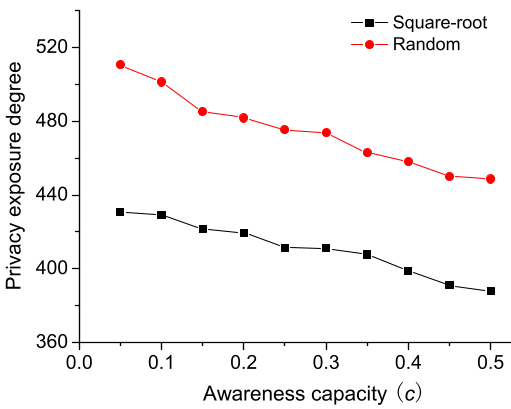 Fig 2: The Square-root distribution (proven Nash Equilibrium) consistently results in lower privacy exposure across different awareness capacities.
Critical Analysis & Future Outlook
While the paper provides a elegant mathematical proof for privacy optimization, it assumes that nodes are willing to behave optimally—a "social norm."
- Limitation: The model assumes that answers from all experts are of equal quality, ignoring "Trust and Reputation" filtering which might extend the search path.
- Real-world Application: This logic is highly applicable to modern Decentralized Social Networks (DeSo). By strategically indexing "rare" expertise at the edge, these networks can significantly reduce the metadata trail left by users during discovery.
Conclusion
The study proves that privacy in a social network isn't just about encryption; it's about routing efficiency. By aligning our "awareness" of our social circle with the scarcity of information, we can find answers faster and keep our secrets safer.