
PIDX: Quantifying the Incalculable Risk of Social Media Privacy
Privacy Measurement for Social Network Actor Model
The paper introduces a framework for quantifying personal privacy risks in social networks using the Actor Model. It proposes three distinct metrics—Weighted (w-PIDX), Maximum (m-PIDX), and Composite (c-PIDX) Privacy Indexes—to rank and measure data exposure.
TL;DR
Privacy is often treated as a binary state, but this paper argues it should be measured as a spectrum. By introducing the Composite Privacy Index (c-PIDX), the authors provide a mathematical framework to calculate exactly how much "privacy" a user loses when they share specific combinations of data, accounting for both the sensitivity of the information and the power of inference.
Contextual Positioning
In the wake of massive data breaches (like the 2011 Sony PlayStation Network hack), the industry lacked a standardized metric to answer: How much privacy was actually lost? This work moves beyond qualitative descriptions into an Actor Model-based quantitative ranking, filling a critical gap in privacy legislation and risk assessment.
The Problem: The "Inference" Trap
Existing privacy tools often fail because they view data points in isolation. The authors highlight four challenges:
- Subjectivity: Privacy means different things to different people.
- Impact Variance: A Social Security Number (SSN) is inherently riskier than a Favorite Quote.
- Hidden Information: Knowing your "Occupation" often allows an attacker to infer your "Salary."
- Combinatorial Risk: While Gender, City, and Date of Birth seem low-risk, combined they can identify 87% of the US population.
Methodology: The PIDX Framework
The researchers developed a three-step procedure to calculate privacy exposure.
1. The Actor Model & Attributes
An actor is defined by a set of attributes, each assigned an Attribute Privacy Impact Factor (APIF) between 0 and 1.
- Sensitivity (s): How vital is this data? (e.g., SSN = 0.9, Name = 0.05).
- Visibility (p): To what degree is this attribute disclosed (0 to 1)?
2. Virtual Attributes & Hidden Info
The most sophisticated part of the model is the Virtual Attribute. It represents the "synergy" of data. If attributes and are known, they unlock a virtual attribute with a high sensitivity score, even if and individually are low-impact.
3. The Three Indexes
The paper compares three mathematical approaches:
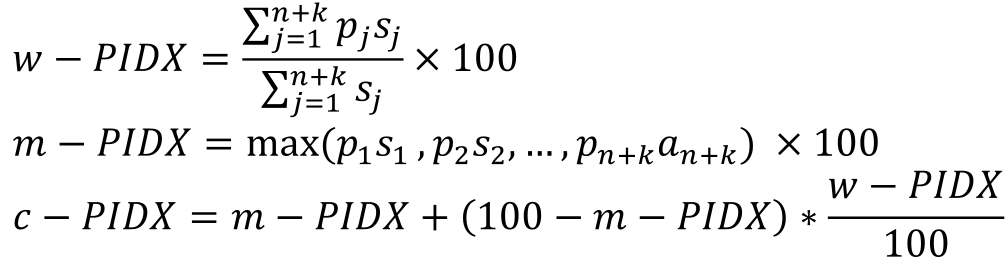
- w-PIDX (Weighted): An average of all known attribute risks. Good for seeing gradual change but underestimates major risks.
- m-PIDX (Maximum): Only tracks the single most sensitive attribute leaked. Great for ranking but ignores the "volume" of other data leaked.
- c-PIDX (Composite): The "Gold Standard." It uses the maximum risk as a baseline and then adds the weighted average of the remaining leakages.
Experiments: Proving c-PIDX Superiority
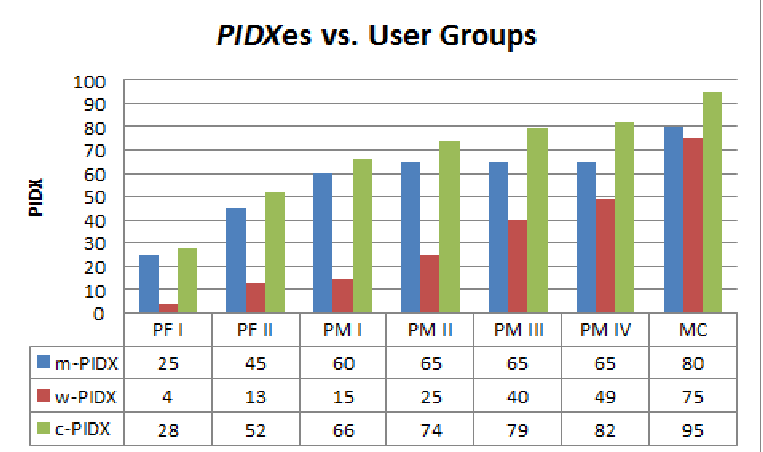
The authors tested the indexes against different user personas, such as "Privacy Fundamentalists" (reluctant to share) and "Pragmatic Majority" (will share for convenience).
Impact of Hidden Information
In one scenario, merely knowing a user's Education allowed the system to infer their Hometown with 90% probability. For a "Privacy Fundamentalist," this single inference caused their c-PIDX to jump from 28 to 63 (a 125% increase), proving that users are often more exposed than they realize.
Virtual Attribute Risk
The team found that ignoring the combined effect of Zip Code, Gender, and Birth Date significantly undercounted risk. By including the Virtual Attribute, the risk index increased by 30%.
Critical Analysis & Conclusion
The c-PIDX emerges as the most robust metric because it captures the "Maximum Risk" (if you lose your SSN, you are already in trouble) while still rewarding users for keeping other minor details private.
Limitations: The current model relies on a "Static Model" where APIF values (sensitivity) are pre-assigned by experts or surveys. In reality, these values change over time and across different cultural contexts.
Future Outlook: The logical next step is moving from the Actor Model to the Community Model. How does your privacy score change based on what your friends share? In a hyper-connected network, your PIDX might be influenced more by your peers than by your own settings—a scary but necessary reality to quantify.
Takeaway: If you can't measure it, you can't manage it. c-PIDX provides the ruler we need for the social media age.