
Hybrid Generalization: Securing Medical Records in the Social Media Era
Privacy Preservation Based on Key Attribute and Structure Generalization of Social Network for Medical Data Publication
The paper introduces a K-anonymous greedy clustering algorithm designed for medical data publication in social networks. It combines node attribute generalization with graph structure preservation to prevent re-identification attacks while maintaining data utility.
TL;DR
In the age of interconnected data, hiding your name isn't enough. This paper presents a novel K-anonymous greedy clustering algorithm specifically designed for medical data published within social networks. By simultaneously generalizing node attributes and masking graph structures, it successfully thwarts linkage attacks while keeping the data useful for researchers.
Background: The Death of Privacy by Linkage
The Privacy Rule of HIPAA was once the gold standard, but the explosion of social networks has created a "data fusion" nightmare. Even if a hospital removes your name (Unique Identifier), they often leave "Quasi-identifiers" like your ZIP code, age, and gender. An attacker can link these to your public Facebook profile and suddenly, your private medical diagnosis is no longer private. This is known as a Linkage Attack.
Problem & Motivation: The Tug-of-War
The core challenge in data publication is the trade-off between Privacy and Utility.
- Prior Work either focused on table-based anonymity (ignoring connections) or graph-based anonymity (ignoring individual attributes).
- The Insight: Real-world medical social data is a hybrid. We need a method that treats a person not just as a row in a table, but as a node in a complex web of relationships.
Methodology: Dual-Factor Clustering
The authors propose a Greedy Clustering Algorithm. Instead of arbitrary grouping, it identifies "Super-nodes" based on two critical metrics:
1. Generalization Information Loss (GIL)
This measures how much "blur" is added to attributes. For example, changing an age from "23" to "[20-30]" loses specific info but gains privacy.
2. Structural Information Loss (SIL)
This measures the damage done to the social graph. When we group nodes into a cluster, we must decide how to represent the edges between them to prevent "structure re-identification."
Logic Framework
The algorithm selects a cluster center (usually the node with the highest degree) and pulls in similar nodes. This process is governed by a parameter , which allows the data publisher to choose if they care more about attribute accuracy or structural integrity.
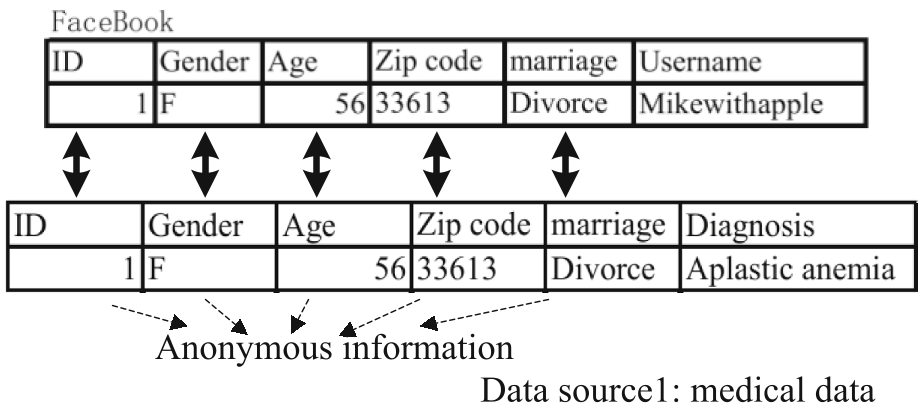 Above: Figure illustrating how attackers link open social networks with anonymous medical data.
Experiments & Results
The researchers tested their approach on a medical dataset containing attributes like Gender, Age, and Diagnosis.
- SOTA Comparison: The methodology adheres to the -anonymity principle where each individual is hidden among at least others.
- Ablation (Parameter 'a'): They found that as increases (higher privacy), the information loss naturally rises. However, by adjusting , they could mitigate specific types of loss. Specifically, when , the algorithm achieves a balanced "sweet spot" for both attributes and structure.
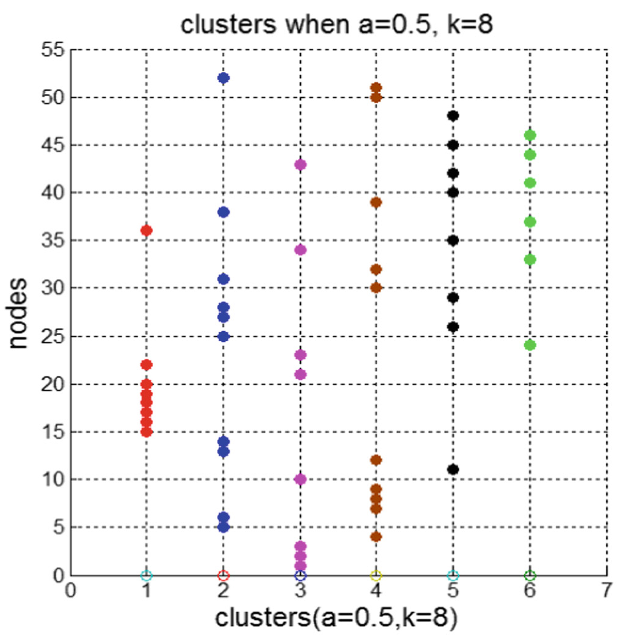 Above: Figure 4 shows the growth of information loss as the cluster size (K) increases.
Critical Insight & Conclusion
Takeaway
The value of this work lies in its holistic view of data. By treating medical records as a "Social Graph" rather than a stagnant database, it addresses the reality of modern data mining.
Limitations & Future Work
While robust, the current algorithm is designed for static networks. In reality, social networks are dynamic—people add friends and change attributes constantly. The authors acknowledge that future research must tackle "Dynamic Anonymity" to ensure privacy remains intact as the graph evolves over time.
Final Thought
As we move toward more open scientific research, techniques like hybrid clustering are essential to ensure that "the death of privacy" doesn't become the price we pay for medical discovery.