
Efficient Private Profile Matching: Bypassing Heavy Cryptography with Smart Perturbation
SPECIAL SECTION ON PRIVACY PRESERVATION FOR LARGE-SCALE USER DATA IN SOCIAL NETWORKS
The paper introduces a highly efficient perturbation-based private profile matching mechanism for social networks. By representing fine-grained user profiles as vectors and employing a cooperative noise-cancellation framework, the authors achieve secure dot-product computation without relying on expensive cryptographic primitives.
TL;DR
Researchers have developed a new way to find "friends with common interests" in social networks without exposing sensitive profile data. By using perturbation-based noise instead of heavy encryption (like Paillier or RSA), they achieve secure profile matching with speeds order of magnitude faster than current SOTA methods, making it truly practical for mobile devices.
Background: The Price of Privacy
In the world of Mobile Social Networks (MSNs), the "Friend Discovery" feature is a double-edged sword. To find someone with similar interests, you usually have to share your profile. But profiles contain sensitive data—religion, health, political views, and habits.
The academic community has traditionally solved this using Secure Multi-party Computation (SMC). While mathematically elegant, SMC is a "performance killer." Using Homomorphic Encryption to calculate a simple dot-product on a smartphone is like using a tank to go grocery shopping—it's overkill and painfully slow.
The Core Insight: Perturbation over Encryption
The authors of "Perturbation-Based Private Profile Matching" take a different route. Instead of encrypting the data into a black box, they hide it in plain sight using noise.
1. Vectorization of Interests
First, they convert fine-grained interests into unary binary vectors. If your interest in "AI" is a 3 on a scale of 0-3, it becomes [1, 1, 1]. This conversion allows the similarity between two users to be calculated as a dot-product.
2. The Cooperative framework
The "Basic Scheme" works through a clever distribution of data:
- Alice adds a noise vector to her profile (becoming ). She sends to Bob and to a Helper.
- Bob adds noise to his profile , sending the mix to the Helper and to Alice.
- Through a series of local dot-product calculations and exchanges, the noise terms cancel out, leaving Bob with the final similarity score, without him ever seeing Alice's raw bits.
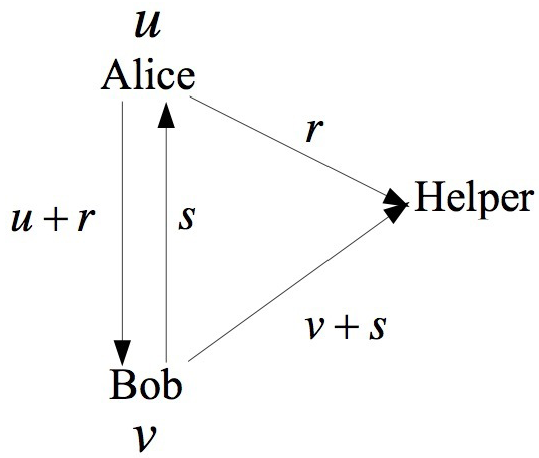 Figure 1: The additive secret sharing process in the Basic Mechanism.
Solving the "Trust" Problem (Collusion and Verifiability)
A single helper might be malicious. What if Bob colludes with the Helper to subtract the noise and find Alice's profile?
- Collusion Resistance: The authors extend the scheme by "slicing" the noise. Instead of one helper, helpers each receive a tiny piece of the noise. To cheat, Bob would have to compromise every single helper—a much harder feat in a decentralized network.
- Verifiability: In many protocols, only one person gets the result. This paper introduces a parallel structure where both Alice and Bob compute the result independently and can verify their consistency.
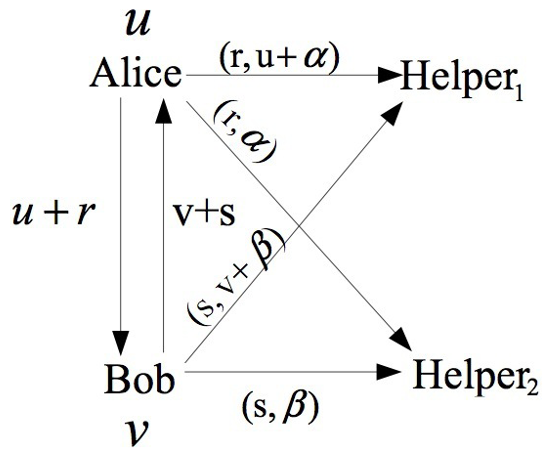 Figure 2: The architecture for verifiable results, ensuring both parties can trust the output.
Performance: Lightning Fast
The most striking part of this research is the efficiency gain. Current standards rely on 1024-bit or 2048-bit exponentiations, which take roughly 40ms to 250ms per operation. On a mobile CPU (400 MHz), these add up quickly.
The proposed perturbation method relies on AES (2.6ms) and simple multiplications. As shown in the simulation results, even with 30 attributes and 5 helpers, the total execution time remains significantly lower than existing cryptographic benchmarks.
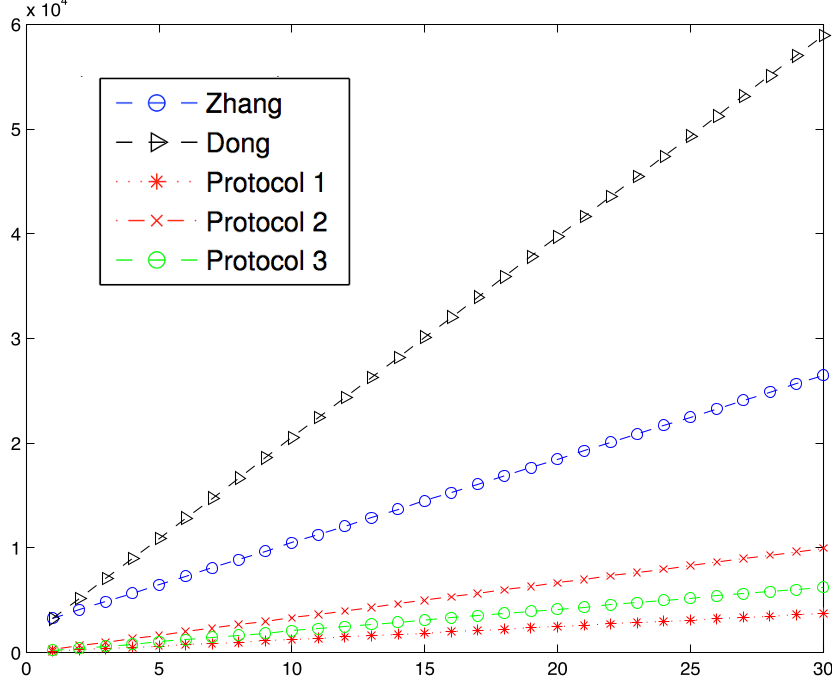 Figure 3: Computational cost vs. number of attributes. Notice how Protocol 1, 2, and 3 stay flat compared to the exponential growth of prior work.
Critical Perspective: Is it Secure Enough?
The security here is based on the Semi-Honest Model and the assumption that the majority of helpers are benign. While not as "mathematically absolute" as full encryption against an active malicious adversary, it offers a "Practical Security" trade-off.
The limit of this approach is the reliance on the availability of helpers. However, in a social network with thousands of active nodes, finding 5-10 "helpers" is a low barrier to entry for the massive speed gains provided.
Conclusion
This paper serves as a reminder that the most sophisticated math isn't always the best for engineering. By shifting from heavy-weight asymmetric encryption to lightweight additive perturbation, the authors have paved the way for privacy-preserving features that actually work on your smartphone without draining the battery.