
Cooperative Jamming: Securing Networks Without Knowing Your Enemy's Location
SPECIAL SECTION ON PRIVACY PRESERVATION FOR LARGE-SCALE USER DATA IN SOCIAL NETWORKS
The paper proposes a novel cooperative jamming scheme for wireless social networks using space power synthesis. It focuses on achieving "jamming nulling" at a legitimate receiver without requiring the channel state information (CSI) of eavesdroppers, leveraging a superposition principle of signals in free space.
TL;DR
This research introduces a spatial power synthesis model that creates a "jamming-free zone" precisely at a legitimate receiver. Unlike previous SOTA methods that require perfect Channel State Information (CSI) of eavesdroppers, this scheme uses the physical properties of wave superposition to blind eavesdroppers across a wide area while leaving the legitimate link untouched.
Background: The CSI Bottleneck
In the realm of Physical Layer Security (PLS), the "Cooperative Jamming" (CJ) strategy is a heavy hitter. The idea is simple: have friendly nodes broadcast Artificial Noise (AN) to drown out the signal for eavesdroppers.
However, there is a catch. To ensure the jamming doesn't interfere with the legitimate receiver, the system typically needs to know exactly how the signal travels to every node—this is the CSI. In real-world social networks, eavesdroppers are often "silent" or "passive," meaning we have zero CSI for them. This makes traditional beamforming impossible.
The Insight: Space Power Synthesis
The authors shift the perspective from digital signal processing to the physics of electromagnetic waves. By treating jamming signals as vectors in a far-field space, they formulate a superposition principle where multiple signals can be designed to cancel each other out at a specific coordinate .
The Methodology
The core of the approach lies in the Amplitude and Phase conditions. For two jammers to nullify their power at a receiver:
- Amplitude Condition: The ratio of their emission currents must match the ratio of their distances to the receiver ().
- Phase Condition: The signals must arrive exactly (or ) out of phase.
 Figure 1: The anti-eavesdropping model featuring a Transmitter (Tx), Receiver (Rx), and multiple cooperative jammers (Jms).
Finding the "Worst-Case" Eavesdropper
Since we don't know where the eavesdropper is, the authors analyze the Worst-Case Secrecy Rate. They formulate a non-convex optimization problem and solve it using two innovative steps:
- Wavy Zigzag Search: A geometric method to find the location where an eavesdropper would have the highest SINR (the most dangerous spot).
- HSA & 1-D Search: Algorithms to allocate power between the transmitter and jammers to maximize the secrecy rate at that "worst" location.
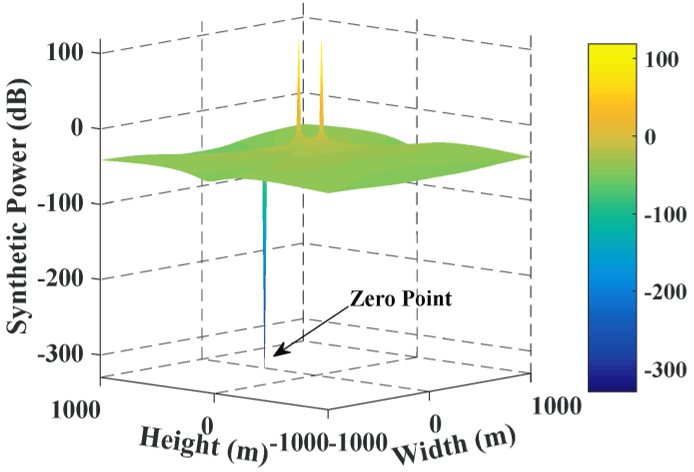 Figure 2: Heat maps of synthetic jamming power. The blue "valley" represents the zero-power point successfully created at the receiver's location.
Experimental Results
Through Monte Carlo simulations, the paper proves:
- Uniqueness: By adjusting the wavelength () or using more than two jammers, the system can ensure there is only one zero point in the entire field—located exactly at the receiver.
- Efficiency: The proposed 1-D search reduces the massive computational overhead of three-variable optimization into a simple single-variable task, making it feasible for low-power IoT or mobile devices.
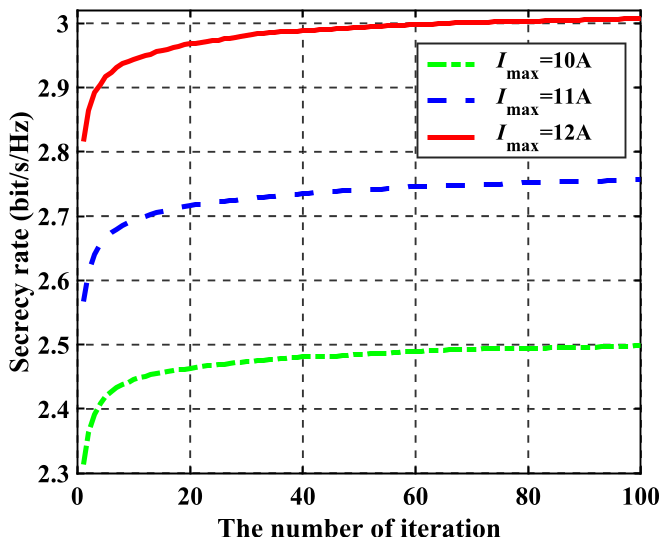 Figure 3: Convergence of the Heuristic Simulated Annealing (HSA) algorithm across different power constraints.
Critical Insight & Future Directions
The brilliance of this work is its hardware-agnostic logic. Rather than relying on complex antenna arrays, it uses the spatial distribution of simple single-antenna nodes to achieve a high-precision nulling effect.
Limitations: The model assumes a free-space propagation environment. In complex urban environments with heavy multi-path fading and obstacles (shadowing), the simple path loss model might struggle. Future work should investigate how these "zero points" shift in non-line-of-sight (NLoS) scenarios.
Conclusion
This "Novel Cooperative Jamming Scheme" provides a theoretical foundation for "blind" security. By manipulating the physical synthesis of power, it turns the broadcast nature of wireless signals—once a vulnerability—into a tool for precision interference.