
Efficient Friend Discovery: Privacy Matching via Perturbation, Not Heavy Encryption
SPECIAL SECTION ON PRIVACY PRESERVATION FOR LARGE-SCALE USER DATA IN SOCIAL NETWORKS
The paper introduces a perturbation-based private profile matching mechanism for social networks, enabling fine-grained similarity measurement via secure dot-product. By mixing private data with random noise and distributing shares among cooperative users, it achieves privacy preservation without heavy cryptographic primitives, ensuring a significantly lower computational overhead.
TL;DR
Social networks thrive on discovery, but sharing your deeply personal list of interests to find a "match" is a privacy nightmare. While most researchers use heavy-duty math like Homomorphic Encryption to solve this—often making mobile apps crawl—this paper proposes a faster "perturbation-based" approach. By mixing your profile with random noise and having a few friends help with the math, you can find common ground without ever revealing your original data to anyone.
The Performance Wall of Privacy
In the context of mobile social networks (MSNs), fine-grained profile matching (where we don't just see if you like jazz, but how much you like it) usually requires calculating the dot-product of attribute vectors.
The status quo relies on the Paillier Cryptosystem or Garbled Circuits. The problem? These are computationally "expensive." On a mobile device with a 400 MHz CPU, a single 2048-bit exponentiation can take 250ms. If your profile has hundreds of dimensions, the wait time becomes unacceptable for a real-time "shake to find friends" feature.
The Insight: Noise as a Shield
Instead of locking the data in a mathematical vault (encryption), why not hide it in a crowd (perturbation)?
The Basic Architecture
The authors propose a "split-and-share" logic:
- Alice (Initiator) takes her profile , adds a random noise vector , and creates .
- She sends the "blurry" vector to Bob (Candidate) and the "key" to a Helper.
- Through a series of cross-computations, the noise and (Bob's noise) cancel out during the final summation.
This ensures that:
- Bob never sees Alice's (hidden by ).
- The Helper never sees or (only sees and a masked version of ).
- The final result is a clean dot-product.
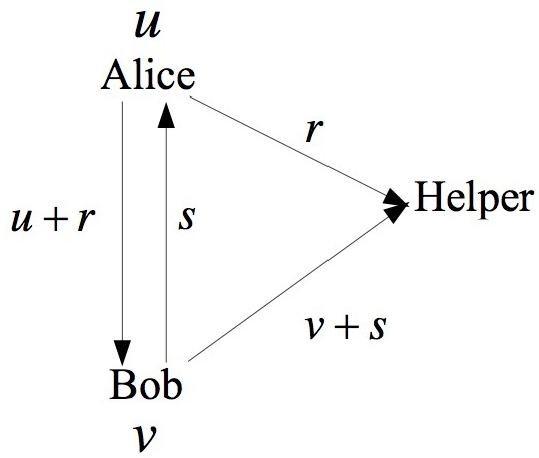 Figure 1: The data distribution process ensuring no single party holds both the data and the mask.
Methodology: From Basic to Robust
The paper doesn't stop at the basic "three-party" dance. It introduces two critical upgrades:
- Collusion Resistance: What if Bob and the Helper are friends and decide to cheat? The authors suggest "slicing" the noise into pieces and distributing them to different helpers. An attacker would now need to compromise every single helper to recover the original profile.
- Verifiability: In many protocols, only one person gets the final answer. The "Verifiable Scheme" uses a parallel execution structure where both parties compute the result simultaneously and can verify the consistency of the output.
Experimental Results: Speeding Up the Social Graph
The most striking part of the research is the performance comparison. Using a 400 MHz mobile CPU simulation, the authors compared their protocol against leading standards (Zhang et al. and Dong et al.).
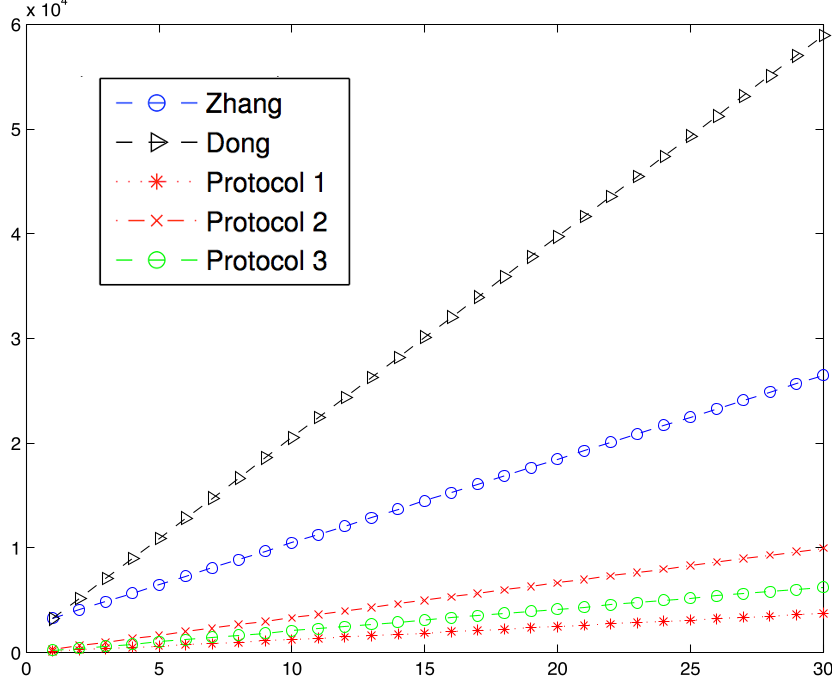 Figure 2: Computational cost vs. Number of attributes (). The proposed protocols (1, 2, 3) maintain a near-flat, low-cost profile compared to the exponential growth of previous works.
Key Findings:
- Efficiency: Because the method uses symmetric 128-bit AES and basic multiplication, it bypasses the "exponentiation bottleneck."
- Scalability: Even with 10–15 helpers (the Collusion Resistant version), the system remains faster than the single-party Paillier approach.
- Fine-Grained Accuracy: Despite the noise, the reconstruction of the L1 distance is mathematically exact ( is recovered perfectly once noise is subtracted).
Critical Insight & Conclusion
The genius of this paper lies in its Inductive Bias toward decentralization. By moving away from a "Trusted Central Server" and utilizing the idle compute power of other users in the social network, it achieves both privacy and speed.
Limitations: The model assumes a "semi-honest" majority. If more than 50% of the helpers are malicious and collude with a party, the privacy guarantees can fail. However, in large, decentralized social networks, this threshold is a robust practical bet.
For future mobile applications, this work provides a blueprint for "Low-Latency Privacy"—proving that you don't need to choose between a fast user experience and the protection of personal data.