
Securing Distributed Healthcare Intelligence: A Shield for COVID-19 and Cancer Data
Privacy Preserving Association Rule Mining on Distributed Healthcare Data: COVID-19 and Breast Cancer Case Study
The paper proposes a Privacy Preserving Distributed Association Rule Mining (PPDARM) scheme tailored for distributed healthcare datasets, specifically applied to COVID-19 and Breast Cancer. It identifies security flaws in existing elliptic curve-based Paillier cryptosystems and introduces a more robust protocol that ensures site privacy even over insecure communication channels.
TL;DR
In the race to diagnose life-threatening diseases like COVID-19 and Breast Cancer, data is the most valuable fuel. However, medical privacy laws often trap this data in "silos" within individual hospitals. This paper presents an enhanced Privacy Preserving Distributed Association Rule Mining (PPDARM) protocol. By fixing security vulnerabilities in existing elliptic-curve cryptosystems, the authors allow hospitals to collaborate and find high-accuracy diagnostic rules (reaching up to 99% confidence) without ever seeing each other's raw patient data.
Context & Motivation: The Accuracy-Privacy Paradox
Data mining on a single Electronic Health Record (EHR) system is often inaccurate due to small sample sizes. While aggregating data from multiple hospitals would solve this, privacy concerns and the risk of data disclosure during transmission create a "paradox."
The authors point out that previous attempts (such as the work by Chahar et al.) were theoretically sound but practically flawed. They demonstrated that in an insecure network environment, a participant designated as the "Miner" could easily eavesdrop on and decrypt the local counts of other hospitals, effectively "peeling back" the privacy layer.
Methodology: Fixing the "Miner" Vulnerability
The core contribution is a modification of the encryption phase to prevent the "Miner" site from learning individual counts.
The Insight
Instead of simply encrypting the support count (), each site adds a layer of "noise" before encryption:
- Randomization: Each site selects a random number ().
- Large Integer Scaling: A shared large integer ()—greater than the total possible transactions—is used to scale the random number.
- The Formula: The site sends .
When the Miner decrypts the aggregate, it sees a massive, meaningless number. Only the "Combiner" site, by applying a Modulo Z operation, can strip away the components to reveal the true global sum of .
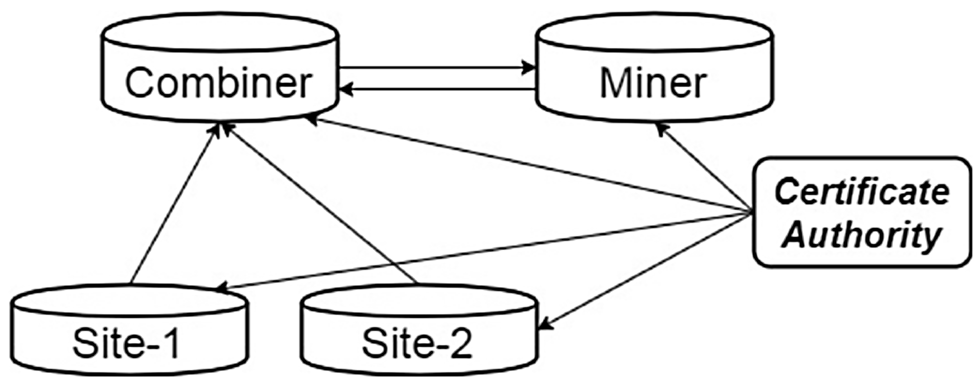 Figure 1: The three-party communication model involving Sites, a Combiner, and a Miner.
Experiments: Superior Diagnostic Rules
The researchers tested their approach on the Wisconsin Breast Cancer Dataset. The goal was to find association rules like:
IF Bland Chromatin=3 AND Bare Nuclei=1 THEN Class=Benign
Key Findings:
- Accuracy Boost: Global rules reached 96% to 99% confidence, whereas individual EHR systems struggled between 85% and 94%.
- Computational Efficiency: The cost of the extra randomization is "negligible," making it practical for real-world hospital networks.
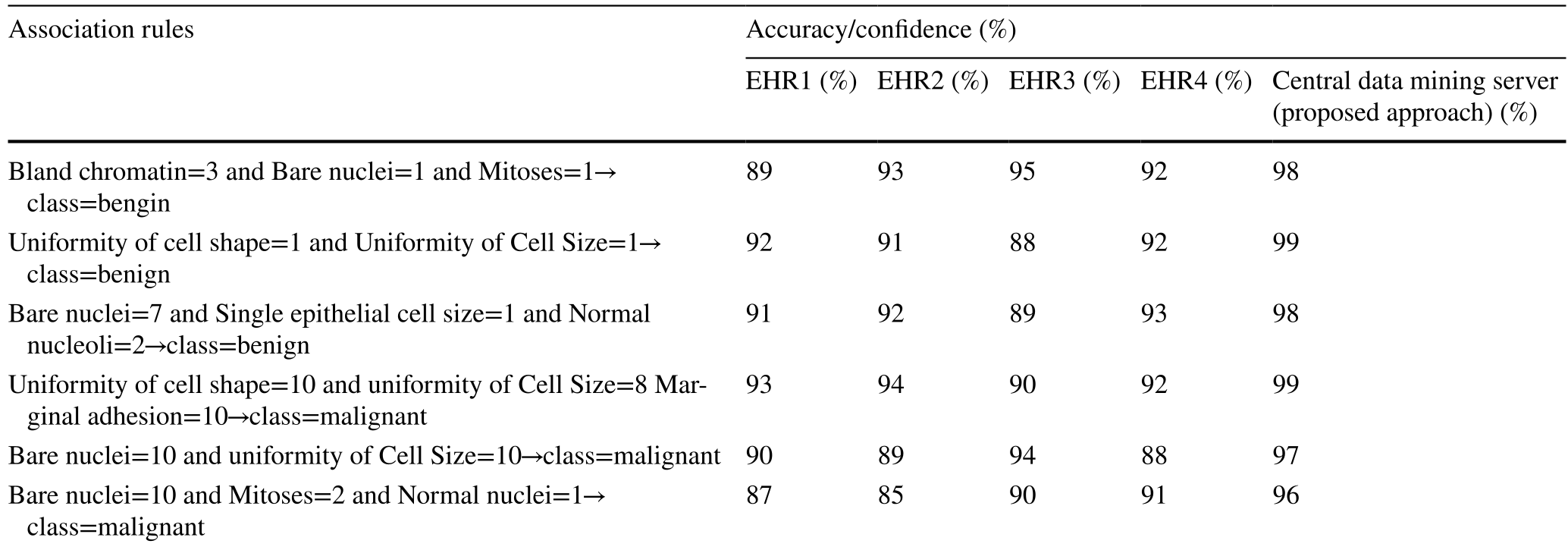 Table 1: Accuracy comparison between individual EHRs and the Proposed Collaborative Server.
Critical Insight & Future Outlook
The beauty of this research lies in its Inductive Bias toward the "Honest-but-Curious" model. It acknowledges that even within a trusted medical network, the technical roles (like the Miner) shouldn't have the power to deanonymize peers.
Limitations: The scheme assumes that the "Combiner" and "Miner" do not collude. If these two entities were to share their internal states, the privacy of other sites could still be at risk. Future work might look into Multi-Key Homomorphic Encryption to remove the need for this trust assumption.
Takeaway: As we prepare for future pandemics, protocols like this ensure that "Data Silos" no longer hinder medical breakthroughs. We can now achieve the accuracy of a global database with the privacy of a local one.