
Policy-Driven Replication: Solving the DOSN Availability-Privacy Tradeoff Without Heavy Encryption
Privacy-Preserving Data Allocation in Decentralized Online Social Networks
This paper introduces a privacy-preserving data allocation strategy for Decentralized Online Social Networks (DOSNs). It utilizes a hierarchical tree structure to model user profiles and replicates data exclusively onto the devices of "trusted" friends who are already authorized by the owner's privacy policies, achieving high availability without the overhead of heavy encryption.
TL;DR
Decentralized Online Social Networks (DOSNs) often struggle with a paradox: how do you keep data available when the owner is offline without giving it to "strangers" or drowning in encryption overhead? This paper proposes a clever shift: replicate data in plaintext, but only on the devices of friends who are already authorized to see it. By mapping profiles to hierarchical trees and using a "Primary Trusted Replica" gatekeeper, the system achieves high availability and privacy with significantly lower latency than traditional cryptographic methods.
The Scalability Wall in Decentralized Privacy
In a centralized world (Facebook/X), the provider keeps your data 24/7. In a decentralized world, when you turn off your phone, your data disappears unless someone else hosts it. Previous SOTA designs like Persona or Cachet solved this by encrypting data and dumping it onto a Distributed Hash Table (DHT).
The problem? Encryption doesn't scale. If you have 500 friends, you might have to perform hundreds of asymmetric encryption operations or manage complex Attribute-Based Encryption (ABE) keys every time you post a photo. This leads to massive storage bloat and sluggish performance on mobile devices.
Methodology: The Hierarchical Trusted Replica
The authors propose two major innovations to bypass the encryption bottleneck:
1. Profile as a Tree
User data isn't treated as a flat list but as a Hierarchical Content Tree. Permissions are inherited: if you can't see the "Image1" node, you automatically can't see the "Comments" or "Likes" under it. This structure simplifies access control logic for the peers hosting the data.
2. The Replication Strategy
Instead of encrypting data for "untrusted" storage, the system selects "Trusted Replicas."
- Primary Trusted Replica (ptr): When the owner is online, they are the ptr. When they go offline, the first online authorized friend in the replica list takes over.
- Authorization-Aware Placement: The system evaluates the owner's privacy policies and identifies online friends who satisfy the criteria (e.g., "Friends in my Dunbar Circle" or "Friends within 5km"). It then pushes a plaintext copy of the data to them.
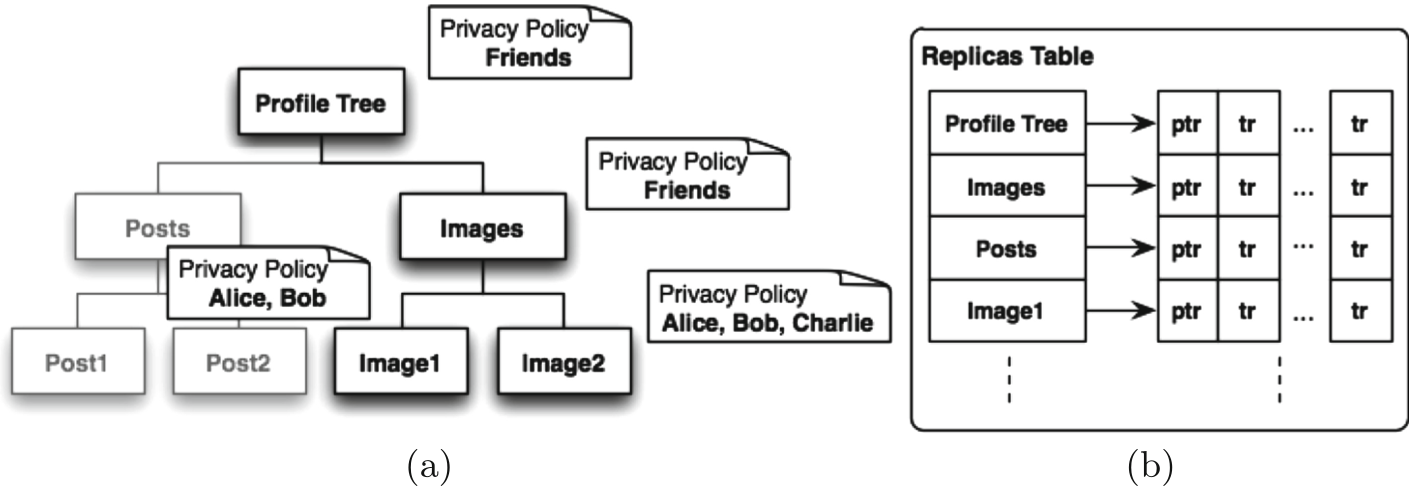 Figure 1: The mapping between the Profile Tree and the Replicas Table (Ru).
Experimental Insights: Real-World Feasibility
The researchers tested their approach using SocialCircles!, a custom Facebook app that sampled real user chat statuses and friendship ties. Using the PeerfactSim.KOM simulator, they modeled 3,000 peers.
Key Findings:
- High Availability: Even with heavy churn (users going online/offline constantly), the "real unavailable" rate—content that an authorized user wants to see but cannot find—remains extremely low (approx. 1.6%).
- Uniform Load Balancing: The burden of hosting data is distributed evenly. Most replica peers store fewer than 6 content objects, preventing any single user's device from being overwhelmed.
- Latency Consistency: Operation duration stayed under 10 seconds, a critical threshold for maintaining a "social" user experience.
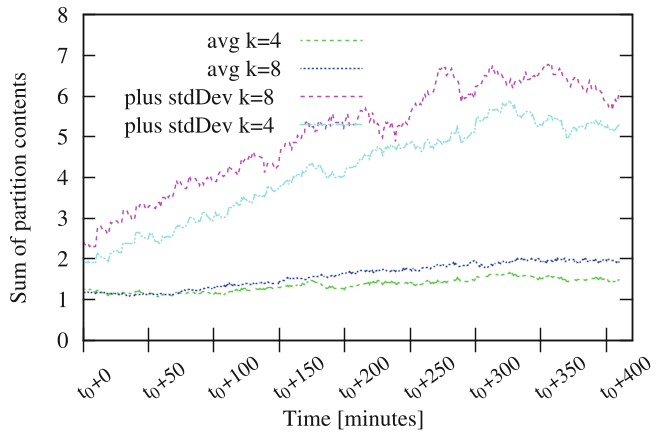 Figure 2: Performance metrics including content availability (a) and network message size (f).
Critical Analysis & The Academic Horizon
The brilliance of this work lies in its Inductive Bias: it assumes that in a social network, your "accessors" are also your "service providers." By aligning storage with social trust, it eliminates the need for the "math-heavy" walls of encryption.
Limitations:
- Integrity Risks: While the data is private, a "malicious friend" could theoretically modify the data they host. The authors suggest using digital signatures to mitigate this, but it wasn't the focus of this study.
- Island Effect: If a user has very strict privacy policies (e.g., "only my spouse can see this") and that person is offline, the data becomes unavailable. The authors mention a fallback to DHT storage as future work for these edge cases.
Conclusion
This paper effectively argues that we don't always need more complex math to solve privacy; sometimes, we just need better data allocation logic. By leveraging the inherent structure of social relationships, we can build DOSNs that are as fast as centralized ones while remaining truly private.