
PPDM in Deliberative Consultations: Balancing Resident Trust and Data Insights
Privacy Preserving Data Mining for Deliberative Consultations
This paper investigates Privacy Preserving Data Mining (PPDM) techniques specifically for deliberative consultations utilizing electronic surveys. It identifies the Reconstruction-based technique using randomization methods as the most viable strategy for maintaining high privacy at the resident level while ensuring computational efficiency.
TL;DR
To encourage honest participation in electronic local government consultations, privacy is paramount. This paper evaluates three main Privacy Preserving Data Mining (PPDM) paradigms—Heuristic, Cryptography, and Reconstruction—and advocates for a Reconstruction-based setup. By distorting answers at the user's side, organizations can perform robust statistical analysis without ever touching "raw" sensitive data.
Background: The Trust Deficit in Digital Democracy
Deliberative consultations are essential for local governments to gauge public opinion on critical issues like infrastructure or schools. However, residents are often hesitant to provide truthful opinions if they fear their data could be misused or linked back to them. Existing Privacy SOTA methods, while theoretically sound, often fail when applied to the messy, asynchronous world of the Internet.
The Problem with Current SOTA Approaches
The author categorizes the barriers into three technical bottlenecks:
- Heuristic-based: These are designed to hide "rules" in existing datasets (Aggregate level), not to protect the individual providing the data.
- Cryptography-based (SMC): While mathematically "perfect" for accuracy, they require all participants to be online and interacting simultaneously. For a city-wide survey with thousands of residents, the performance cost is prohibitive.
- The Synchronization Paradox: In traditional SMC, if you want to run a new analysis, you must contact all the original respondents again. This is impossible in public consultations.
Methodology: The Reconstruction-Based Solution
The paper proposes a transition to Reconstruction-based techniques. The core insight is that we don't need the actual data to build a valid model; we only need an accurate estimation of the distribution of that data.
1. Local Distortion (The "Front-line" Defense)
Data is distorted before it even leaves the resident’s computer.
- Binary/Nominal Data: Uses a P-matrix (Transition Matrix) where an answer is kept with probability p or flipped with probability 1-p.
- Continuous Data: Uses Additive Perturbation, adding random noise from a known distribution to the original value.
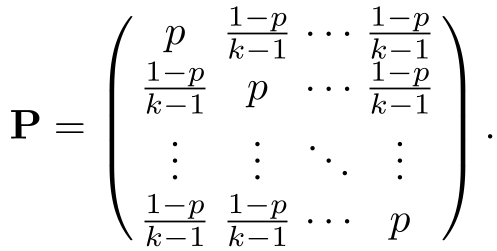
2. Centralized Model Building
The server receives only the "noise-heavy" data. By knowing the randomization factor p, the "Miner" (the government or analyst) can mathematically reconstruct the overall distribution to calculate means, build decision trees, or perform clustering.
Comparative Excellence
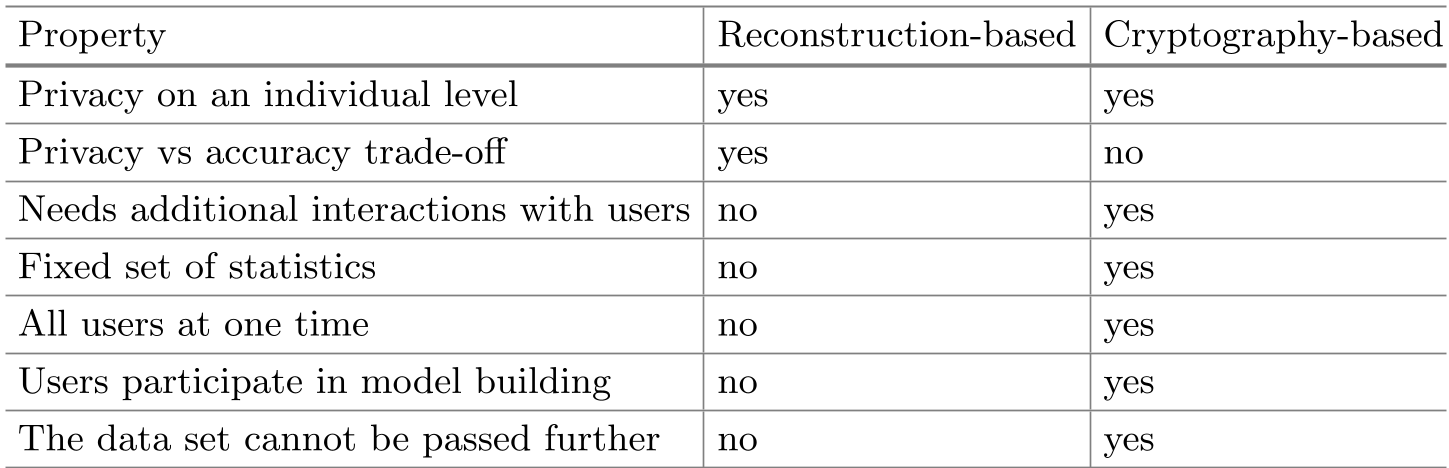
The paper provides a critical comparison (Table 1) highlighting why Reconstruction-based methods outperform Cryptography-based ones in a consultation context:
| Property | Reconstruction-based | Cryptography-based |
|---|---|---|
| Privacy on individual level | Yes | Yes |
| Privacy vs Accuracy trade-off | Yes | No |
| Needs additional interactions | No | Yes |
| Data set can be passed further | Yes | No |
Critical Insight: The "Browser-as-a-Shield"
The methodology identifies a major deployment advantage: because the distortion process for one user does not depend on others, it can be implemented as a browser extension or a client-side script. This shifts the "trust boundary" to the user's own device, significantly enhancing the perceived and actual security of the consultation process.
Future Outlook & Limitations
While this method solves the "participation" and "performance" problems, it introduces an Accuracy-Privacy Trade-off. The more you distort the data to protect the user, the less precise the final statistical model becomes.
The author suggests that future research should focus on Hybrid Models—specifically combining k-anonymity with randomization—to minimize this accuracy loss while maintaining the benefits of decentralized data distortion.
Conclusion
This paper moves PPDM from theoretical cryptography to practical civic application. For designers of e-participation portals, the takeaway is clear: stop trying to protect the database, and start empowering the user to "noise-ify" their data at the source.