
PDLC: Shielding Patient Privacy in the Era of Collaborative Healthcare Analytics
Privacy Preserving Distributed Learning Clustering of HealthCare Data Using Cryptography Protocols
The paper introduces Private Distributed Local Clustering (PDLC), a novel density-based clustering framework designed for vertically partitioned healthcare data. It utilizes homomorphic encryption and secure multi-party computation (SMC) to enable collaborative data mining across multiple organizations without exposing raw patient records.
TL;DR
Healthcare providers often need to collaborate to diagnose complex conditions, but data privacy laws (like HIPAA) prevent them from sharing raw patient records. This paper presents Private Distributed Local Clustering (PDLC), a method that allows multiple hospitals to perform joint density-based clustering on vertically partitioned data using sophisticated cryptographic protocols like homomorphic encryption and secure multi-party computation.
Contextual Positioning
In the landscape of Privacy-Preserving Data Mining (PPDM), this work sits between "Randomization" (which often loses accuracy) and "Pure Cryptography" (which can be slow). By focusing on Density-Based Clustering, the authors provide a way to handle complex, non-spherical data clusters (common in biology and medicine) that traditional K-Means approaches fail to capture.
The Problem: The "Vertical" Data Silo
Most privacy research focuses on horizontal partitioning (different people, same attributes). However, in healthcare, we often find vertical partitioning:
- Hospital A has patient blood pressure and age.
- Hospital B has the same patient's genomic markers and history.
To find patterns, they must combine these attributes. Centralizing this data is a legal nightmare. Previous SOTA methods often ignored the "influence" dependencies between these scattered features, leading to poor cluster accuracy.
Methodology: Local Intelligence, Global Security
The researchers break the problem into two distinct phases to minimize communication overhead and maximize privacy:
1. Local Learning and Analysis (LLA)
Each site works independently first. Using a Gaussian influence function, each hospital calculates "field functions" to determine which points are "core" points (high density) and which are "outliers."
2. Private Distributed Clustering (PDC)
This is where the magic (and math) happens. Instead of sending data, sites use:
- Secure Distributed Summation (SDS): Summing point densities across sites without revealing individual contributions.
- Homomorphic Encryption: Performing algebraic operations on encrypted text so no third party (or participating site) can see the raw numbers.
- Secure Intersection (SIC): Finding common members of a cluster across different sites without revealing the non-matching members.
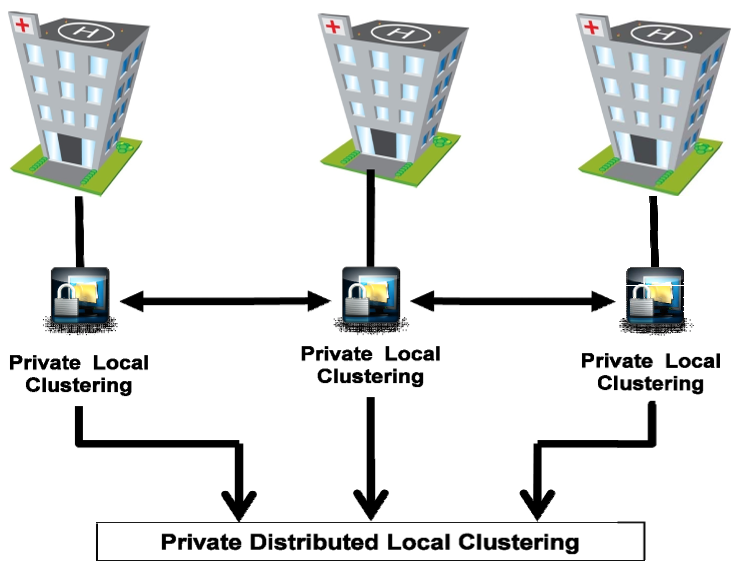 Figure 1: The framework for PDLC in a distributed healthcare scenario.
Experimental Validation
The authors tested the DLC algorithm on a complex synthetic dataset featuring 13 clusters of irregular shapes and significant noise (6%).
- Accuracy: The algorithm successfully identified all 13 clusters.
- Efficiency: The complexity is dominated by for neighbor searches, making it viable for large datasets.
- Robustness: Even if some sites collude (attempt to cheat to see others' data), the multi-layered encryption/noise approach makes it mathematically difficult to recover real values.
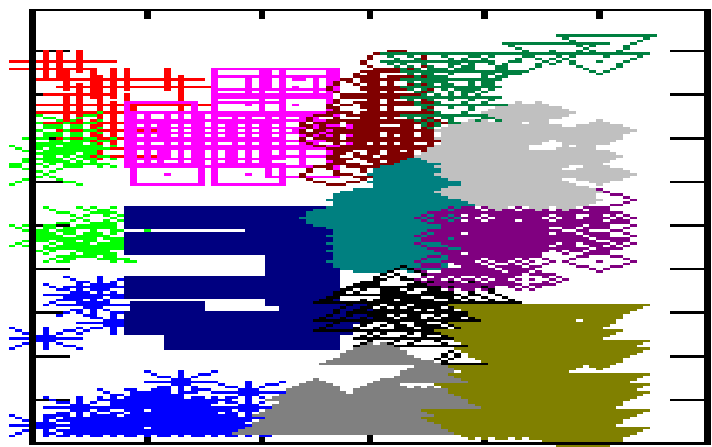 Figure 2: The final clusters identified by the DLC algorithm showing successful noise handling.
Critical Insight & Future Outlook
The core genius of PDLC is its Inductive Bias. By relying on density rather than centroids, it naturally ignores outliers early in the process. This "early denoising" reduces the amount of data that needs to be processed through expensive cryptographic protocols.
Limitations: The current model assumes a "semi-honest" environment. In the future, the authors intend to implement Zero-Knowledge Proofs (ZKP) to defend against "malicious" actors—sites that might provide false data to intentionally skew the results.
Takeaway for the Industry
For developers and data architects in the medical AI space, this paper proves that you don't need a single "data lake" to perform high-quality analytics. Cryptography protocols are reaching a point of maturity where Distributed Privacy can now support the complex, multi-dimensional clustering required for modern precision medicine.