
PPFR: Bridging the Gap Between Social Integration and User Privacy
Privacy-Preserving Friend Recommendation in an Integrated Social Environment
The paper proposes a Privacy-Preserving Friend Recommendation (PPFR) protocol designed for integrated Online Social Networks (OSNs). It leverages a hybrid approach combining Differential Privacy (DP) and Secure Multi-Party Computation (SMC) via Paillier homomorphic encryption to achieve state-of-the-art privacy guarantees for cross-platform collaborations.
Executive Summary
TL;DR: In an era where data partnerships (like Facebook and Spotify) are essential for personalized experiences, privacy is often the casualty. This paper introduces a Privacy-Preserving Friend Recommendation (PPFR) protocol that enables platforms to collaborate without seeing each other's raw data. By fusing Secure Multi-Party Computation (SMC) with Differential Privacy (DP), the authors ensure that neither the social graph of the server nor the identity of the client's users is exposed.
Positioning: This work is a robust methodological integration that addresses the real-world trade-off between "utility" (better friend suggestions) and "privacy" (preventing graph reconstruction).
The Core Problem: The Integration Privacy Paradox
When a specialized OSN (like Spotify) wants to recommend friends, it often lacks the rich structural density of an established giant (like Facebook). To fix this, platforms form Integration Partnerships (IP). However, current non-private methods allow:
- Server Leakage: A client can reconstruct the server's entire social graph by making repeated queries.
- Client Leakage: The server learns which of its users are active on the client's localized platform.
Existing solutions either use pure SMC (which is computationally expensive and doesn't stop inference from output scores) or pure DP (which often requires a trusted third party).
Methodology: The Hybrid Defense
The authors propose a multi-stage protocol that uses Paillier Homomorphic Encryption to perform private set intersections.
1. Architecture Overview
The protocol follows a structured exchange where the server (S) and client (C) interact as semi-honest participants.

2. The Logic of Mutual Friends
The "Mutual Friend" count is essentially a set intersection operation. The technical challenge is to calculate without the server knowing which users and are being queried.
- SMC Phase: The client sends encrypted user IDs. The server computes the similarity score in the encrypted domain using homomorphic addition.
- DP Phase: Before the score is returned to the client, the server adds Laplace Noise () to the final tally. This ensures the output is edge-differentially private, meaning the presence or absence of a single friendship relation cannot be reliably inferred.
The mathematical intuition behind deriving the mutual friend count from the encrypted state is represented as: This quadratic operation is achieved through a clever protocol exchange to maintain homomorphic efficiency.
Experimental Validation
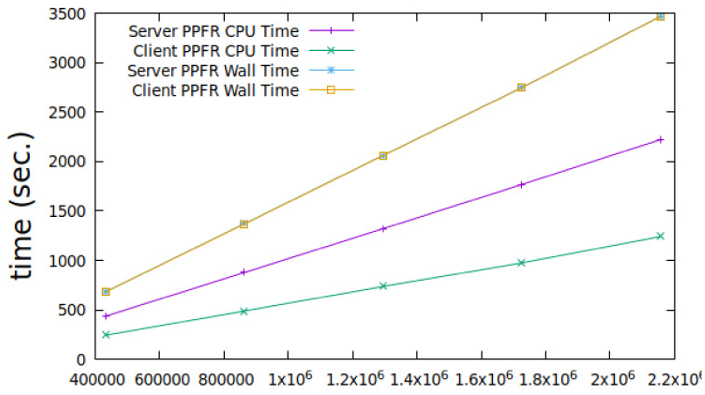
The researchers tested their protocol on the DBLP co-authorship dataset, featuring over 2.1 million authors and 9.5 million edges.
Performance Results
The protocol demonstrates highly predictable linear scaling. As shown in the performance graphs, while privacy adds overhead, it remains feasible for large sub-graphs.
Utility vs. Privacy
A key find was the behavior of Spearman’s ρ and Kendall’s τ. As the privacy budget () increases (less noise), the utility naturally climbs.
- High Utility: At and a list size of 70, the system achieves a rank correlation of ~0.89.
- Precision/Recall: The system maintains high precision for top-K recommendations, ensuring that even with added noise, the most relevant friends still surface at the top.
Critical Analysis & Conclusion
Takeaway
The PPFR protocol proves that you don't have to sacrifice social graph integrity for recommendation accuracy. By moving the computation to the encrypted domain and "blurring" the results with DP, OSNs can safely exchange values.
Limitations & Future Work
- Semi-Honest Assumption: The current security proof assumes participants follow the rules. In the real world, "malicious" actors might try to send crafted inputs to break the DP bounds.
- Computational Cost: While linear, the cost of Paillier encryption/decryption is non-trivial for massive real-time systems.
- Future Outlook: The authors suggest moving toward Malicious Adversary Models and exploring more complex recommendation signals (e.g., Random Walks or Deep Graph Embeddings) within the same privacy-preserving framework.
This research lays the groundwork for a more ethical social media ecosystem where integration doesn't equate to exploitation.