
Exploiting Social Trust: A New Frontier in Privacy-Preserving Data Aggregation
Privacy-preserving function computation by exploitation of friendships in social networks
This paper introduces a privacy-preserving framework for computing functions over social network data by leveraging "circles of trust." It utilizes a "star cover" algorithm to partition users into clusters based on friendship, achieving Differential Privacy (DP) while significantly improving the privacy-accuracy tradeoff compared to local perturbation methods.
TL;DR
Current privacy-preserving methods often force a choice between high accuracy (requiring total trust in a server) and high privacy (resulting in noisy, low-utility data). This paper proposes a third way: Circles of Trust. By partitioning social networks into "stars" where nodes trust their center, the authors reduce the amount of noise needed for Differential Privacy, achieving accuracy gains of up to 626x on real-world datasets.
The Motivation: Moving Beyond Binary Trust
In the realm of privacy-preserving function computation (like calculating the average rating of a movie or counting votes), we typically see two extremes:
- Regime I (Local Privacy): You trust no one. You add noise to your own data. When the server sums up everyone's noisy data, the accumulated "error" is massive.
- Regime II (Central Trust): You send raw data to the server. Accuracy is perfect, but if the server is hacked or malicious, your privacy is zero.
The authors ask a brilliant question: Why ignore the fact that we already have friends we trust? In a social network, if I trust a friend to see my data, we can "pre-aggregate" our values. This simple shift creates a buffer that masks individual data points before they ever reach a potentially untrusted server.
Methodology: The Star Cover Approach
The core technical contribution is the Spanning Star Forest.
1. Partitioning the Network
The server uses the social graph's topology to find a Minimum Dominating Set (MDS). These are your "Star Centers." Every other user in the network is assigned to a star center who is their direct friend (one-hop trust).
2. Local Aggregation
Instead of every user talking to the server, they send their private value to their Star Center. The center calculates a local sum:
3. Differentially Private Reporting
The Star Center adds Laplacian noise to this local sum rather than to individual values. Because the noise is added to an aggregate, the relative impact of the noise on the final global sum is much smaller.
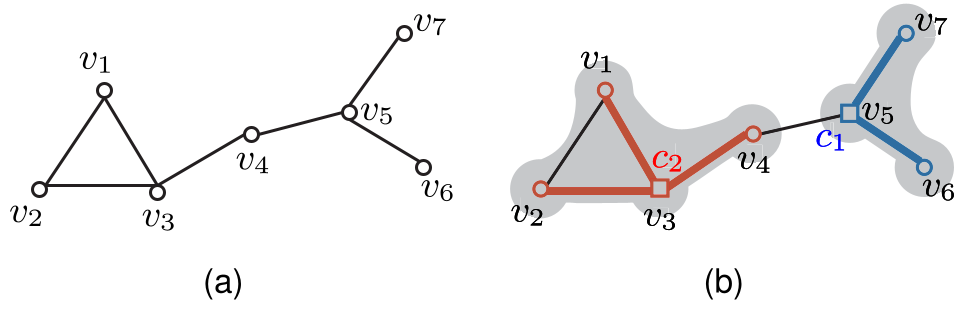 Figure 1: Transitioning from a complex social graph (a) to a star cover (b) where gray areas represent protected circles of trust.
Mathematical Intuition: Why does it work?
The accuracy of Differential Privacy (DP) is measured by Mean Squared Error (MSE).
- In Regime I, the MSE is proportional to (the total number of users).
- In this Star Cover approach, the MSE is proportional to (the number of stars).
Since (the number of centers) is usually much smaller than , the Relative Accuracy Gain (RAG = N/r) can be astronomical in well-connected networks.
Experimental Results
The authors tested their algorithm on Google+ and Pokec datasets:
| Metric | Google+ (Dataset A) | Pokec (Dataset B) |
|---|---|---|
| Nodes (N) | 95,897 | 1,198,274 |
| Star Centers (r) | 153 | 209,360 |
| Accuracy Gain (RAG) | 626.7x | 5.72x |
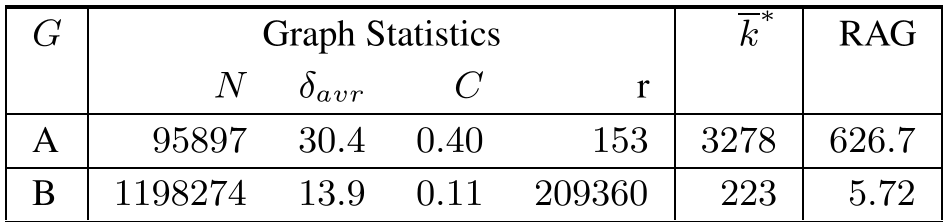 Table 1: The RAG score highlights how connectivity (high in Google+ ego networks) directly translates to privacy efficiency.
Critical Analysis & Conclusion
The genius of this work lies in its Inductive Bias: it assumes that social structures aren't just for communication, but can serve as a geometric foundation for privacy.
Limitations:
- Trust Dynamics: The model assumes "one-hop trust" is absolute. If a "friend" center is malicious, they see the raw data of their leaf nodes.
- Topology Knowledge: The server must know the graph structure to perform the star cover, which is itself a potential privacy leak.
Future Outlook: This work lays the groundwork for "Socially-Aware Differential Privacy." As Federated Learning becomes more common, using friendship-based clusters to reduce noise or communication rounds could be the next major optimization step for privacy-preserving AI.
Takeaway: By simply leveraging the "friends" we already have, we can make data aggregation hundreds of times more accurate without sacrificing formal privacy guarantees.