
POI-Ti-Dico: Balancing Personal Privacy and Social Discovery in Location-Based Recommendations
A Platform for Privacy-Preserving Geo-social Recommendation of Points of Interest
The paper introduces POI-Ti-Dico, a privacy-preserving geo-social recommendation platform that suggests Points of Interest (POIs) using Differential Privacy. It consists of a Java-based server and an Android client, achieving a balance between location-based utility and user data protection.
TL;DR
POI-Ti-Dico is a pioneering platform designed to provide personalized Point of Interest (POI) suggestions without compromising user privacy. By integrating Differential Privacy (DP) into the recommendation engine, the system adds calibrated noise to check-in statistics, preventing adversaries from reverse-engineering a user's location history from the suggestions they receive.
Contextual Positioning
In the landscape of Geo-Social Networks (GSNs), this work serves as a bridge between pure data utility and rigorous privacy engineering. While traditional systems like Foursquare or Facebook Places focus on accuracy at any cost, POI-Ti-Dico is a "privacy-first" implementation that treats privacy as a tunable parameter rather than an afterthought.
The Core Motivation: The "Recommendation Leak"
The authors identify a critical vulnerability: even if you keep your check-ins private (friends-only), the recommendations you receive are often based on your history. An adversary monitoring these suggestions can perform a "reconstruction attack." If the system recommends a specific clinic based on your past visits, your health status is effectively leaked. Existing SOTA systems rarely offer formal guarantees against this type of inference.
Methodology: Sanitation through Noise
The POI-Ti-Dico architecture revolves around a server-side "sanitization" process.
1. The Architecture
The system uses a PostGIS-enabled PostgreSQL database to handle spatial logic. When a user requests "Top-k" POIs within a radius, the server doesn't look at the raw check-in counts. Instead:
- It retrieves the exact count of check-ins for POIs in a specific category and time window.
- It applies a Laplace distribution to add noise to these counts.
- It ranks the POIs based on these noisy values.
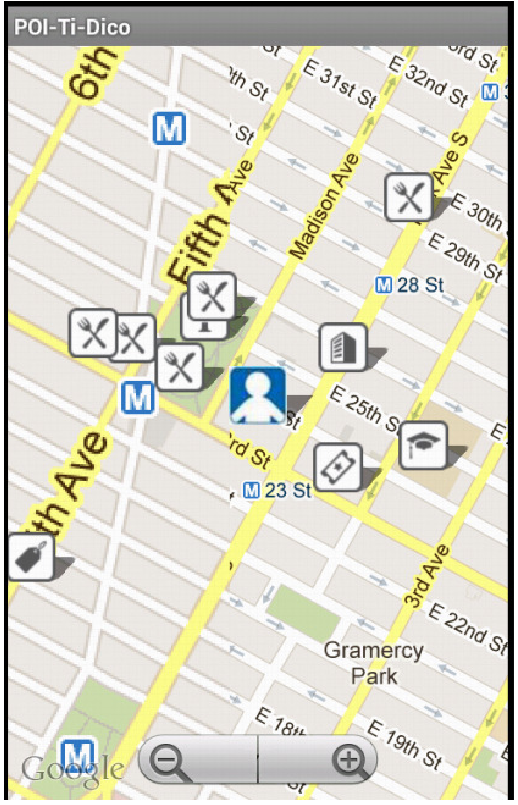 (a) Search parameters; (b) List of recommended POIs; (c) Map view; (d) Visualizing error/noise impact.
2. Formal Privacy Guarantees
By utilizing Differential Privacy, the authors ensure that the probability of any specific output (recommendation set) is nearly the same whether or not a specific individual’s check-in data is included in the database. This provides a "mathematical shield" regardless of how much background information an attacker possesses.
Experimental Results & Performance
The system was validated using a massive dataset of 11.7 million check-ins from Foursquare.
- Data Utility: Even with privacy-preserving noise, the system successfully identifies popular POIs.
- The Privacy-Utility Trade-off: The Android app includes a "privacy slider." At higher privacy levels, some suggested POIs might not be the exact top-k (marked with a red 'X' in the demo), but they remain relevant to the user's geographical context.
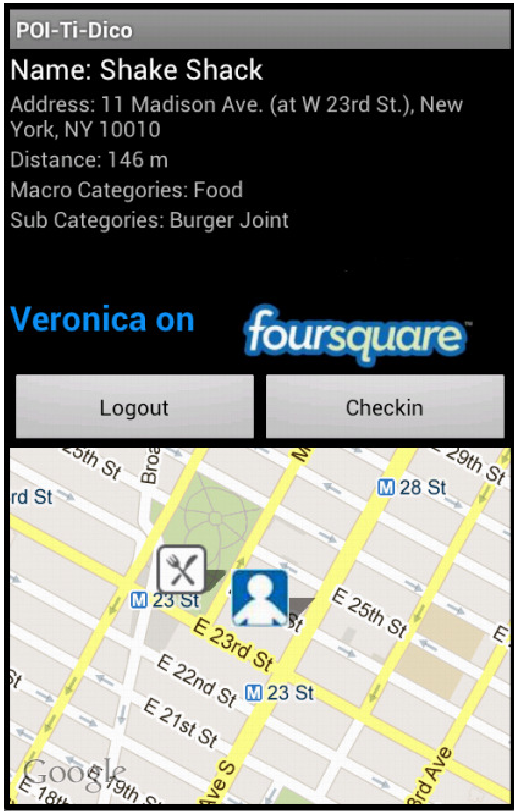 The map interface (d) highlights POIs that were suggested due to added noise (Red X) versus those that would have been suggested in a non-private setting.
Critical Insights & Future Outlook
Takeaway: The success of POI-Ti-Dico proves that Differential Privacy is not just a theoretical concept for census data; it is practical for real-time, mobile-first social applications.
Limitations & Future Work:
- Fine-grained vs. Coarse-grained: Currently, the system protects individual associations (User A visited Place B). However, "group privacy" (e.g., inferring that a specific demographic visits a specific neighborhood) remains an open challenge.
- Dynamics: As users move, the privacy budget might deplete. Future iterations will need to address how to handle continuous location streams without exceeding privacy "expenditure" limits.
In conclusion, POI-Ti-Dico offers a blueprint for the next generation of social apps where users don't have to choose between finding a great local restaurant and keeping their medical or political affiliations private.