
PPLSS: Navigating the Trade-off Between Social Connectivity and Absolute Location Privacy
Privacy-Preserving Location Sharing Services for Social Networks
The paper proposes PPLSS, a Privacy-Preserving Location Sharing Service for social networks using a novel "Order-Retrievable Encryption" (ORE) scheme. It enables users to share exact locations within a specified distance without revealing coordinates to untrusted servers, achieving significantly lower communication overhead than prior cryptography-based spatial query methods.
TL;DR
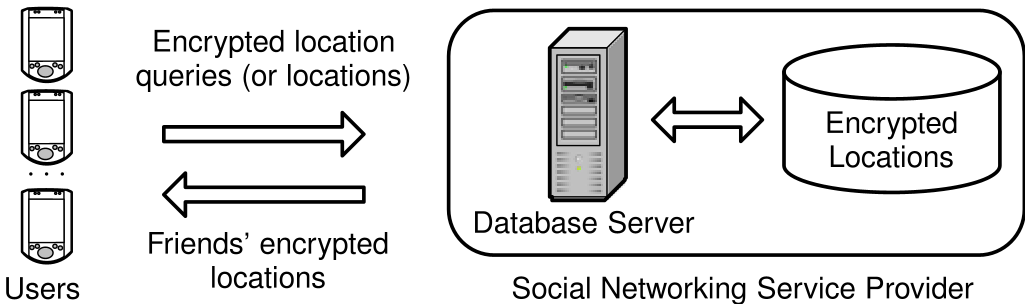
In the era of "Find My Friends," we often trade our precise movement history for the convenience of proximity alerts. This paper introduces PPLSS, a framework powered by a new cryptographic primitive called Order-Retrievable Encryption (ORE). It allows an untrusted server to determine if your friends are nearby and send you their exact locations, all while the server remains completely blind to where any of you actually are.
The Privacy Paradox in Social Mapping
Current Location-Based Social Networks (LBSNs) like Foursquare or Facebook Places operate on a "Trust the Server" model. While effective, this creates a honey pot of spatio-temporal data vulnerable to breaches or insider threats.
Prior research attempted to fix this using:
- Spatial Cloaking: Hiding you in a "cloud," which unfortunately results in fuzzy, approximate locations.
- Secure Multi-party Computation (SMC): Mathematically elegant but prone to massive communication overhead.
- Trusted Third Parties (TTP): Simply moving the "trust" problem from the service provider to another entity.
The authors identify a gap: How can we get exact results with low latency and no third party?
The Core Innovation: Order-Retrievable Encryption (ORE)
The breakthrough is the ORE scheme. Unlike Order-Preserving Encryption (OPE) which maintains a global 1D order (e.g., ), ORE allows a server to compare distances relative to a specific query point.
How it Works (The Intuition)
- Encryption: Your location is transformed into a high-dimensional vector and multiplied by a secret matrix known only to your friend group.
- Querying: When you look for friends, you send an "Encrypted Query Point."
- Comparison: The server runs a
Cmpfunction. For any two encrypted friend locations, the server can tell which one is closer to you, but it cannot calculate the actual distance or see the coordinates.
Scaling Up: ORE-Index & Personalized Privacy
Standard ORE requires the server to scan every friend in your group (O(n)). To make this production-ready, the authors proposed two major enhancements:
1. The Ring-Based Index
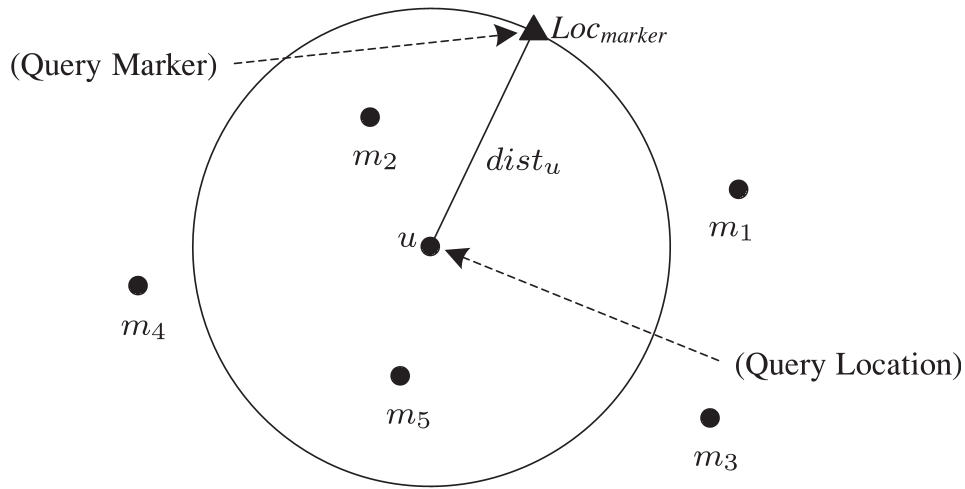
The server organizes friend locations into an ORE-Index—a tree structure where nodes represent concentric rings around a reference point. This allows the server to prune the search space, focusing only on the "rings" that fall within your requested search radius.
2. Personalized Privacy Regions
Not all friends are equal. You might want your family to see you whenever they are within 10km, but colleagues only when they are within 500m. Setting a dist_priv allows the comparison logic to fail automatically if the requester is outside your personal comfort zone.
Performance vs. State-of-the-Art
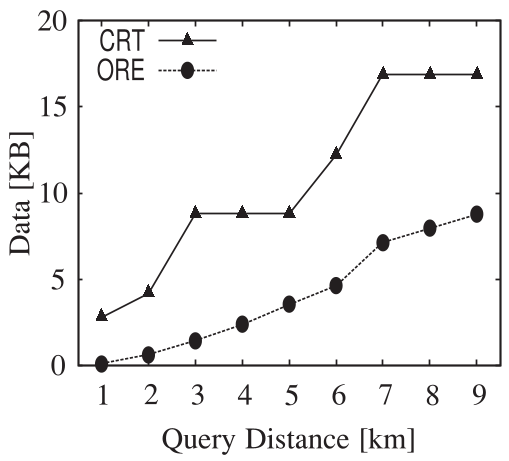
The researchers benchmarked PPLSS against the CRT scheme (a leading cryptography-based spatial query protocol).
- Communication: ORE is significantly leaner. For a group of 50,000 users, ORE uses roughly 60% of the data CRT requires.
- Processing: The ORE-Index makes query times nearly negligible. For a 1km range query, the indexing approach is 10x faster than a sequential scan.
Academic Insight: The Security Catch
The authors highlight a critical vulnerability in basic scalar-product encryption: a Brute Force Row Attack. If an adversary knows a few plaintext/ciphertext pairs and the dimension is low (like 2D), they can reverse-engineer the secret key. The Solution: PPLSS uses Dimension Augmentation (expanding 2D data into higher dimensions) and Secret Splitting to ensure that even a malicious server with significant computing power cannot crack the location matrix.
Conclusion
PPLSS represents a significant step toward "Privacy by Design" in social apps. By moving the logic of proximity detection into the encrypted domain, we no longer need to choose between finding our friends and keeping our movements private.
Future Outlook: The next challenge lies in handling "honest-but-curious" friends who might try to trilaterate your position by moving their own query points—a problem that may eventually require integration with Differential Privacy.