
Enhanced Equicardinal Clustering: A Dual Shield for OSN Node and Edge Privacy
Privacy Preserving Online Social Networks using Enhanced Equicardinal Clustering
The paper introduces an Enhanced Equicardinal Clustering scheme designed to protect both node and edge privacy in Online Social Networks (OSNs). By forcing clusters to have a minimum of k users and maintaining equal cluster sizes, it achieves a high degree of k-anonymity with significantly lower information loss than traditional methods.
Executive Summary
TL;DR: This paper tackles the critical tension between data utility and user privacy in Online Social Networks (OSNs). By re-engineering the K-means algorithm into an Equicardinal Clustering framework, the authors ensure that every user is grouped into clusters of nearly identical size. This "safety in numbers" approach guarantees k-anonymity for both user attributes and network connections, outperforming traditional anonymization by 50x in anonymity degree while maintaining high data utility.
Academic Positioning: This work bridges the gap between Clustering-based Anonymization and Structural Graph Privacy, presenting a mathematically validated method to minimize information loss in large-scale social datasets.
The Problem: Why Naive Anonymization Fails
Most OSNs attempt to protect privacy by simply stripping names and replacing them with random IDs. However, an adversary with "background knowledge" (e.g., knowing a target has a specific number of friends or certain public attributes) can perform a Structural Re-identification Attack.
Previous attempts to solve this via clustering often suffered from anonymity skew: some clusters would end up very large, while others remained small. A user in a cluster of size 3 is far more vulnerable than a user in a cluster of 100. This paper identifies that uniformity in cluster size is not just a preference—it is a privacy requirement.
Methodology: The Architecture of Equicardinality
The core of the proposed method is a modification of the K-means algorithm to ensure that each of the clusters contains approximately users.
1. Attribute-Based Distance Calculation
The system quantifies the similarity between users by mapping their attributes (age, location, interests) into an R-dimensional space and calculating the Euclidean distance:
2. The Equicardinal Reassignment
Traditional K-means assigns a node to the absolute nearest centroid. The Equicardinal variant uses an ordered distance matrix. If the nearest centroid's cluster is already "full" (reached the limit), the algorithm moves to the next best cluster. This ensures no cluster is under-populated, thereby guaranteeing the k-anonymity threshold for every single node.
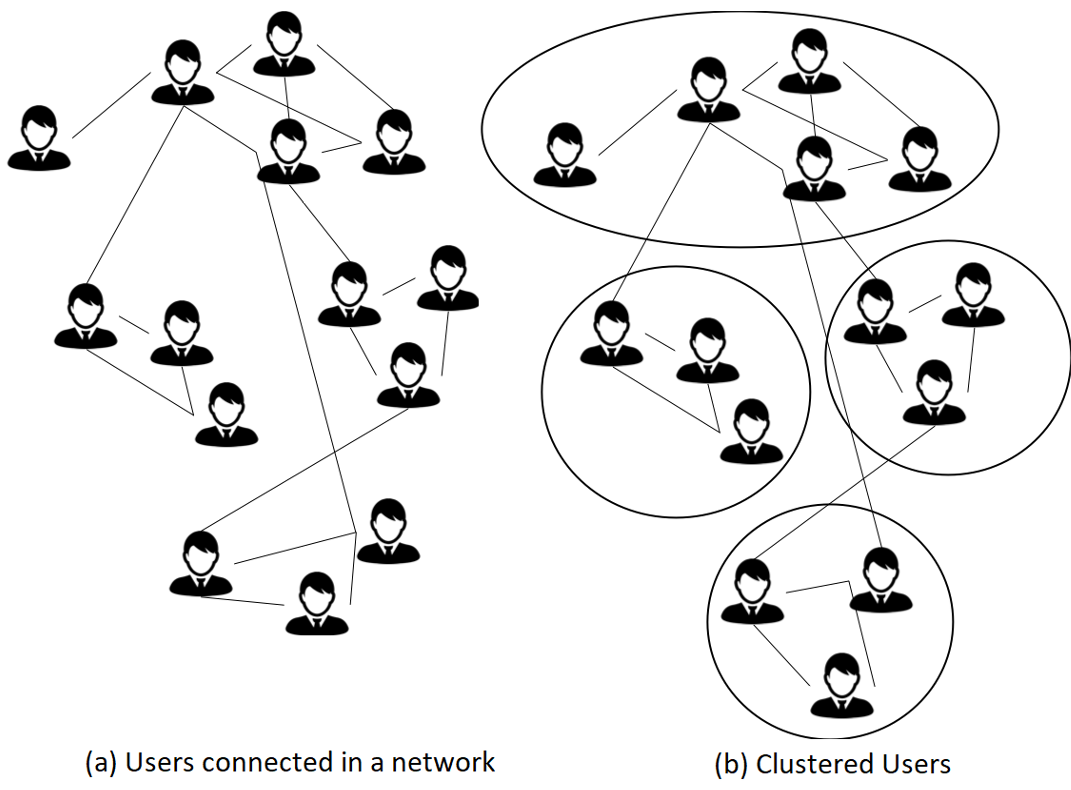
3. Masking the Edges
To prevent "Link Privacy" leakage, the paper introduces Super Edges. Instead of showing individual friendships, the anonymized graph shows weighted connections between clusters. These weights are normalized by the cluster sizes to hide the exact number of internal links.
Experimental Results & SOTA Comparison
The authors validated their approach on massive real-world datasets from Yelp (1.1M users) and Facebook (1M users).
- Anonymity Boost: On the Facebook dataset, the degree of anonymization increased by 50x compared to standard clustering.
- Utility Retention: On the Yelp dataset, the increase in Information Loss (IL) was a negligible 0.07%.
- Scalability: Even with 20,000 users, the running time remains efficient (approx. 20 seconds), making it viable for real-time anonymization pipelines.
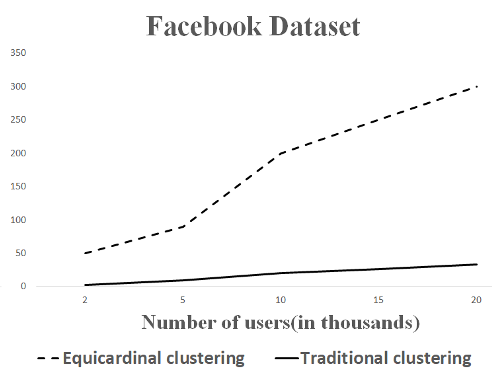 The chart above illustrates how Information Loss decreases as the number of users increases, proving the method becomes more effective in "dense" social environments.
Critical Insight & Conclusion
Takeaway
The genius of the Enhanced Equicardinal Clustering lies in its recognition that "Information Loss" and "Anonymity" are not just points on a line, but variables controlled by the distribution of users. By enforcing equal cardinalities, we eliminate the "weakest link" in the social graph.
Limitations & Future Work
While the method is robust for static graphs, the authors note that dynamic OSNs (where users constantly join or leave) present a challenge for maintaining equicardinality without re-clustering the entire network. Future research will likely explore incremental clustering variants to handle the high velocity of modern social data.
Keywords: OSN Privacy, K-Anonymity, Equicardinal Clustering, Node Anonymization, Social Graph Security.