
Towards Privacy-Preserving Process Mining: Balancing Clinical Insights with Patient Confidentiality
Towards Privacy-Preserving Process Mining in Healthcare
The paper introduces a conceptual framework for Privacy-Preserving Process Mining (PPPM) specifically tailored for the healthcare sector. It evaluates the impact of traditional data transformation techniques—such as encryption, suppression, and noise addition—on healthcare event logs and the resulting utility of process mining algorithms.
TL;DR
Process mining offers transformative potential for healthcare efficiency, yet the sensitivity of patient data remains a major bottleneck. This paper analyzes why standard anonymization fails for complex medical event logs and proposes a new Privacy-Preserving Process Mining (PPPM) framework. The core innovation lies in using Privacy Metadata to allow mining algorithms to "understand" how data has been altered, thereby improving the accuracy of results derived from anonymized logs.
The "Precision vs. Privacy" Paradox in Healthcare
In healthcare, process mining is used to map patient pathways, find bottlenecks in ERs, and ensure compliance with clinical guidelines. However, healthcare data is notoriously "noisy" and "variable." Unlike a standard manufacturing process, every patient’s journey can be unique.
The authors point out a critical vulnerability: Atypical Process Behavior. Even if you remove a patient's name, their unique sequence of treatments (e.g., a rare diagnosis followed by a specific blood test at an exact time) acts as a "fingerprint" that can reveal their identity when compared against external knowledge.
Methodology: The Privacy-Preserving Framework
The paper identifies that simply applying data mining techniques like "noise addition" is destructive because it breaks the chronological order essential for process mining.
The Proposed Three-Step Framework
- Anonymization: Transformation of sensitive attributes (Case ID, Resource, Timestamps).
- Privacy Metadata: Recording how the data was changed (e.g., "timestamps were shifted by 2 days"). This is stored in a standardized extension of the XES (eXtended Event Stream) format.
- Privacy-Aware Mining: Utilizing the metadata to perform "uncertainty-aware" analysis, helping researchers understand the confidence levels of the discovered process models.
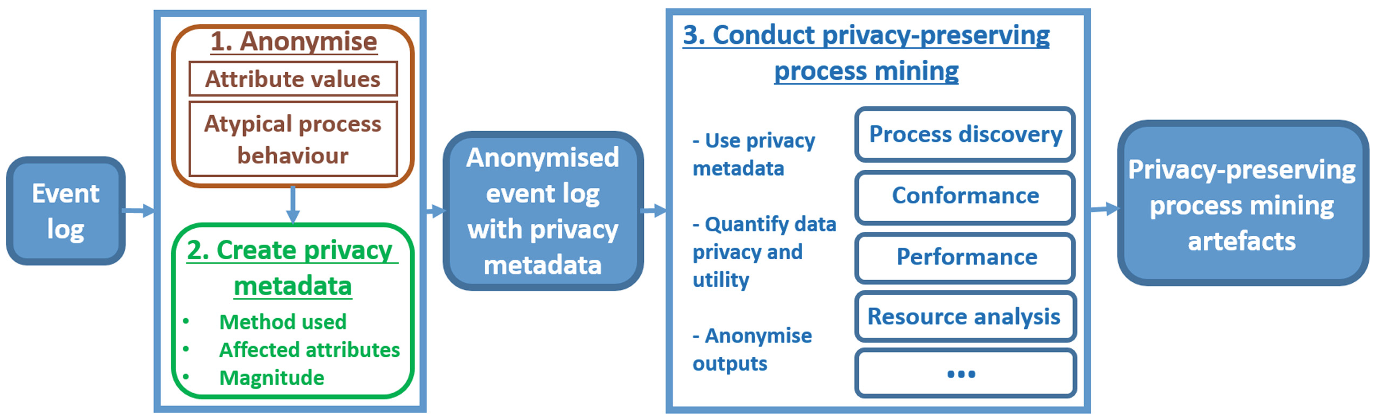 Figure 1: The proposed framework for managing the lifecycle of anonymized process data.
Evaluation of Traditional Techniques
The authors evaluated how standard data transformation affects process mining utility. The results are summarized in an essential "Suitability Matrix":
| Technique | Case ID | Activity | Time | Resource | Data Attributes |
|---|---|---|---|---|---|
| Encryption | Valid (+) | Valid (+) | Partial (+/-) | Valid (+) | Partial (+/-) |
| Swapping | Valid (+) | Invalid (-) | Invalid (-) | Invalid (-) | Invalid (-) |
| Noise Addition | Invalid (-) | Invalid (-) | Invalid (-) | Invalid (-) | Invalid (-) |
| Generalization | N/A | Partial (+/-) | Partial (+/-) | Partial (+/-) | Partial (+/-) |
Key Insights from the Matrix:
- Data Swapping & Noise: While great for static tables, they are "poison" for process mining because they destroy the causal links between events.
- Encryption: Offers the best utility but is vulnerable to frequency analysis (e.g., an attacker can guess that the most frequent "encrypted" activity is "Registration").
Experimental Findings: The Variability Trap
The paper highlights a significant challenge with existing tools like PRETSA (a log sanitization algorithm). In the Dutch Academic Hospital dataset, where 82% of traces are unique, efforts to anonymize infrequent "atypical" behaviors result in massive data loss. If you remove all unique paths to protect privacy, you lose the very insights that usually interest healthcare managers—the "outliers" and "bottlenecks."
 Figure 2: A typical healthcare event log showing the complexity of attributes (Age, Diagnosis, Treatment Codes) that require protection.
Critical Analysis & Conclusion
Takeaway
The paper concludes that there is no "silver bullet." Privacy in healthcare process mining requires a multi-layered approach. The shift from "masking data" to "managing metadata" is a significant step toward making process mining legally compliant with regulations like GDPR or HIPAA.
Limitations
- Output Privacy: The framework focuses on the input (event logs), but the output (the discovered process map itself) can still leak information. For instance, a process map showing a rare treatment path taken by only one person is inherently identifying.
- Computational Overhead: Privacy-aware algorithms are more complex and may slow down analysis on large-scale hospital datasets.
Future Outlook
The next frontier in this field involves Differential Privacy, ensuring that the presence or absence of a single patient in a dataset does not significantly change the resulting process model.