
Defending the Digital Handshake: A Deep Dive into Privacy-Preserving Profile Matching in MSNs
Privacy Preserving Profile Matching in Mobile Social Networks: A Comprehensive Survey
This paper provides a comprehensive survey and analysis of privacy-preserving profile matching methodologies in Mobile Social Networks (MSN). It identifies the core paradigm shift from Online Social Networks (OSN) to MSN, categorizes matching schemes into coarse-grained and fine-grained approaches, and evaluates State-of-the-Art (SOTA) techniques based on their architectural implementation—Centralized, Distributed, or Hybrid.
TL;DR
Mobile Social Networks (MSNs) like Tinder and Foursquare have revolutionized how we interact with proximity-based strangers. However, the mechanism that makes them work—Profile Matching—is an inherent privacy nightmare. This survey examines the evolution of cryptographic and non-cryptographic techniques designed to help two strangers find common ground without revealing their entire digital identities to one another or a central server.
Academic Standpoint: This work acts as a critical taxonomy and comparative analysis, positioning itself as a foundational guide for researchers looking to navigate the trade-offs between matching granularity and computational overhead in mobile environments.
The Core Dilemma: Connectivity vs. Secrecy
In a standard Mobile Social Network, "friend-finding" requires an initiator to broadcast interests to responders in the vicinity. If the intersection of their profiles meets a certain threshold, a connection is made.
The technical "pain point" is two-fold:
- Malicious Probing: An attacker can systematically change their interests to "fish" for the private data of others (Dictionary Profiling).
- Resource Constraints: Unlike cloud servers, mobile devices have limited battery and CPU power, making heavy Homomorphic Encryption (HE) difficult to implement for real-time discovery.
Methodology: Coarse vs. Fine-Grained Matching
The survey bifurcates the field into two distinct mathematical philosophies:
1. Coarse-Grained (Set-Based)
These methods treat profiles as sets of attributes. They use Private Set Intersection (PSI) to count how many tags match.
- Pros: Low complexity, faster discovery.
- Cons: Lacks nuance. For example, if two people like "Movies," the system won't know if one watches them weekly while the other watches them yearly.
2. Fine-Grained (Vector-Based)
These treat profiles as vectors with weights (e.g., Movie Interest = 0.9). Matching is calculated using Private Dot-Product (PDP).
- Pros: Highly accurate "Finest Match."
- Cons: Usually requires expensive encryption (like Paillier) or Secure Multiparty Computation (SMC), which drains mobile batteries.
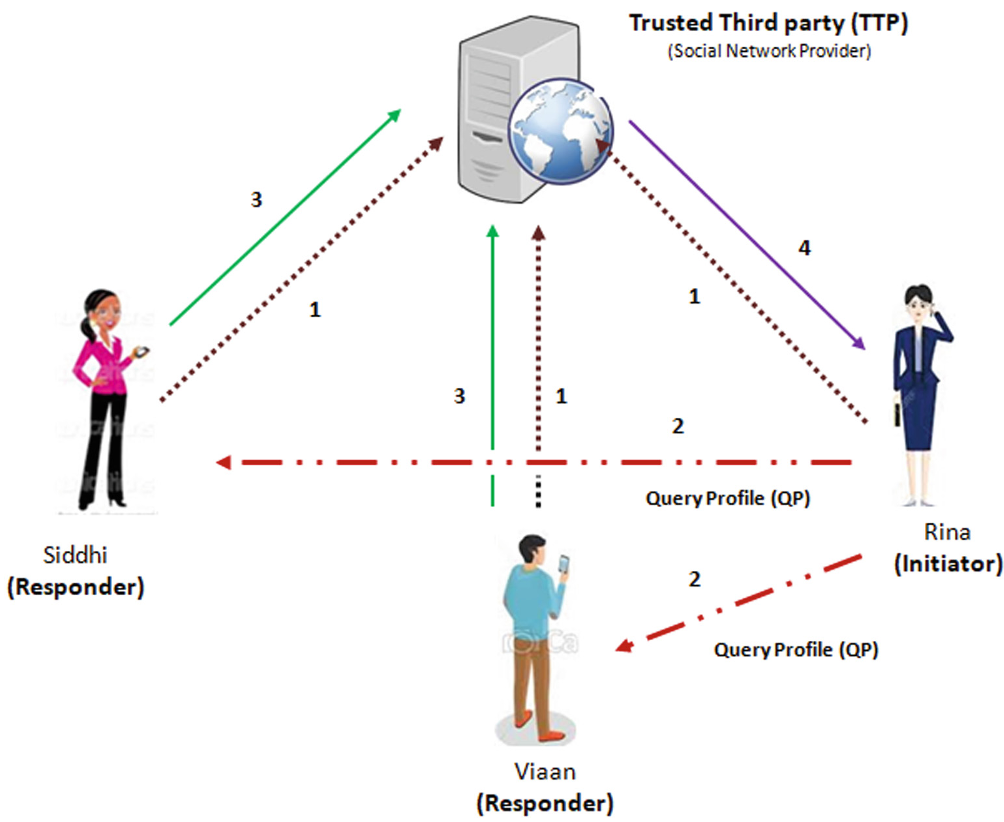 Figure 1: The general workflow of a hybrid profile matching system involving a Trusted Third Party (TTP) for verification.
The Architectural Shift
The survey provides a critical look at how systems are built:
- Centralized: Easy to implement but creates a "Single Point of Failure." If the server is breached, every user's interests are exposed.
- Distributed: Most suitable for MSNs but vulnerable to Cheating Attacks, where a user lies about their match result to gain access to a stranger's profile.
- Hybrid: The current SOTA recommendation. It uses a server for verification but performs the actual matching locally on devices to keep raw data off the cloud.
Experimental Analysis & Results
The authors present a comparative table (Table 1) of over 16 major protocols. A key takeaway is the rise of Confusion Matrix Transformation (CMT) and Perturbation techniques. These methods add "noise" to user data (Differential Privacy) to speed up matching while sacrificing a small percentage of accuracy.
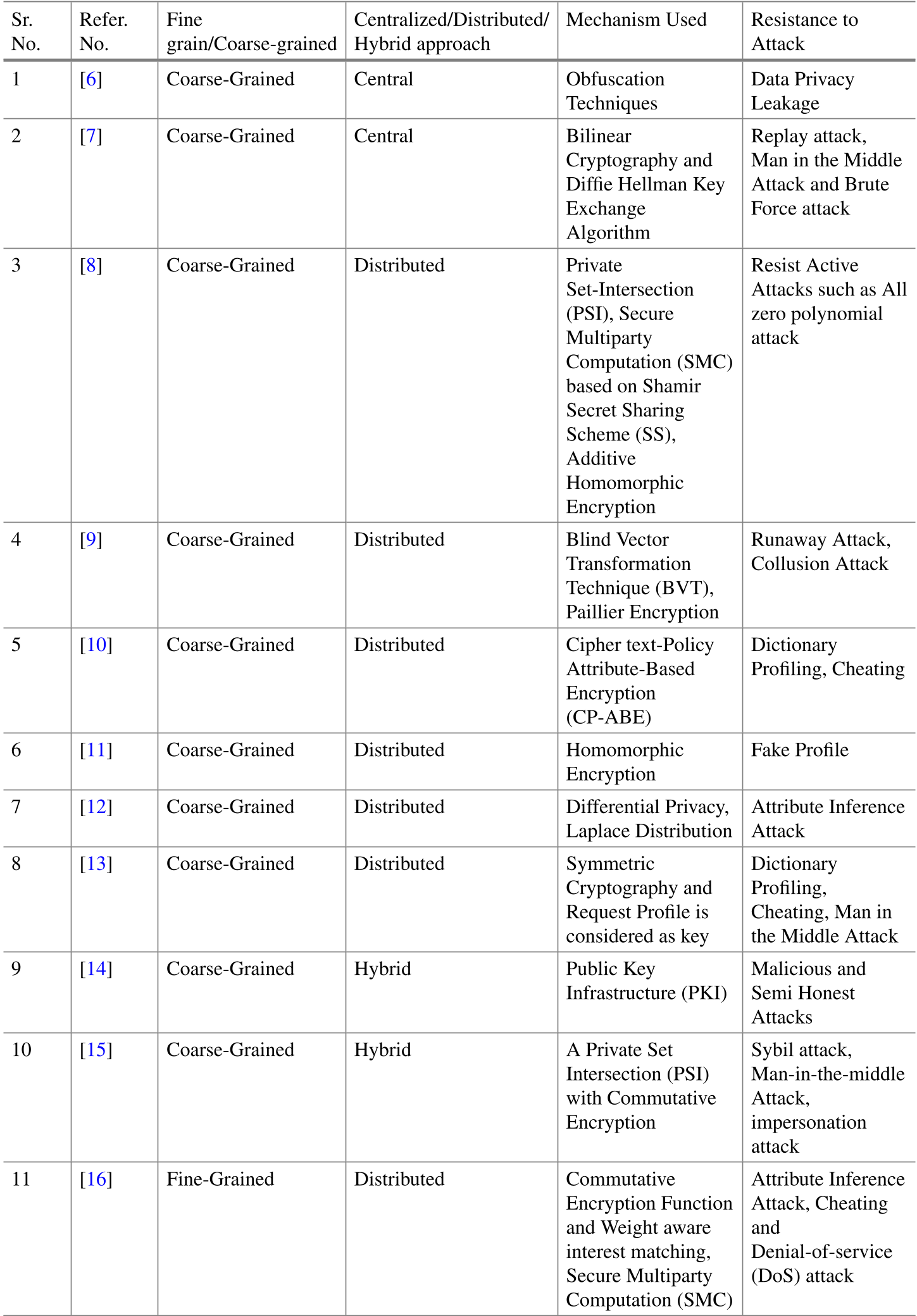 Table 1: Comparison of privacy mechanisms and their resistance to specific attacks like MitM and Sybil.
Critical Insight: The "Verifiability" Gap
The most profound observation in this survey is that while we have many ways to hide data, we have fewer ways to verify the honesty of the match. If a responder claims a "90% match" just to talk to you, how can the system prove they are lying without looking at their private data? This paradox remains the frontier of MSN research.
Conclusion & Future Outlook
The paper concludes that the industry is moving away from purely centralized models toward fully distributed, lightweight cryptographic protocols.
The next generation of MSNs will likely leverage:
- Multi-hop matching: Finding friends of friends in a local mesh.
- Attribute-Based Encryption (ABE): Allowing users to "unlock" certain details only if the other person meets specific criteria.
- Hardware-assisted security: Utilizing Trusted Execution Environments (TEEs) on modern smartphones to handle the heavy lifting of encryption.
For developers and researchers, the lesson is clear: Privacy is no longer an "optional setting"—it is the fundamental infrastructure upon which the future of mobile social proximity is built.