
Security in the Crowd: Mastering Privacy-Preserving Profile Matching in MSNP
Overview on Privacy-Preserving Profile-Matching Mechanisms in Mobile Social Networks in Proximity (MSNP)
This paper provides a comprehensive overview of privacy-preserving profile-matching mechanisms in Mobile Social Networks in Proximity (MSNP). It categorizes current solutions into Private Set Intersection (PSI) and Private Vector Dot Product approaches, highlighting the use of the Paillier cryptosystem to achieve secure fine-grained matching.
TL;DR
Mobile Social Networking in Proximity (MSNP) allows users to discover friends in places like bars or airports via Bluetooth/WiFi. However, the requirement to share personal profiles creates a massive privacy paradox. This paper explores how Private Set Intersection (PSI) and Vector Dot Product (facilitated by Paillier encryption) allow users to find "matches" without actually revealing their sensitive data to strangers or servers.
The Proximity Paradox
Modern smartphones make it easy to find nearby people with common interests. But here is the problem: to know if you have common interests with a stranger, you usually have to tell them your interests first. In an MSNP environment, any malicious user nearby could "sniff" your profile (age, gender, habits) during this discovery phase.
Existing solutions often rely on a trusted third party (TTP), but if the server is hacked, every user's private life is exposed. Peer-to-peer solutions exist, but they are often too slow for mobile hardware or provide such "coarse" results that you can't tell the difference between a casual acquaintance and a perfect match.
Methodology: Two Paths to Privacy
The research categorizes the solution space into two distinct mathematical approaches:
1. Private Set Intersection (PSI) for Mobility
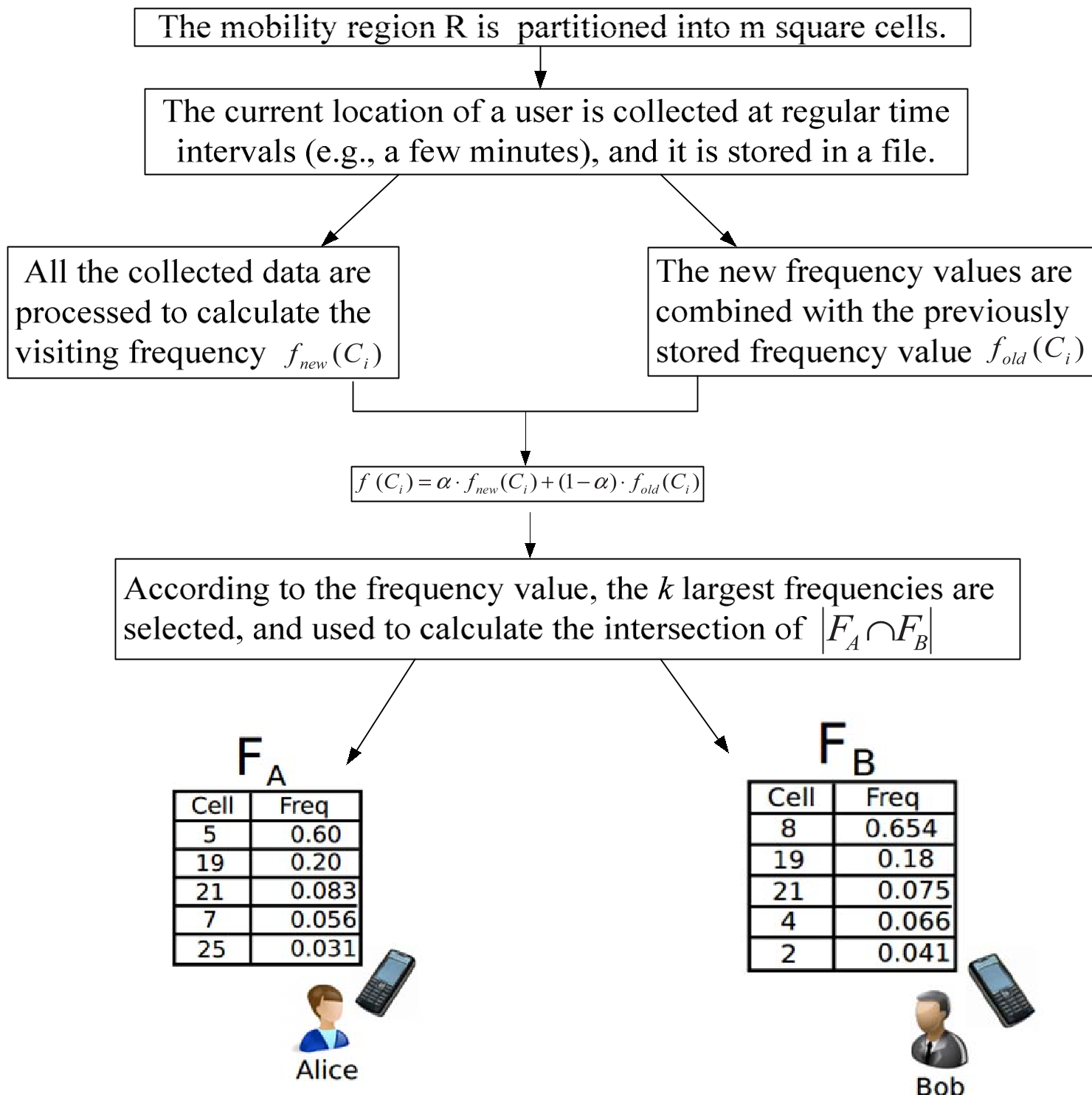
This approach treats your profile as a set of visited locations. By using Exponentially Weighted Moving Averages (EWMA), the system calculates your most frequent "cells" on a map.
- The Logic: If Alice and Bob share more than locations in their top- visited spots, they are "place-friends."
- Privacy Guard: Bob only learns that they are similar, not which specific locations they share or the exact number of overlaps.
2. Fine-Grained Vector Matching (The Paillier Approach)
To solve the "coarse-grained" problem, the paper highlights protocols where profiles are treated as vectors. This allows for calculating Manhattan () or Euclidean () distances.
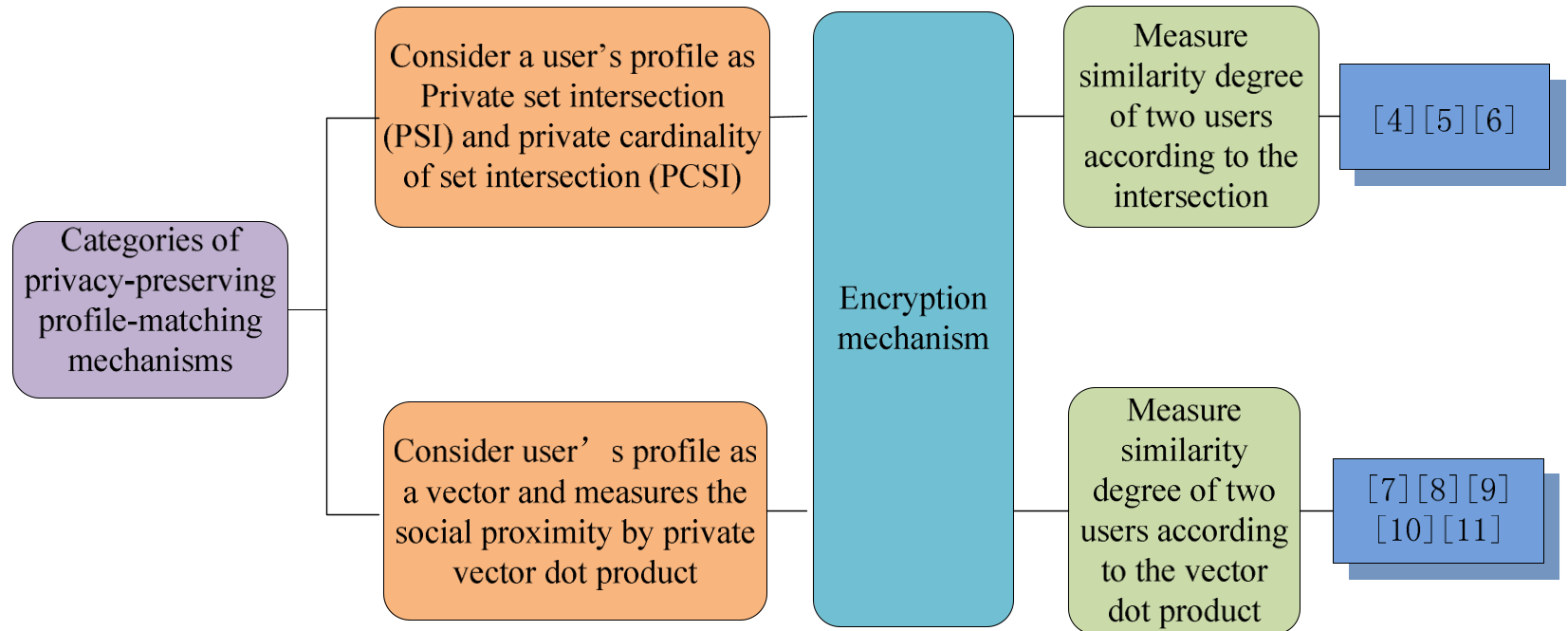
The core of this method is the Paillier Cryptosystem. Because Paillier is homomorphically additive, Bob can perform calculations on Alice’s encrypted data without ever seeing the raw numbers.
Protocol Levels:
- Level-I Privacy: Alice learns the matching score; Bob learns the matching metric Alice used.
- Level-II Privacy: Alice learns the score; Bob learns nothing—not even the metric.

Deep Dive: Why Vector Dot Products?
The paper explains that fine-grained matching is superior because it differentiates intensity. For example, if two people like "movies," coarse PSI says they match. But if Alice watches two movies a day and Bob watches one a month, they aren't a great match. Vector-based matching captures these nuances by comparing numerical values within the profile vector rather than just binary presence/absence.
Critical Insight & Results
The comparison highlights a significant trade-off:
- PSI is faster but "blunt." It counts overlaps but ignores depth.
- Vector matching (Protocol 1 & 2) provides high-resolution matching (Fine-grained) but demands significant CPU cycles for Paillier encryption/decryption.
Future Outlook: The Need for "Lightweight"
The Senior Editor’s takeaway: While the mathematical foundation for private matching is solid (Paillier/PSI), the computational tax is still too high for seamless real-time mobile interaction.
The next generation of MSNP research must focus on:
- Lightweight Cryptography: Reducing the overhead of homomorphic operations.
- Verifiability: Preventing malicious responders from sending fake data to game the matching results.
- Real-world Deployment: Moving beyond theoretical protocols to implementations that don't drain a smartphone's battery in minutes.
Conclusion
This paper serves as a vital map of the MSNP landscape. By moving from simple attribute sets to complex vectors and leveraging additive homomorphic encryption, researchers are closing the gap between social utility and personal privacy.