
Beyond Pseudo-names: The Structural Vulnerabilities of Social Network Data
15482_Privacy Preserving Social Network Data Publication.
This paper provides a comprehensive survey of privacy-preserving social network data publishing, categorizing various de-anonymization attacks and protection mechanisms. It highlights the shift from naive anonymization to advanced techniques like K-Anonymity, Graph Perturbation, and Differential Privacy, establishing a taxonomy for balancing data utility with user privacy.
TL;DR
The explosion of Online Social Networks (OSNs) has created a goldmine for researchers, but "anonymizing" this data is notoriously difficult. This paper reveals that simply removing names (Naive Anonymization) does almost nothing to prevent re-identification. By leveraging the "structural fingerprint" of a user—such as how many friends they have or the specific patterns of their connections—adversaries can de-anonymize individuals with alarming accuracy. The paper surveys the transition from basic K-anonymity to formal Differential Privacy.
The "Structural Fingerprint" Problem
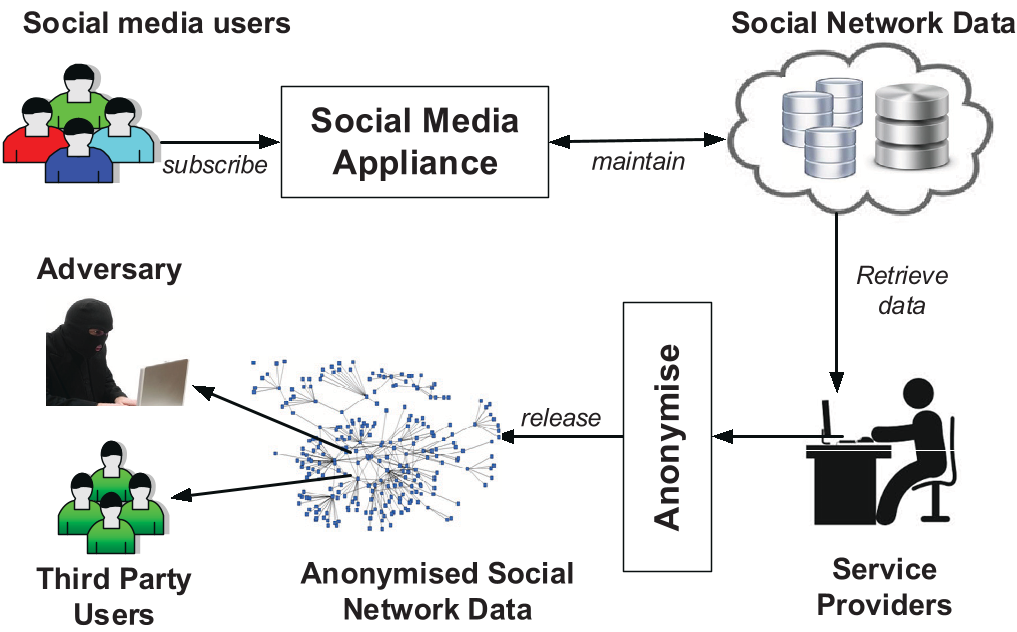
Most users believe that if their name is replaced with a random ID, they are safe. This paper argues that topology is identity.
Adversaries use several types of background knowledge to unmask users:
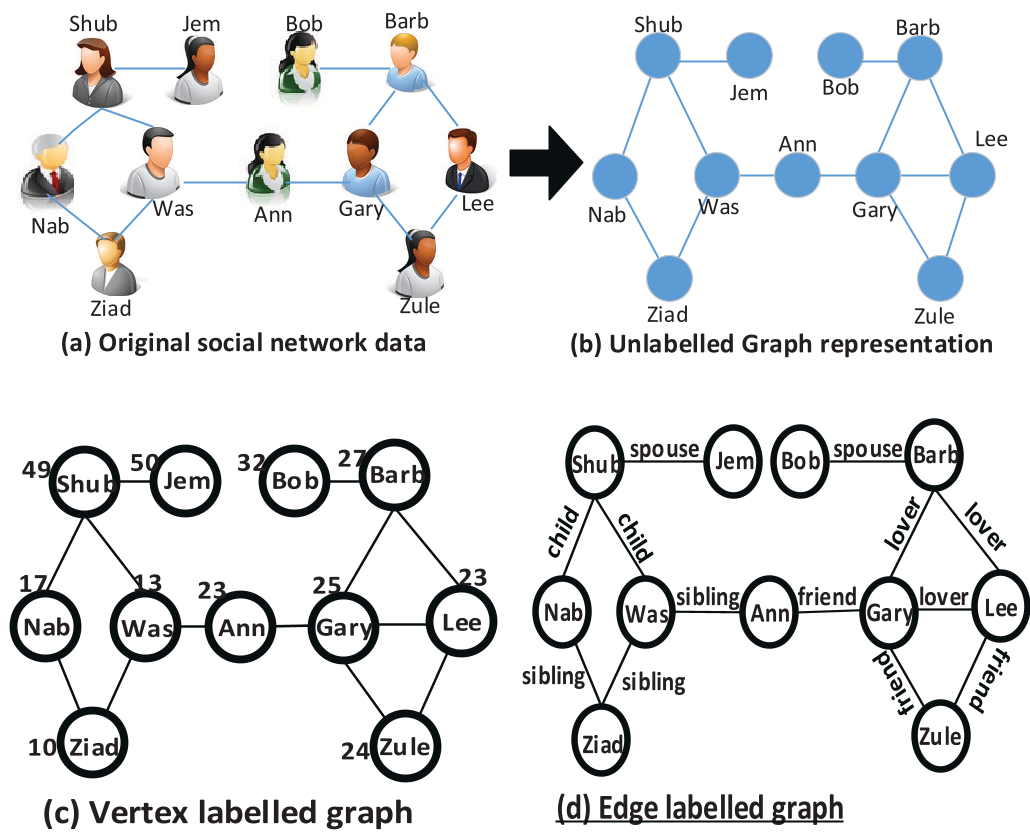
- Degree Knowledge: Knowing Gary has exactly 4 friends.
- Neighborhood Knowledge: Knowing Gary's friends also know each other in a specific "clique."
- Auxiliary Knowledge: Using a public profile from LinkedIn to unmask an anonymous profile on a sensitive health social network.
Methodology: How We Fight Back
The paper classifies defenses into two main schools of thought:
1. The K-Anonymity Family
The goal is to ensure every node is "hidden in a crowd" of similar nodes.
- K-Degree Anonymity: Modifying edges so every node shares its degree with at least others.
- K-Neighborhood Anonymity: Using DFS-based coding to ensure neighborhood subgraphs are isomorphic.
- K-Automorphism: The gold standard of structural anonymity, ensuring the graph has structural symmetries.
2. Differential Privacy (The Modern Frontier)
Unlike earlier methods, Differential Privacy (DP) doesn't care what the attacker knows. It adds noise (often via Laplace distribution) so that the presence or absence of a single user (Node DP) or a single friendship (Edge DP) doesn't significantly change the output of the data analysis.
Experiments & The Utility Trade-off
Every time you add a "fake" edge to protect privacy, you lose "utility" (how useful the data is for real science). The paper evaluates metrics like:
- Average Path Length: Does the "Six Degrees of Separation" still hold?
- Clustering Coefficient: Are the community structures preserved?
- Spectrum/Eigenvalues: Does the overall mathematical robustness of the network remain?
| Method | Privacy Metric | Utility Metric |
|---|---|---|
| Liu (k-degree) | k-anonymity | Graph Statistics |
| Zou (k-auto) | k-anonymity | Structural Cost |
| Boldi (Uncertainty) | Entropy | Sampling Accuracy |
Critical Insight: The "No Free Lunch" of Privacy
The paper concludes with a sober warning: as we move toward "Node Differential Privacy"—the strongest form of protection—the utility of the data often plummets. Furthermore, most current models assume a static graph, but social networks are dynamic. An attacker who observes the network over time can bypass many of these defenses.
Takeaways for Researchers
- Scalability: Most K-isomorphism algorithms are NP-hard. We need better heuristics for graphs with billions of edges.
- Dynamicity: We need protection that evolves as the graph grows.
- The Multi-platform Threat: Anonymizing one network is useless if the user's "structural fingerprint" can be mapped from another public network using "Seed-and-Grow" attacks.