
Safeguarding Social Graphs: A Scalable Approach to k-Degree Anonymization
Preserving privacy in social network graph with K-anonymize degree sequence generation
The paper proposes an iterative algorithm to generate k-anonymous vertex degree sequences for social network graphs to prevent vertex re-identification. By ensuring every node shares its degree with at least k-1 others, it establishes a robust defense against passive attacks with background degree knowledge.
TL;DR
In the era of big data, publishing social network datasets for research often compromises user privacy. This paper introduces a high-efficiency iterative algorithm to achieve k-degree anonymity, ensuring no user can be uniquely identified by their connection count. By transforming the graph's degree sequence with minimal edge additions, the method balances the need for privacy with the necessity of maintaining data utility.
The Privacy Dilemma in Social Networks
When social data is released, simply removing names (de-identification) is insufficient. An adversary with minimal background knowledge—such as knowing a target has exactly 50 friends—can often pinpoint an individual within a "sanitized" graph.
The core challenge is the Vertex Re-identification Attack. If a node possesses a unique degree, it becomes a beacon for de-anonymization. To solve this, the graph must satisfy k-degree anonymity: for every node , there must be at least other nodes sharing the same degree.
Methodology: The Iterative Greedy Strategy
The authors move away from complex dynamic programming and propose a linear-time iterative solution.
1. Optimization Goal
The objective is to minimize the Degree Anonymization Cost (), defined as the distance between the original degree sequence and the anonymized sequence : Since the authors only allow edge additions, the degree of any node can only increase.
2. The Algorithm Logic
The algorithm processes the degree sequence sorted in decreasing order. After forming an initial group of nodes, it faces a decision for the -th node:
- Merge: Incorporate the node into the previous group.
- New: Start a new group with this node.
The decision is driven by comparing the cost of merging () versus the cost of creating a new -sized cluster (). This greedy mechanism ensures the algorithm remains computationally efficient () while keeping the information loss low.
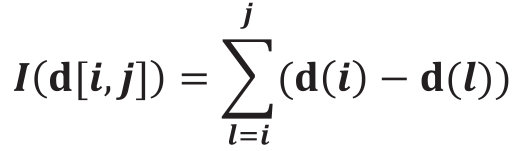 Common degree assignment formula for a subsequence.
Experimental Validation
The method was tested across various scales, from the small Zachary Karate Club (34 nodes) to the larger Euroroad network (1,174 nodes).
Key Findings:
- Identity Protection: For the synthetic graph, identifying nodes with unique degrees (e.g., node 4 with degree 5) became impossible as probability dropped to .
- Cost Scaling: As increases, the Information Loss increases. This is logical; to make more nodes "look the same," more artificial edges must be added, drifting further from the original topography.
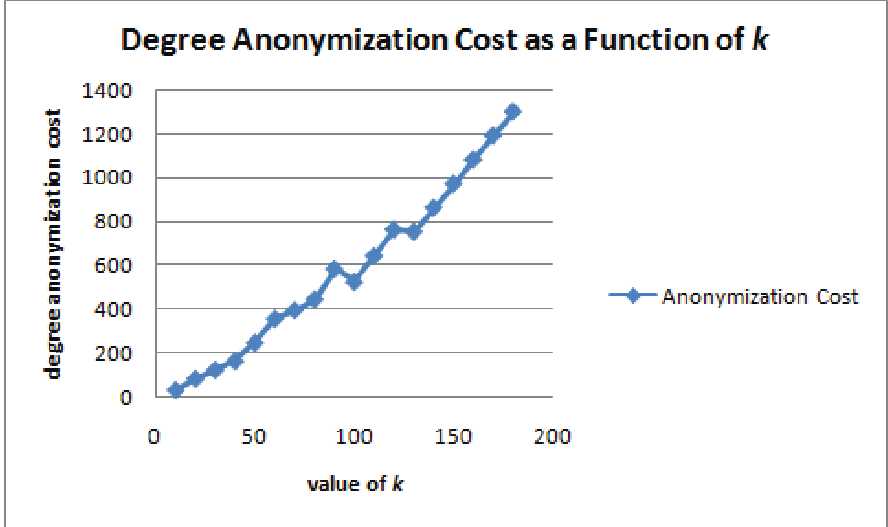 Figure: Degree Anonymization Cost vs. k for the Euroroad Dataset.
Critical Insights & Future Directions
This work proves that anonymization doesn't have to be computationally prohibitive. By focusing on the degree sequence first, we simplify a complex topological problem into a sequence manipulation task.
However, a few challenges remain:
- Realizability: A k-anonymous degree sequence isn't always "realizable" (meaning you can't always build a simple graph from it without self-loops or multi-edges).
- Utility Metrics: While distance is a good mathematical proxy, it doesn't always reflect how "useful" the graph remains for things like community detection or pathfinding.
The Bottom Line: This iterative approach provides a practical tool for data scientists who need to share graph data while respecting individual privacy in an increasingly connected world.