
Secure Social Analytics: Verifiable Graph Intersections in Untrusted Clouds
Privacy-Preserving Verifiable Graph Intersection Scheme With Cryptographic Accumulators in Social Networks
This paper proposes an efficient and privacy-preserving verifiable graph intersection scheme based on cryptographic accumulators and homomorphic encryption. Designed for social network applications (e.g., SIoT), it allows a requester to outsource graph intersection calculations to an untrusted cloud server while ensuring data confidentiality and result integrity.
TL;DR
In the era of Social Internet of Things (SIoT), finding common relationships (graph intersection) is vital but privacy-intensive. This paper introduces a novel cryptographic framework that allows an untrusted Cloud Server (CS) to compute these intersections on encrypted data. By using Bilinear-map Accumulators and ElGamal encryption, it ensures that the cloud learns nothing about the social graphs and the requester can mathematically verify that the result hasn't been tampered with.
Context: The Social Graph Dilemma
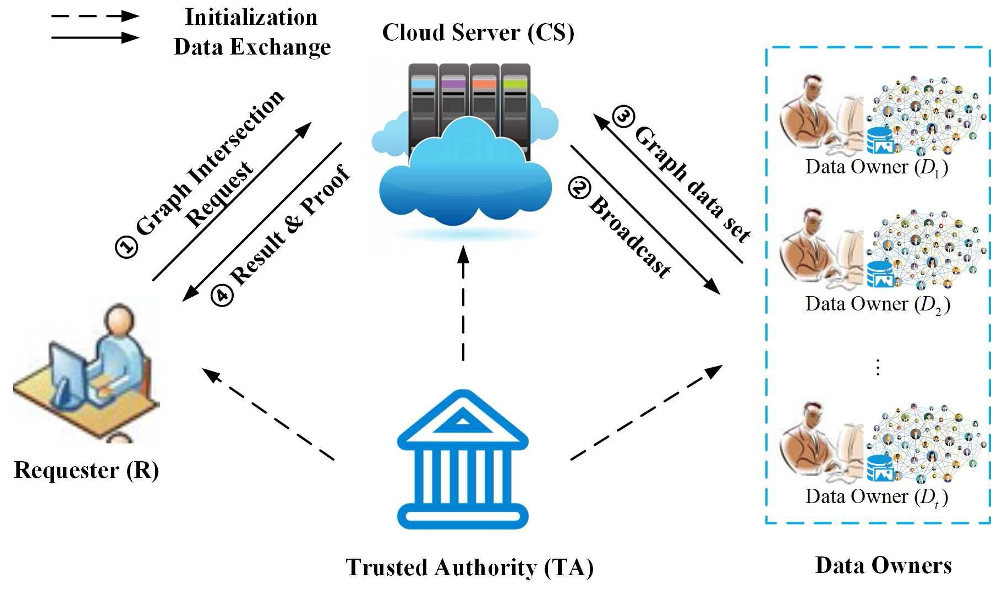
Social networks are essentially massive graphs where vertices are users and edges are relationships. When different organizations (Data Owners) want to find "common friends" across their databases, they face two massive hurdles:
- Storage & Computation: Graph operations are too heavy for local devices.
- Trust: Outsourcing to the cloud is convenient, but can we trust the cloud not to peek at our private data or take "shortcuts" in computation?
Existing solutions like k-automorphism or basic Secure Multi-Party Computation (SMPC) either leak too much information or lack a way for the user to verify the final result's correctness.
Methodology: The Cryptographic "Check and Balance"
The authors solve this by splitting the problem into two parts: Privacy and Verifiability.
1. Privacy via Homomorphic Encryption
The Data Owners (Di) do not send raw graphs. They encrypt their adjacency matrices using ElGamal encryption. Because ElGamal is multiplicatively homomorphic, the Cloud Server can multiply the encrypted values representing edges. If both users have an edge (1 × 1), the result is 1; otherwise, it's 0. The cloud performs this math without ever seeing the underlying 1s and 0s.
2. Verifiability via Accumulators
To ensure the cloud didn't "miss" any vertices or edges, the scheme uses Bilinear-map Accumulators. Think of this as a digital "summary" of a set.
- Subset Condition: Using witnesses, the cloud proves the intersection is actually a subset of the original graphs.
- Completeness Condition: Using the extended Euclidean algorithm over polynomials, the cloud proves that no common elements were left out.
Experiments: Performance Trade-offs
The study evaluated the scheme using graphs ranging from 200 to 1200 vertices.
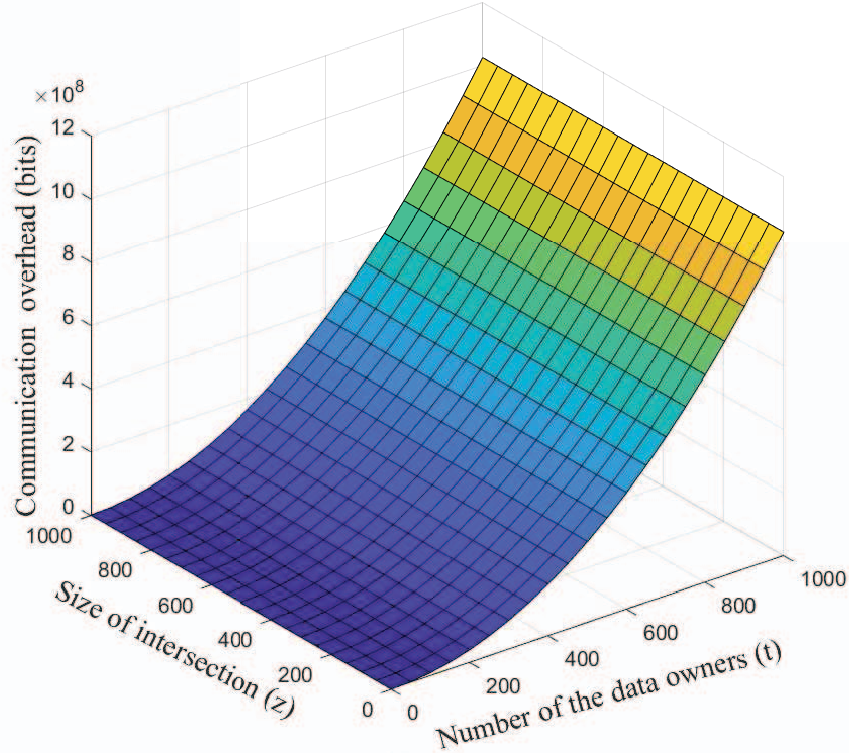
- Computational Cost: The heaviest lift is for the Data Owners during the initial encryption phase (as shown in the matrix encryption charts below). This is the "cost of privacy."
- Verification Efficiency: Crucially, the Requester's job is light. Verifying 500 data owners takes significantly less time than performing the intersection locally.
Critical Insight: Why This Matters
The breakthrough here is not just the intersection itself, but the proof of completeness. In traditional cloud computing, a "lazy" server might return a partial result to save power. This scheme makes "lazy" behavior mathematically impossible to hide. By combining keyed hashes and dummy sets, the authors also mitigate "traffic analysis" attacks where the cloud tries to guess graph size by looking at message lengths.
Conclusion & Future Work
The proposed scheme successfully bridges the gap between graph theory and verifiable outsourcing. While the encryption time (ElGamal) currently presents a bottleneck for real-time mobile applications with thousands of vertices, the mathematical framework for verifiability is solid. Future research might look into Lattice-based encryption to reduce this overhead and provide resistance against future quantum attacks.
Key Takeaways:
- Social friendships can be queried without exposing the full network.
- Cloud servers can be held accountable via cryptographic witnesses.
- Accumulators are the secret sauce for verifying set-based graph operations.