
H-PVA: Bridging the Trust Gap in Online Crowdsourcing Markets
Privacy-preserving verifiable incentive mechanism for online crowdsourcing markets
The paper proposes H-PVA, a privacy-preserving and verifiable incentive mechanism designed for heterogeneous users in online crowdsourcing markets. It leverages Oblivious Transfer and Timed-Lapse Cryptography to protect user bids and selection preferences while ensuring the crowdsourcer's payments are verifiable under budget constraints.
TL;DR
Online crowdsourcing relies heavily on incentive mechanisms to attract participants. However, current systems face a "trilemma" of balancing Budget Constraints, Privacy Preservation, and Payment Verifiability. This paper introduces H-PVA, a mechanism that uses advanced cryptographic tools like Oblivious Transfer and Timed-Lapse Cryptography to ensure that users' bids remain secret, organizers cannot cheat on payments, and the system remains efficient for mobile devices.
Problem & Motivation: The "Honest Organizer" Fallacy
Most crowdsourcing research focuses on the Selfishness of users—ensuring they bid truthfully. Yet, they often overlook the potential for a Malicious Crowdsourcer. Since only the organizer sees the full list of bids and declares the outcome, they could easily insert fictitious bids or lie about the threshold to underpay users.
From a privacy standpoint, users are also hesitant to reveal their true costs and task limits (preferences), as this data could be exploited in future auctions. The challenge is: how do you verify a calculation (the payment threshold) if the inputs to that calculation (the bids) must remain secret?
Methodology: The Cryptographic Sandwich
The H-PVA (Heterogeneous-user based Privacy-preservation Verifiable Auction) mechanism tackles this using a three-layered approach:
1. Heterogeneous User Pricing
Unlike simple models where every task is the same, H-PVA recognizes that different users have different capacities (). It uses a multi-stage approach where a sample set determines a "Threshold Payment" () for sequential arrivals.
2. Privacy via Oblivious Transfer (OT) & Paillier
To prevent the server from seeing raw bid data, the authors use:
- Oblivious Transfer: Allows a user to get an encrypted rank of their bid without the AI knowing which rank they chose.
- Order-Preserving Homomorphic Encryption (Paillier): This is the "secret sauce." It allows the crowdsourcer to compare and sort bids and perform the budget math directly on the encrypted values without ever decrypting them.
3. Verification via Timed-Lapse Cryptography (TLC)
To ensure the crowdsourcer didn't cheat, the AI service releases a decryption key () at the end of each stage. This allows users to retroactively check the "Bulletin Board" to verify that the threshold was calculated correctly according to the algorithm.
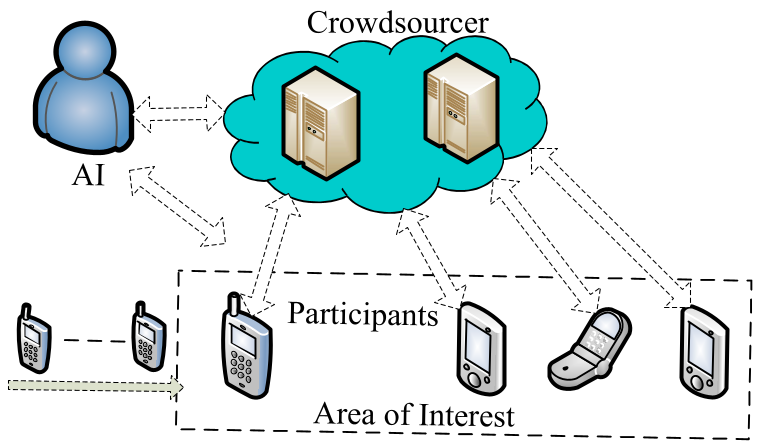 Fig 1: The Heterogeneous-user based online auction scenario showcasing the flow between users, crowdsourcer, and the AI.
Detailed Workflow
The mechanism operates in three distinct phases:
- Initialization: The AI publishes public keys and parameters on a public Bulletin Board.
- Bidding & Commitment: Users submit encrypted bids. The crowdsourcer determines if the bid is below the current secret threshold and allocates tasks if the budget permits.
- Decommitment & Verification: Once a "stage" ends, the TLC service publishes the secret key. Users can now verify the crowdsourcer’s past decisions while the crowdsourcer uses the data to set the next stage's threshold.
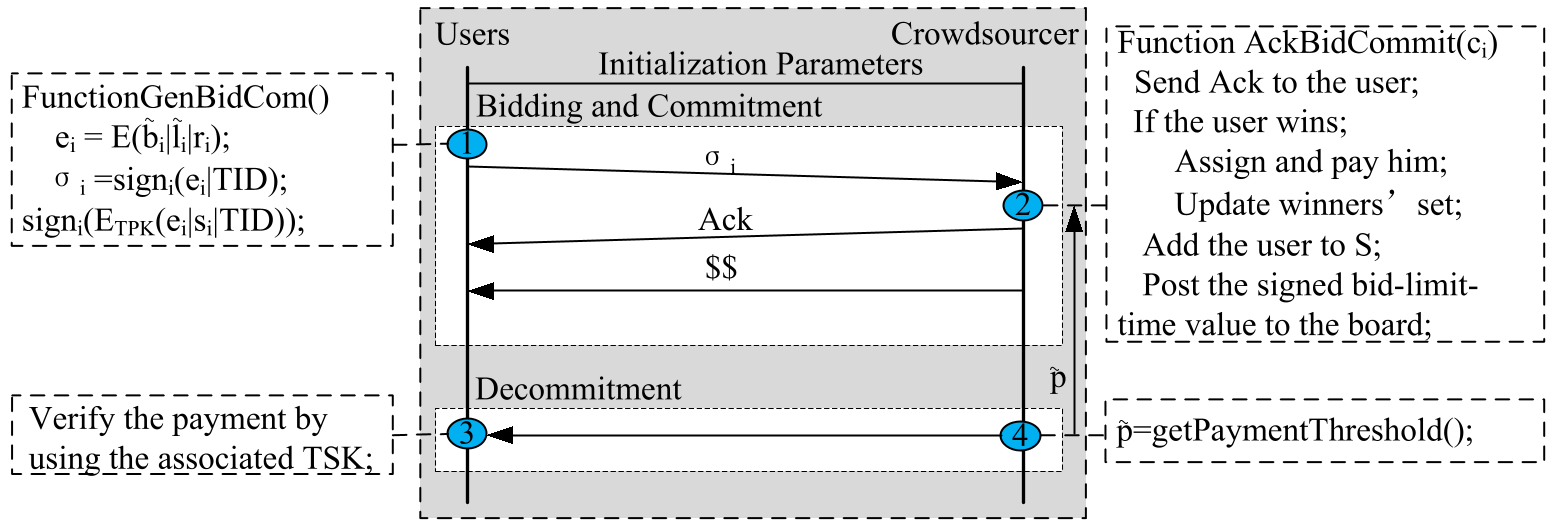 Fig 2: The step-by-step interaction for commitment and verifiable proof.
Experiments & Results
The authors tested H-PVA on an Ubuntu environment using the GMP library to simulate mobile-cloud interactions.
- Efficiency: Even with 500 users, the Auction Interface (AI) processing time is only ~2.3 seconds.
- Scalability: The sorting overhead for the crowdsourcer is incredibly low (microseconds), meaning the system can handle high-frequency task arrivals.
- Mobile Friendly: The heaviest computation resides on the AI and Crowdsourcer (Cloud), while the user's mobile device only handles light signature generation and verification.
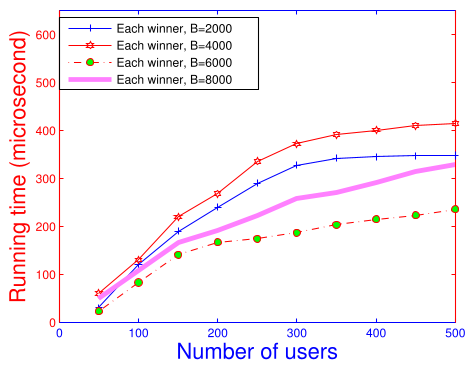 Fig 3: Relative computation overhead as the number of users increases.
Critical Perspective: Takeaways & Limitations
Takeaways: H-PVA successfully proves that privacy doesn't have to come at the cost of verifiability. By using homomorphic properties, we can run complex incentive algorithms on "dark data."
Limitations:
- The AI Trust Model: The system relies on an "Auction Issuer" (AI) that is assumed to be semi-honest. If the AI and Crowdsourcer collude, the privacy guarantees could crumble.
- Network Overhead: Maintaining a "Bulletin Board" with appropriate digital signatures for every interaction requires a robust network infrastructure.
- Fixed Intervals: The use of Timed-Lapse Cryptography implies a delay in verification; users can only prove they were cheated after the stage interval has passed.
Future Outlook
This work provides a blueprint for secure "Internet of Things" (IoT) monitoring. Future iterations could likely replace the centralized AI with a Decentralized Autonomous Organization (DAO) on a blockchain, removing the last point of centralized trust while retaining the elegant homomorphic math proposed here.