
Verifiable Privacy-Preserving Set Operations: Scaling Big Data Crowdsourcing safely
Privacy-Preserving Verifiable Set Operation in Big Data for Cloud-Assisted Mobile Crowdsourcing
The paper introduces a privacy-preserving and verifiable set operation scheme for cloud-assisted mobile crowdsourcing. It utilizes ElGamal encryption, keyed hash functions, and bilinear-map accumulators to enable an untrusted cloud to compute set intersections while allowing the requester to verify result correctness and completeness.
TL;DR
In the era of Big Data, mobile crowdsourcing is a goldmine for data analysis, but it poses a triad of challenges: resource constraints, data privacy, and computation integrity. This paper proposes a novel framework that delegates complex set operations (like intersections) to an untrusted cloud using Bilinear-Map Accumulators and Ring Signatures. Most importantly, it reduces the heavy verification overhead on mobile devices through Batch Verification, making it feasible for real-world smartphone-to-cloud architectures.
Problem & Motivation: The Paradox of Crowdsourcing
Requesters (task owners) want to analyze data from thousands of workers but cannot store or process "Big Data" locally. While the cloud offers unlimited scaling, it is "curious but honest" at best, and malicious at worst.
Current solutions face a deadlock:
- Privacy vs. Utility: Once you encrypt data to hide it from the cloud, performing set operations (like finding common items among users) becomes mathematically difficult.
- Trust vs. Verification: If the cloud performs the computation, how can the requester be sure the cloud didn't skip some workers to save costs or return a forged result?
- Identity Privacy: Workers won't participate if their identities are leaked alongside their sensor data.
Methodology: The Core Mechanism
The authors solve this by decomposing set intersection correctness into two mathematical conditions:
- Subset Condition: Proof that the result is truly a subset of every worker's set.
- Completeness Condition: Proof that no elements were left out (i.e., the remaining sets are co-prime).
1. The Bilinear-Map Accumulator
The framework uses an accumulator to "digest" sets into a short value: . This allows a requester to verify membership without downloading the full dataset.
2. System Architecture
- Workers: Encrypt data using ElGamal and sign it with a Ring Signature to keep their identity hidden within a group.
- Cloud: Computes the intersection on hashed values and generates a proof using polynomial interpolation with Fast Fourier Transform (FFT).
- Requester: Performs a lightweight verification using bilinear pairings.
Impact of Batch Verification
The genius of this work lies in the Batch Verification extension. Without it, the requester must check proofs for every single worker ( workers), leading to a linear increase in battery drain. By aggregating these proofs into a single pairing equation, the overhead remains manageable even as the crowdsourcing task scales to 50,000 participants.
Experimental Insights
Testing on a real-world setup with Amazon EC2 (Cloud) and HTC Nexus 9 (Mobile) revealed:
- Scalability: The cloud can generate proofs for 50,000 workers in under 15 seconds.
- Energy Efficiency: For a requester, batch verification is nearly 10x faster than individual verification at high scale.
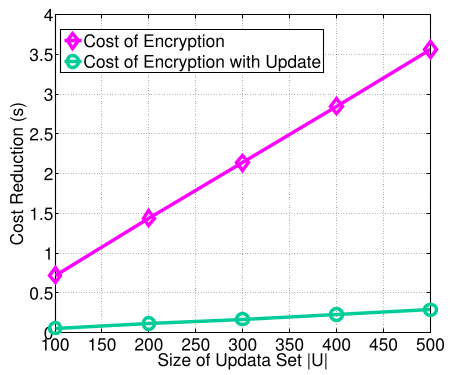
- Flexibility: The system supports Data Updates, allowing workers to change parts of their set without re-encrypting the entire collection, saving precious mobile CPU cycles.
Critical Analysis & Conclusion
While the paper provides a robust solution for set intersections, some challenges remain:
- Ring Signature Overhead: Producing ring signatures on mobile devices still takes significant time (as shown in the experiments, over 3 seconds for a group size of 50).
- Mapping Tables: The requester must pre-define a mapping table, which might be difficult for high-entropy or continuous data types.
Takeaway: This research successfully transitions theoretical verifiable computation into a practical mobile-cloud implementation. The use of Batch Verification is a critical design pattern for any future privacy-preserving big data system.